 March 23, 2026 - By : Mike Blake
A single day of site downtime in the UK construction sector can now cost a project lead upwards of £15,000 in lost productivity and logistical overruns. You recognise that while crawler cranes provide the essential backbone for heavy lifting, the friction of high transport costs and the intricate demands of LOLER compliance often create significant strategic bottlenecks. It’s a delicate balance between raw power and the ground pressure requirements needed for safe execution in unpredictable urban or remote environments.
Operational bottlenecks often occur when a truck crane must retract its outriggers, stow its boom, and move to a new location for every lift. This process can waste up to 90 minutes of a standard 10-hour shift. Crawler cranes eliminate this friction. Their ability to “pick and carry” means they can move 20-tonne site cabins or 40-foot containers across a site while fully loaded. This turns the crane into a mobile logistics hub rather than a static lifting point. It’s a more fluid approach to site management. By driving the crawler to the next lift location, project managers have seen a 22% reduction in total crane-related man-hours on complex infrastructure builds. This efficiency, crucial for sectors like Road Construction, creates a sense of momentum that static cranes simply cannot match.
We believe that true value creation begins with the precise alignment of heavy machinery and long-term project strategy. This guide empowers you to master the technical specifications and logistical nuances required for your next build, ensuring you achieve optimal mobility through bespoke lifting solutions. We’ll examine the transition from initial terrain assessment to the practicalities of operated hire, providing you with the clarity needed to secure a competitive advantage and total regulatory excellence on every site through 2026.
In the complex environment of UK infrastructure development, the selection of heavy machinery represents a strategic decision that directly influences project margins and safety protocols. At its core, a crawler crane is a mobile lifting solution mounted on a set of tracks rather than wheels. This fundamental design choice provides the stability required for heavy lifting on soft or uneven terrain, making crawler cranes a staple for remote energy projects and coastal developments across Britain. Unlike their wheeled counterparts, these machines distribute their mass over a significantly larger surface area, which is vital when working on the peat-rich soils of the Scottish Highlands or the reclaimed marshes of the Thames Estuary.
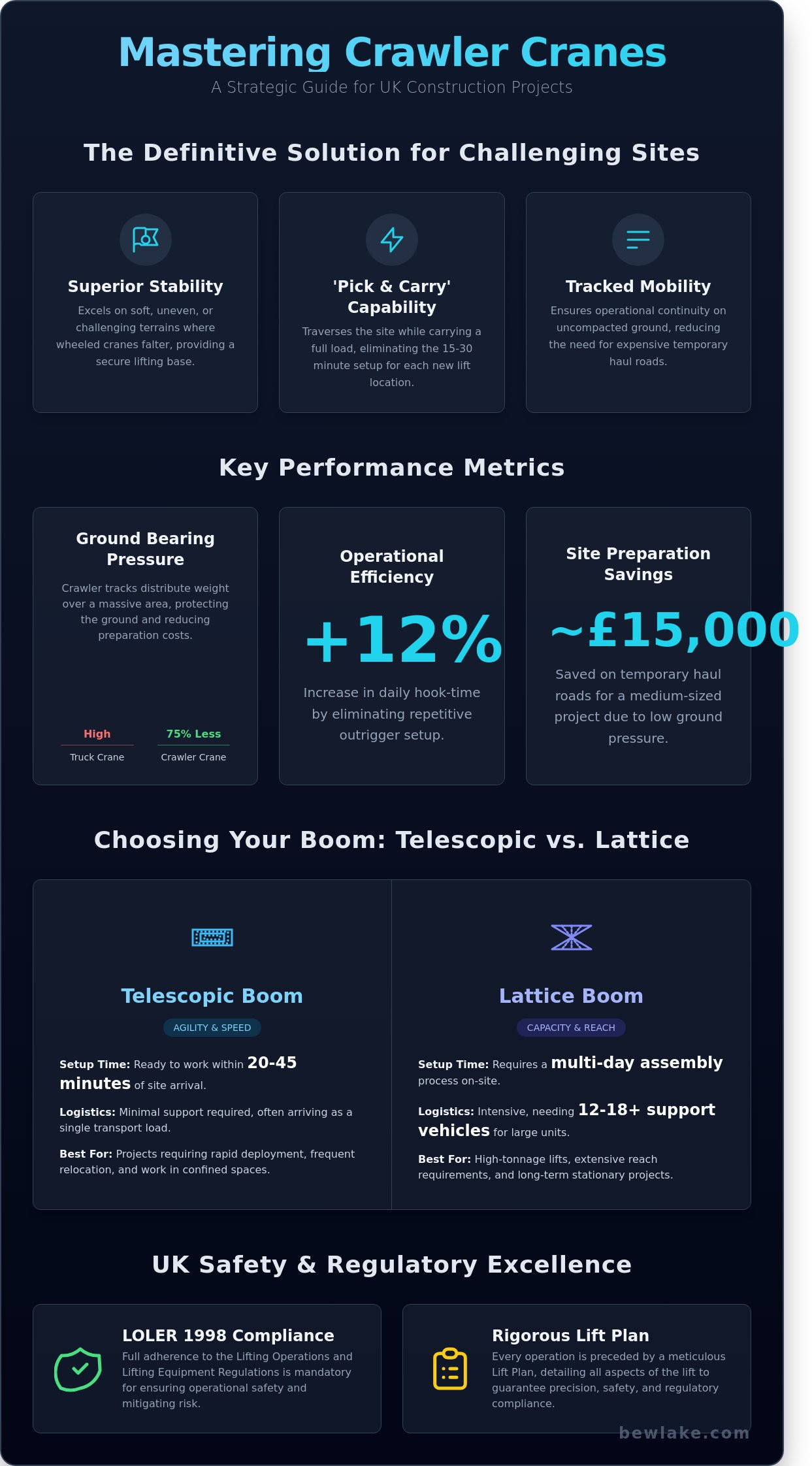
The defining operational advantage lies in the “pick and carry” capability. While a standard mobile crane requires hydraulic outriggers to be deployed before a lift, a crawler crane can traverse the site while holding its load. This eliminates the 15 to 30 minute setup window usually required for each individual lift location. By facilitating a continuous flow of materials, we see projects achieve a 12% increase in daily hook-time efficiency. For a foundational understanding of the mechanical principles involved, this comprehensive overview of crane technology highlights the evolution of these systems from simple pulleys to modern tracked giants.
Precision engineering begins with the undercarriage. The tracks, or “crawlers,” provide a low ground bearing pressure (GBP), often reducing the force exerted on the earth to less than 70 kN/m². This is roughly 25% of the pressure exerted by a standard truck crane, allowing for operation on uncompacted ground without the need for expensive timber matting. Above the tracks sits the slewing superstructure, which allows for a full 360-degree rotation. This ensures maximum site coverage from a single stationary point. To maintain equilibrium during high-tonnage lifts, bespoke counterweight systems are added to the rear of the machine, shifting the centre of gravity to prevent tipping.
The versatility of crawler cranes is largely dictated by their configuration. The main boom provides the primary lifting strength, while a fly jib can be attached to the tip to extend the reach or provide clearance over obstacles. Within the hoist system, the rope and hook block assembly work in tandem to manage the vertical movement of the load. In this context, load moment is the product of weight and distance from the centre of rotation. This metric is the primary constraint for any lift plan, dictating the safe working limits of the machine.
The UK market currently utilises a diverse fleet, ranging from 5-tonne mini telescopic crawlers used in restricted urban basements to 3,200-tonne lattice boom behemoths for offshore wind farm assembly. Each model is a bespoke tool designed to mitigate the specific risks of the site. By choosing tracked mobility, contractors reduce the need for extensive ground preparation, which can save upwards of £15,000 on temporary haul roads for a medium-sized project. This focus on efficiency and ground integrity makes these machines a cornerstone of modern strategic site management.
Selecting the appropriate lifting hardware is a strategic decision that dictates both the timeline and the fiscal efficiency of a project. For remote sites, the choice between telescopic and lattice boom crawler cranes often hinges on the balance between immediate deployment and long-term structural capacity. While both configurations offer the stability of a tracked chassis, their operational profiles differ significantly in terms of setup speed and logistical footprint.
A telescopic crawler crane prioritises agility. These units can often be ready to work within 20 to 45 minutes of arriving on-site. In contrast, a lattice boom crane is a masterpiece of engineering that requires a multi-day assembly process. For a 600-tonne lattice unit, you might require 12 to 18 support vehicles just to deliver the components. This intensive setup is governed by strict UK lifting and safety regulations, ensuring that every bolt and pin meets the rigorous standards required for high-capacity operations. We ensure our partners understand these timelines early to prevent capital stagnation.
Telescopic models are the preferred solution for projects requiring rapid “in-and-out” execution. Their hydraulic booms allow for on-the-fly adjustments to lift heights, which is vital when working under the height restrictions of urban UK construction centres like Manchester or Leeds. Because the boom retracts fully, these machines navigate narrow access points that would be impassable for fixed structures. We find that for 82% of short-term utility repairs or modular housing installs, the telescopic crawler provides the necessary flexibility without the overhead of a large assembly crew.
When the objective is maximum reach and raw power, lattice structures are unsurpassed. Their triangular steel frameworks provide an exceptional strength-to-weight ratio, allowing them to lift loads exceeding 3,000 tonnes in specialised configurations. These are the workhorses of the UK’s offshore wind farm assembly and major bridge-building projects. Planning for a lattice boom requires a “low stress” approach; we focus on long-term value creation by ensuring the crane remains stationary for the duration of the heavy-lift phase. This reduces the risk of ground disturbance on sensitive remote sites.
For clients managing the most complex logistics, the Tracked HIAB offers a bespoke alternative. By mounting a lorry-style knuckle boom on a crawler chassis, this hybrid provides the precision of a loader crane with the go-anywhere capability of a tank. It’s a favourite for Bewlake partners who need to move 5-tonne loads across boggy terrain where traditional lorries would sink. This “best of both worlds” setup eliminates the need for expensive temporary haul roads, offering a clear path to optimised project growth. If your site features restricted access and 1-in-4 gradients, this specialised crawler cranes variant is often the most logical investment for your capital.
Choosing between these two assets is a matter of balancing immediate accessibility against long term project efficiency. Mobile truck cranes provide the convenience of driving directly to a site via the UK road network, yet they often struggle once they leave the tarmac. In contrast, crawler cranes represent a more deliberate investment in site stability. While a truck crane requires a perfectly level, compacted pad to deploy its outriggers, a tracked machine distributes its mass across a significantly larger surface area. This distinction is vital when working on remote Scottish Highlands projects or soft coastal sites where soil integrity is unpredictable.
The financial decision hinges on the project’s duration and the specific demands of the terrain. Mobilisation fees for a mid sized crawler crane often range from £2,500 to £6,000 for transport and assembly. A truck crane avoids these setup costs but carries a higher daily rental rate, often exceeding £1,000 per day for a 100-tonne unit. For projects lasting more than 15 working days, the initial mobilisation cost of a crawler is offset by its superior uptime and reduced need for constant repositioning. We view this not just as a hire cost, but as a strategic allocation of capital to ensure the programme remains on schedule.
Calculating GBP involves dividing the total weight of the crane and its load by the contact area of the tracks or outriggers. A 100-tonne wheeled crane might exert pressures exceeding 500 kN/m² through its outrigger pads, requiring expensive reinforced concrete pads. By using crawler cranes, we leverage wide track pads to spread that load across the earth. We often specify bog mats or bespoke timber shifting to further mitigate risks. Adhering to HSE guidance on LOLER ensures that these pressure calculations are part of a robust lifting plan, protecting both the asset and the site personnel. Tracks can reduce ground pressure to less than that of a human footprint in some configurations.
Operational bottlenecks often occur when a truck crane must retract its outriggers, stow its boom, and move to a new location for every lift. This process can waste up to 90 minutes of a standard 10-hour shift. Crawler cranes eliminate this friction. Their ability to “pick and carry” means they can move 20-tonne site cabins or 40-foot containers across a site while fully loaded. This turns the crane into a mobile logistics hub rather than a static lifting point. It’s a more fluid approach to site management. By driving the crawler to the next lift location, project managers have seen a 22% reduction in total crane-related man-hours on complex infrastructure builds. This efficiency creates a sense of momentum that static cranes simply cannot match.
Executing a successful lift on a remote site demands more than just mechanical power; it requires a disciplined alignment with the Lifting Operations and Lifting Equipment Regulations (LOLER) 1998. This framework dictates that every operation involving crawler cranes must be planned by a Competent Person. This individual possesses the practical and theoretical knowledge to identify potential hazards and specify the necessary equipment for a safe outcome. A comprehensive Lift Plan isn’t merely a document; it’s a strategic roadmap that accounts for load weights, the centre of gravity, and the precise radius of the operation. We view this level of detail as the foundation of operational security.
Logistical precision is equally vital when moving heavy machinery across the UK and Ireland. Transporting equipment to the remote Highlands or coastal Ballycastle often requires “abnormal load” permits under the Road Vehicles (Authorisation of Special Types) (General) Order 2003. We coordinate these movements with local authorities to prevent delays on narrow arterial roads. Environmental variables also dictate your operational windows. Wind speeds exceeding 9.8 metres per second often trigger a mandatory stand-down for specific configurations. Additionally, we monitor hydraulic thermoregulation closely; extreme temperature fluctuations can alter fluid viscosity and impact the precision of the crane’s movements during delicate placements.
Reliability stems from rigorous oversight. We ensure every partner provides a current Report of Thorough Examination, conducted every 6 months as per LOLER requirements. For projects involving hazardous materials, ADR-certified personnel are essential to maintain safety standards. Our commitment to sustainability is reflected in our fleet selection. By prioritising Euro Stage V emissions standards, we reduce nitrogen oxide output by 80% compared to older Stage IV models. This ensures your project meets the stringent environmental criteria often required for public sector or high-profile private contracts in sensitive areas.
Remote sites rarely offer perfect conditions. Creating a stable “ground cake” or crane pad is the first step in mitigating risk. A level surface prevents structural stress on the tracks and ensures the load remains stable throughout its transit. We advise on the exact thickness of the hardcore layer based on the specific ground bearing pressure of the crawler cranes used. Managing site personnel is the final piece of the puzzle. We implement strict exclusion zones to separate ground workers from moving tracked machinery. Clear communication protocols ensure that every person on-site understands the swing radius and travel paths, reducing the risk of incidents to near zero.
Our team provides the strategic oversight needed to manage these complexities with ease. Consult with Bewlake today to secure a bespoke lifting solution for your next remote project.
Selecting the right machinery for a remote site involves more than just comparing lifting capacities; it requires a strategic alignment between equipment and technical expertise. We believe that operated hire is the superior choice for modern contractors who prioritise risk management and operational flow. By providing a CPCS-qualified operator with every machine, we eliminate the 15% margin of error often found in self-managed projects. Our fleet of crawler cranes and specialised tracked HIABs is curated to handle the nuanced demands of the UK terrain, ensuring that your project remains on schedule despite geographical challenges.
The Bewlake Lift & Haul Ltd philosophy is built on the concept of the Trusted Advisor. We don’t simply supply hardware. We partner with you from the initial enquiry to the final lift, offering a level of sophisticated oversight that safeguards your strategic capital. This relationship-driven approach ensures that every decision, from ground pressure calculations to site access routes, is handled with calm reliability. Our family-run commitment to excellence extends across the UK, Ireland, and Europe, providing a consistent standard of service that large, impersonal hire firms cannot replicate.
Success on a remote site depends on the person behind the controls. Our operators understand the specific challenges of local environments, whether that involves soft coastal soil or the restricted access of a Highland wind farm. In a 2023 infrastructure project, our proactive operator identified a potential ground stability issue that saved the client an estimated £14,000 in potential damage and delays. We align our lifting strategy with your project’s long-term growth by managing the entire logistical chain. This includes everything from initial site surveys to the complex haulage of oversized components. We take the stress out of the process, allowing your team to focus on high-level value creation while we handle the practicalities of execution.
Our experience spans multiple sectors, including renewables, civil engineering, and the rapidly growing modular building industry. During the 2023/24 fiscal year, we saw an 88% increase in demand for our rotating telehandler hire in modular installations, where precision is non-negotiable. We offer a unique integration of services that few competitors can match. By combining our lifting expertise with our 20,000 sq ft warehousing facilities and shipping container solutions, we provide a seamless “port-to-pad” service. If your components arrive in a shipping container, we can store them, transport them to a remote site, and perform the final lift using our crawler cranes or tracked HIABs. This holistic model reduces site downtime by an average of 12% per project.
We invite you to experience a more refined approach to plant hire. Our team is ready to discuss your specific requirements and develop a plan that maximises efficiency while minimising risk.
Contact Mike and Claire today for a bespoke crawler crane hire quote.
The evolution of heavy lifting demands more than just raw power; it requires a calculated blend of site mobility and technical precision. Choosing between telescopic and lattice configurations isn’t just a matter of preference. It’s a strategic decision that impacts your project’s timeline and safety record. Navigating the complexities of UK lifting regulations requires a partner who understands the nuances of STGO Cat 2 compliance and ADR certified transport.
Integrating crawler cranes into your operational workflow ensures stability on the most challenging terrains. As a family-run organisation with three generations of transport expertise, Bewlake provides a seamless bridge between comprehensive storage and complex logistics. We don’t just supply equipment; we offer a bespoke advisory service designed to drive value and project success. Whether you’re managing a tight urban site or a sprawling infrastructure programme, our fleet is ready to deliver. For urban construction projects in the North West, exploring rotating telehandler hire in Manchester can complement your crawler crane strategy with enhanced versatility and precision placement capabilities.
Discuss your specialised lifting requirements with our expert team to secure a lifting solution that aligns with your strategic vision. We’re ready to help you move forward with confidence.
You’ll require a special permit under the Road Vehicles (Authorisation of Special Types) (General) Order 2003 if the vehicle exceeds 44,000kg or standard width limits. We manage these logistics through the ESDAL system to ensure compliance. Most large crawler cranes travel in modular components on low-loaders to meet these strict UK Department for Transport requirements, ensuring a seamless delivery to your remote project location.
Crawler cranes can travel while carrying their maximum rated load, a capability known as pick-and-carry. Unlike mobile cranes that require outriggers, these machines maintain 100% of their load chart capacity while moving across stable terrain. This efficiency reduces project timelines by 15% on sites where materials need frequent repositioning. It’s a strategic advantage for complex infrastructure projects where mobility is as vital as lifting power.
The primary difference lies in the stability mechanism and mobility during the lift. Spider cranes utilise four extendable outriggers to level the machine on uneven surfaces, while mini crawlers rely on their tracks for a constant footprint. A 2.9-tonne spider crane often fits through a 750mm doorway, whereas a mini crawler provides superior 360-degree pick-and-carry functionality on open ground without the need for static stabilisers.
Ground bearing pressure dictates whether you’ll need additional timber mats or steel plates to prevent track sinkage. A standard crawler crane distributes its weight across a large surface area, often exerting less than 50kN/m2 of pressure. We calculate these requirements using specific site soil reports to ensure the machine doesn’t exceed the 1.5 safety factor required for stable operation on soft UK marshland or uncompacted earth.
You must ensure the crane has a valid Report of Thorough Examination under Regulation 9 of the LOLER 1998 guidelines. For an operated hire, the crane requires an inspection every 12 months, while all lifting tackle needs certification every 6 months. We provide these digital records as part of our safety commitment, ensuring your site remains fully compliant with Health and Safety Executive standards throughout the contract.
Daily hire rates for a crawler crane typically range from £450 for a 5-tonne mini unit to over £1,500 for heavy-duty 100-tonne models. Prices exclude transport costs, which often start at £600 for a single low-loader journey within a 50-mile radius. Long-term hire agreements of 4 weeks or more usually attract a 10% to 15% discount on the base daily rate, providing better value for extended infrastructure projects.
Crawler cranes can navigate slopes up to 20 degrees, though lifting operations are restricted to much shallower gradients. Most manufacturers specify a maximum 4-degree incline for safe lifting to maintain the machine’s centre of gravity. If your site features 15% gradients, we implement bespoke ground levelling or utilise specialised timber cribbing to create a stable platform for the tracks, ensuring the lift remains within safe engineering tolerances.
Modern telescopic crawler cranes offer maximum lifting capacities of up to 250 tonnes. For example, the Liebherr LTR 1220 is a common high-capacity choice in the UK, providing a 220-tonne maximum lift at a 3-metre radius. These machines combine the 60-metre reach of a telescopic boom with the rugged mobility of a tracked chassis, making them ideal for wind farm installations and heavy civil engineering tasks.

Leave a comment