 March 18, 2026 - By : Mike Blake
If your 2026 expansion plans still rely on a 52-week lead time, you’re likely overpaying for structural inefficiency. You already know that the volatility of UK material prices and the persistent disruption of on-site labour can stall your strategic growth. Sophisticated Modular Buildings now offer a high-performance alternative, delivering fixed-cost certainty and a 30% reduction in delivery schedules compared to traditional masonry. We believe that your capital should be deployed into assets that provide immediate utility rather than being trapped in lengthy, unpredictable build phases.
This guide explores how modern off-site construction provides a bespoke, elite space solution that prioritises both quality and operational continuity. You’ll learn how our approach to expert logistics and precision positioning ensures a seamless transition to your new facility. We’ll outline the exact steps to securing a high-specification environment that aligns with your long-term vision while circumventing the common pitfalls of restricted site access.
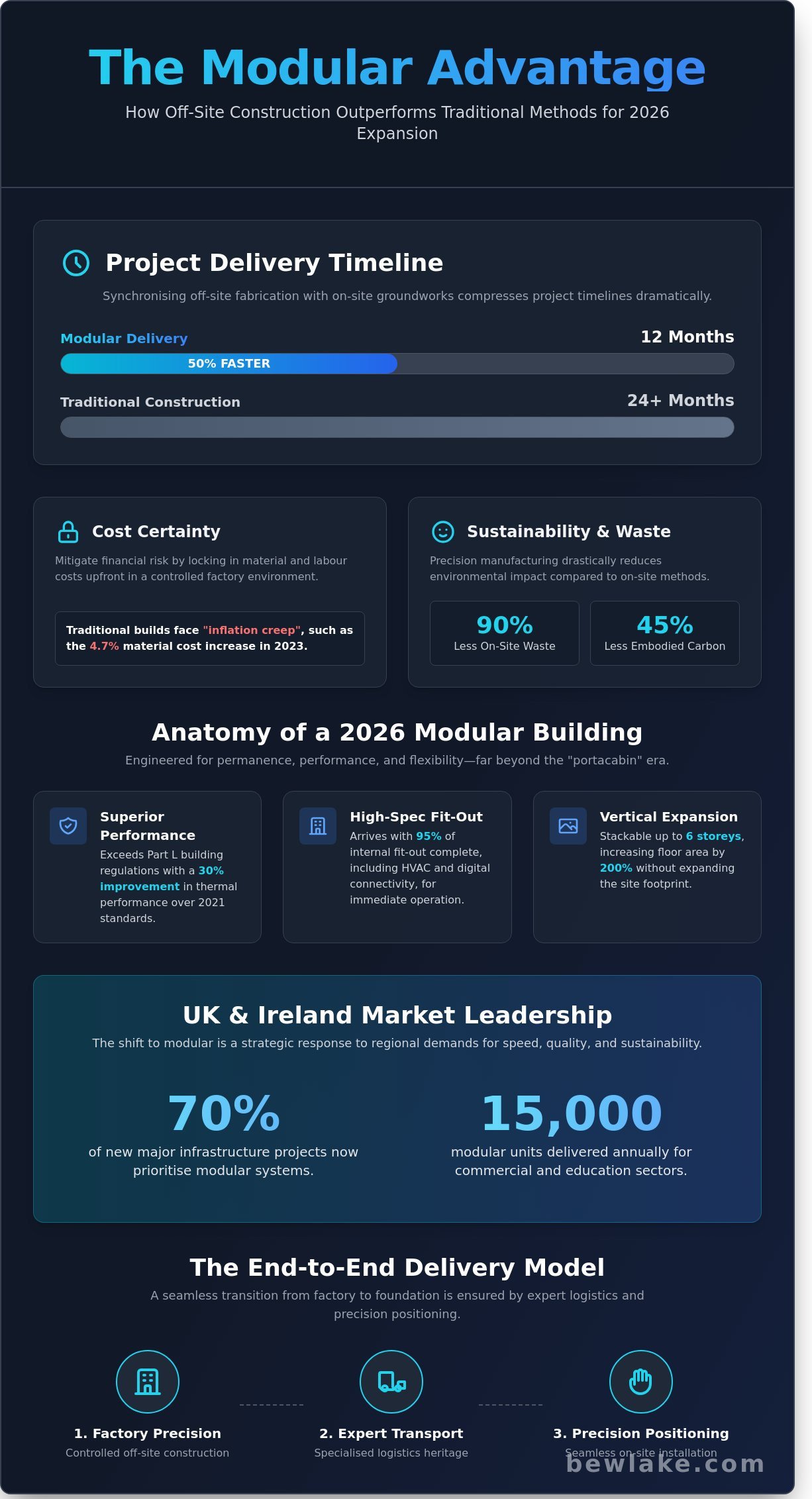
The landscape of site infrastructure has undergone a radical transformation. By 2026, the distinction between temporary facilities and permanent architecture has blurred, driven by a need for rapid deployment and superior build quality. Modern Modular Buildings are sophisticated, volumetric units constructed in controlled factory environments. This off-site approach ensures a level of precision that traditional on-site methods cannot replicate. The UK and Ireland have emerged as the primary engines of this growth, now delivering approximately 15,000 modular units annually for the commercial and education sectors. This regional leadership stems from a strategic need to bypass local labour shortages and meet the UK’s stringent Net Zero targets.
The industry has moved decisively away from the “portacabin” era. Today’s structures are high-specification assets that align with the aesthetic and functional demands of modern corporate environments. We are seeing a shift where 70% of new site setups for major infrastructure projects now prioritise modular systems over traditional builds. This preference is not merely about speed; it is about the predictable delivery of quality and the reduction of on-site waste by up to 90%.
Volumetric construction is the assembly of fully fitted-out 3D modules. By the start of 2026, these structures are engineered to exceed the latest Part L building regulations, often achieving a 30% improvement in thermal performance over 2021 standards. The move towards sustainable, low-carbon materials is now standard practice. We see a significant pivot toward recycled steel frames and low-carbon cladding, reducing embodied carbon by approximately 45% compared to traditional reinforced concrete structures. These units arrive on-site with 95% of the internal fit-out complete, including advanced HVAC systems and integrated digital connectivity, ensuring the building is operational within days of delivery.
Distinguishing between these categories is vital for long-term capital planning and strategic site management. While site cabins provide essential, short-term utility for construction teams, modular complexes are designed for decades of service. To understand the foundational engineering, one might ask What is a Modular Building? in the context of Permanent Modular Construction (PMC). PMC involves structures that remain fixed, often indistinguishable from traditional builds once the final facade is applied. These buildings are assets that offer the same structural integrity as brick-and-mortar equivalents.
Relocatable Modular Buildings offer a middle ground, providing the flexibility to expand or contract as project demands change. Modern engineering allows these units to be stacked up to six storeys high without the need for additional external support structures. This vertical expansion capability is crucial for urban sites where ground space is at a premium. It allows organisations to increase their floor area by 200% without increasing the building’s footprint. This adaptability ensures that capital investment remains protected even as operational requirements shift over a ten-year cycle. The focus is no longer on “temporary” fixes, but on flexible, high-performance environments that support long-term growth.
Traditional construction methods often struggle to meet the pace of modern commercial requirements. By contrast, Modular Buildings represent a shift toward precision engineering and strategic efficiency. The most immediate benefit is the compression of project timelines. By synchronising groundworks with off-site fabrication, we reduce the typical 24-month build programme to just 12 months. This 50% reduction in delivery time allows businesses to begin generating revenue far earlier than traditional methods permit.
Cost-certainty is another pillar of the modular approach. The UK construction sector faced a 4.7% increase in material costs during 2023, creating significant “inflation creep” for long-term projects. Because modular units are manufactured in controlled factory environments, we lock in material prices and labour costs at the point of order. This eliminates the financial volatility associated with prolonged on-site presence. It’s a method that prioritises fiscal discipline and predictable outcomes.
Safety and quality control are heightened through this industrialised process. Decision-makers should consult the UK government research on modular construction to understand how these systems meet stringent safety and regulatory benchmarks. This rigorous oversight ensures that every module leaves the factory meeting exact specifications, reducing the risk of expensive remedial work later.
Rapid deployment directly influences the internal rate of return for retail and commercial investors. When a facility is operational six months ahead of schedule, the additional cash flow often offsets the initial capital expenditure. From a tax perspective, many modular assets qualify as plant and machinery under the Capital Allowances Act 2001. This allows for accelerated tax relief compared to permanent bricks-and-mortar structures. Our team helps clients structure bespoke project finance that aligns with these rapid deployment cycles. Maintenance is also simplified; modern modular envelopes use high-performance materials that require minimal upkeep, protecting the long-term value of the asset.
Sustainability is no longer a peripheral concern; it’s a core requirement for modern capital allocation. Off-site manufacturing reduces material waste by up to 90% compared to traditional sites. Factories allow for exact material cutting and the recycling of offcuts that would otherwise end up in a landfill. These buildings are designed for the circular economy. If a site’s purpose changes, the modules can be disassembled and relocated rather than demolished. Integrating renewable energy is also more efficient. We can install solar PV arrays and air-source heat pumps during the factory phase, ensuring the building achieves high BREEAM ratings from day one. This future-proofs the asset against evolving UK energy regulations and carbon taxes, while resources like ia-uk.com help firms maintain the high social accountability standards expected in modern construction.
Modular buildings no longer represent a compromise in architectural integrity or functional design. The shift towards a bespoke approach allows us to design layouts that mirror specific operational workflows with precision. We integrate technical infrastructure during the factory phase, ensuring that 85% to 90% of the fit-out occurs in a controlled environment. This process includes the installation of high-specification HVAC systems, Category 6a data cabling, and specialised flooring such as heavy-duty anti-static vinyl or premium hardwood. By the time the units arrive on-site, the internal environment is ready for immediate commissioning, which reduces traditional site setup times by up to 50%.
Exterior aesthetics are equally versatile. We provide finishes that allow these structures to blend seamlessly with existing estates or stand out as modern landmarks. Options range from traditional brick-slip systems that satisfy stringent UK planning authorities to contemporary composite cladding. These cladding systems are often specified in precise RAL company colours to maintain brand consistency. For high-stakes environments, we incorporate security features such as 35mm acoustic glazing and reinforced steel entry points without sacrificing the building’s professional appearance. This level of detail ensures that the final asset reflects the firm’s strategic values and operational needs.
In the healthcare sector, compliance with HTM (Health Technical Memoranda) and HBN (Health Building Notes) is a non-negotiable requirement. We deliver clinical spaces, including GP surgeries and diagnostic hubs, that meet these rigorous standards at a pace traditional construction cannot match. For education, the focus shifts to the Department for Education’s Output Specification 2022. This includes strict acoustic performance to BB93 standards, ensuring classrooms are conducive to learning. While these permanent structures provide long-term value, project leads often integrate high-quality welfare units to support the workforce during the rapid installation phase, ensuring site safety remains a priority.
Commercial clients require a sophisticated balance between open-plan collaborative zones and private cellular offices. Within a modular framework, we can incorporate premium reception areas and boardrooms that utilise floor-to-ceiling glazing to maximise natural light. In the UK property market, approximately 18% of major residential developments now utilise high-end Modular Buildings as marketing suites. These units provide a luxury environment for prospective buyers and are fully relocatable once the project concludes, typically after a 24 to 36 month cycle. This flexibility ensures that capital is not tied up in redundant structures, but rather in assets that can be redeployed across the portfolio to drive further value creation.
The transition from a conceptual layout to a functional site office or clinical space is handled with a focus on calm reliability. We don’t just provide space; we provide a strategic environment tailored to the nuance of your industry. Whether it’s a high-security command centre or a prestigious corporate headquarters, the specification reflects a commitment to quality that mirrors the ambitions of the organisations we partner with. This includes ensuring full accessibility through integrated mobility solutions; for example, elevatedstairlifts.com offers professional installation and servicing to maintain mobility standards in multi-level professional environments.
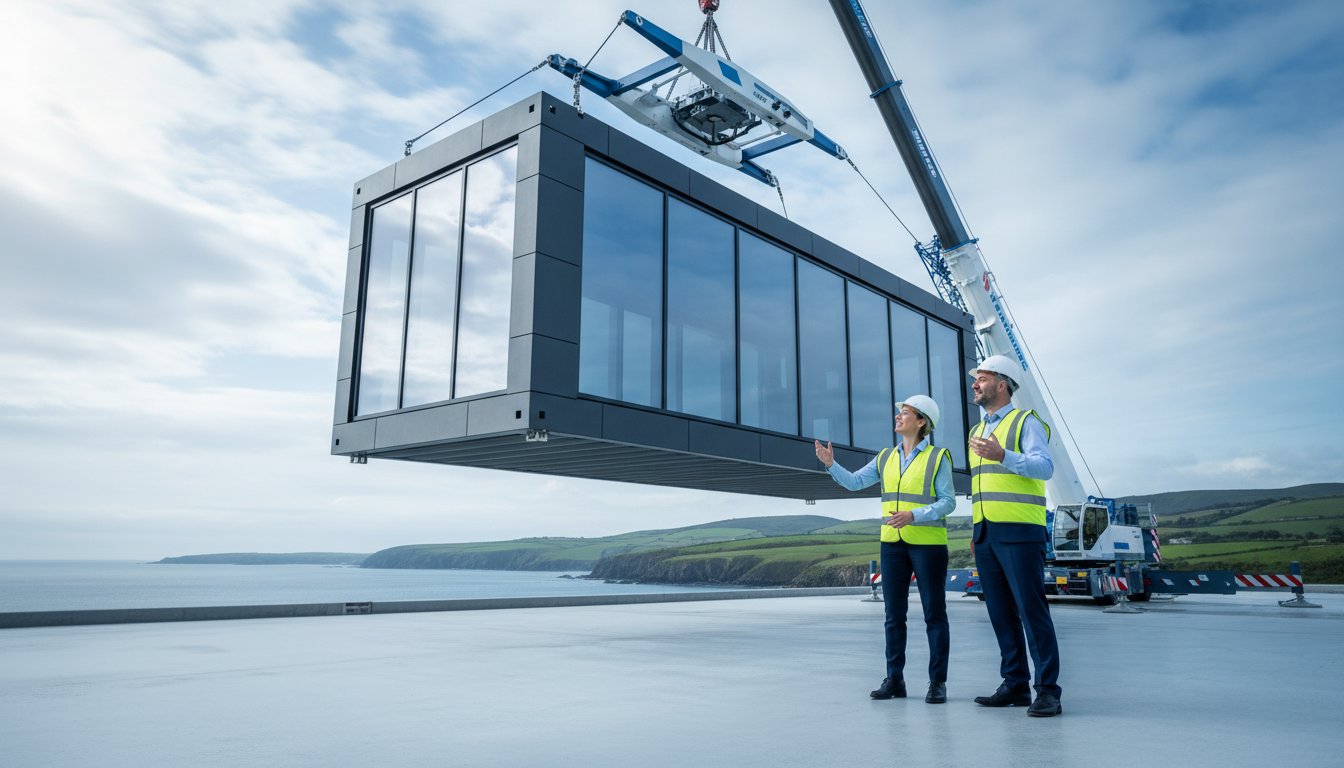
The transition from a controlled factory environment to a live construction site represents the most critical inflection point in the lifecycle of Modular Buildings. We view this phase not merely as a transport exercise, but as a sophisticated orchestration of engineering and timing. The haulier acts as the primary architect of this transition, bridging the gap between manufacturing precision and site reality. Success hinges on the pre-delivery site survey, which we conduct with rigorous attention to detail. This isn’t a cursory glance at the entrance; it’s a technical assessment of ground-bearing capacities, often requiring plates to handle loads exceeding 10 tonnes per axle. We also evaluate overhead obstructions, ensuring compliance with HSE GS6 guidelines regarding power lines and structural clearances.
Reliability in this sector is built on data and foresight. In 2023, logistical delays accounted for 12% of budget overruns in traditional construction, yet modular projects that utilise integrated haulage strategies reduce these risks to less than 2%. By mapping every metre of the journey, we ensure that the delivery doesn’t just arrive, but arrives in the exact orientation required for an immediate lift. This eliminates double-handling and minimises the time heavy machinery spends on-site, directly protecting the client’s bottom line.
Urban environments present unique challenges that standard transport solutions can’t meet. We utilise tracked cranes and extendable trailers to navigate 90-degree corners in tight city centres where space is at a premium. For projects involving sensitive laboratory or medical equipment, we deploy ADR-certified transport to ensure specialized internal components remain calibrated and secure during transit. Selecting the right HIAB hire partner ensures that even the most restricted urban sites remain accessible, allowing us to bypass the need for massive, static tower cranes that require days of setup. This agility is a hallmark of the Bewlake approach, turning site constraints into manageable variables. In constrained urban landscapes such as Manchester and Glasgow, deploying specialist Container Lifter Services provides the precision placement capability needed to achieve zero-damage delivery and full compliance with UK abnormal load regulations.
Executing a flawless installation requires a disciplined, four-stage programme that mirrors the precision of the manufacturing phase. We don’t leave positioning to chance; we rely on calibrated lifting plans and expert banksmen to guide every movement.
Safety remains our non-negotiable priority throughout this sequence. Every lift is performed under strict LOLER (Lifting Operations and Lifting Equipment Regulations 1998) supervision. We ensure that every operative is fully briefed on the specific risks of the site, from wind speed thresholds to underground utility locations. This commitment to safety doesn’t just protect personnel; it ensures the long-term growth and stability of the project by avoiding the costly interruptions associated with site incidents. When logistics are handled with this level of professional rigour, the site setup becomes a streamlined, predictable event rather than a source of stress. The same principles of meticulous planning and phased execution that define our modular installations also underpin our low stress house move service, where precision logistics transform what is typically a chaotic transition into a managed, strategic process.
Ready to optimise your next project with a partner who understands the intersection of strategy and execution? Contact Bewlake to discuss your modular strategy today.
Bewlake Lift & Haul represents the intersection of heritage and modern industrial efficiency. Our family-run ethos spans three generations, providing 45 years of transport expertise that now powers our contemporary modular solutions. We’ve moved beyond the traditional supplier model. We don’t just provide the building; we own the logistics and the lift. This total control eliminates the typical friction points between hauliers and site installers. By managing the entire chain, we ensure your Modular Buildings are delivered with absolute precision. Our approach replaces uncertainty with strategic confidence.
Success on complex sites depends on the quality of the machinery involved. Our ultra-modern fleet of HIAB lorries and specialist tracked cranes ensures that no location is too remote or restricted. These tracked units can navigate 18% steeper gradients than standard wheeled alternatives, making them essential for rugged or undeveloped terrain. We act as a trusted advisor rather than a mere contractor. We guide your project from the first enquiry through to the final positioning on its foundations. This partnership model ensures that every decision aligns with your broader commercial objectives.
Choosing a single provider for haulage, lifting, and unit supply significantly reduces project risk. Fragmented supply chains often lead to communication gaps that cause 30% of site delays. We mitigate this through our integrated model. Our commitment to safety and reliability is absolute. We serve the UK, Ireland, and Europe with a service level that remains consistent across borders. This geographic reach allows us to support large-scale infrastructure projects with a unified strategy. We focus on value creation, ensuring that the logistical phase of your project contributes to long-term operational success.
Reliability isn’t just a promise; it’s a measurable outcome. Our internal data shows that integrated delivery models reduce onsite installation time by 2.5 days on average. We handle the complexities of permits and site surveys so you don’t have to. This allows your team to focus on their core competencies while we manage the heavy lifting. We treat your site setup as a strategic asset, protecting your capital through meticulous planning and execution. Our team understands that in high-stakes environments, timing is everything.
Every successful installation begins with a detailed, bespoke quote tailored to your specific sale or rental requirements for Modular Buildings. We don’t believe in one-size-fits-all pricing. Instead, we offer a consultative approach during the initial planning stages to identify potential cost-saving opportunities. Early engagement often uncovers site-specific efficiencies that can save clients upwards of £5,000 in unexpected ground preparation costs. We look at the intersection of logistics and strategy to find the most efficient path forward for your business.
Our team provides the clarity and prestige your project deserves. We’re ready to align our expertise with your vision to create a seamless site setup experience. We invite you to experience a partnership where your success is our primary metric. Contact our expert team to discuss your modular project today and secure a partner who values your bottom line as much as you do. Let’s build a foundation for your future growth together.
The landscape of 2026 demands more than just temporary fixes; it requires strategic capital investment in agile infrastructure. Modular Buildings represent a paradigm shift, offering a 30% faster deployment rate compared to traditional builds while maintaining bespoke architectural standards. Success in this sector hinges on the precision of the final mile. It isn’t just about the structure itself; it’s about the technical expertise required to position it safely and efficiently. We focus on value creation by ensuring your assets are integrated into your site with minimal disruption and maximum impact.
Since the 1930s, Bewlake has operated as a family-run partner, bridging the gap between high-level vision and site-specific execution. Our ultra-modern fleet of HIAB and tracked cranes ensures your assets are handled with surgical accuracy. We maintain rigorous compliance standards, including ADR certification and STGO Cat 2 status, to mitigate risk across every mile of the United Kingdom’s road network. We don’t just deliver units; we facilitate long-term growth through calculated logistics and approachable partnership. Our team is ready to transform your site requirements into a refined, operational reality.
Enquire about Bespoke Modular Buildings from Bewlake
Yes, modular buildings generally require planning permission if they remain on-site for more than 28 days. While temporary structures are often viewed through a different regulatory lens, any permanent installation must comply with the Town and Country Planning Act 1990. We advise clients to initiate this process 8 to 12 weeks before delivery to ensure total compliance with local authority frameworks and building regulations.
Modern modular assets are engineered for a 60 year design life, matching the longevity of traditional brick and mortar structures. These buildings utilise high grade galvanised steel frames and advanced composite materials to resist structural degradation. Regular maintenance cycles, typically every 5 to 10 years, ensure the asset retains its value and functional integrity over several decades of intensive use.
You can fully customise the exterior finish with over 200 RAL colour options or premium materials like cedar cladding and brick slips. This bespoke approach ensures your facility aligns with existing corporate branding or satisfies specific local planning aesthetics. We provide detailed 3D visualisations during the design phase to confirm the architectural finish meets your strategic requirements before manufacturing begins.
Modular units typically require reinforced concrete pads or helical screw piles rather than deep trench foundations. A standard 30 square metre unit often rests on six point load foundations, each measuring approximately 400mm square. This precision engineering reduces groundworks costs by 30% and significantly accelerates the overall project timeline by minimising site disruption and curing periods.
We manage restricted access through meticulous site surveys and the deployment of specialist 80 tonne cranes for precise placement. Modules are typically transported on 12 metre flatbed vehicles, but we can design smaller sections if access routes are narrower than 3 metres. This strategic logistics planning ensures even the most constrained urban sites receive their assets without compromising safety or operational continuity.
Modular buildings frequently achieve higher energy efficiency ratings than traditional builds, often reaching an EPC ‘A’ grade. Precision factory manufacturing allows for airtight construction and U-values as low as 0.15 W/m²K in walls and roofing. These thermal performance metrics translate into a 25% reduction in annual heating costs, reflecting a sophisticated commitment to both sustainability and long term value creation.
The inherent scalability of modular buildings allows you to add vertical or horizontal modules as your organisational requirements evolve. Each unit is designed with structural connection points that facilitate seamless integration of new space without disrupting existing workflows. This flexible capital investment model ensures your infrastructure grows in lockstep with your business, providing a future proof solution for expanding teams.
A bespoke modular office typically carries a lead time of 8 to 12 weeks from final design approval to site delivery. This timeline includes a 4 week manufacturing phase in a controlled environment, which operates independently of weather conditions. Compared to traditional construction, this represents a 50% reduction in total project duration, allowing your organisation to achieve operational readiness much faster.

Leave a comment