 March 9, 2026 - By : Mike Blake
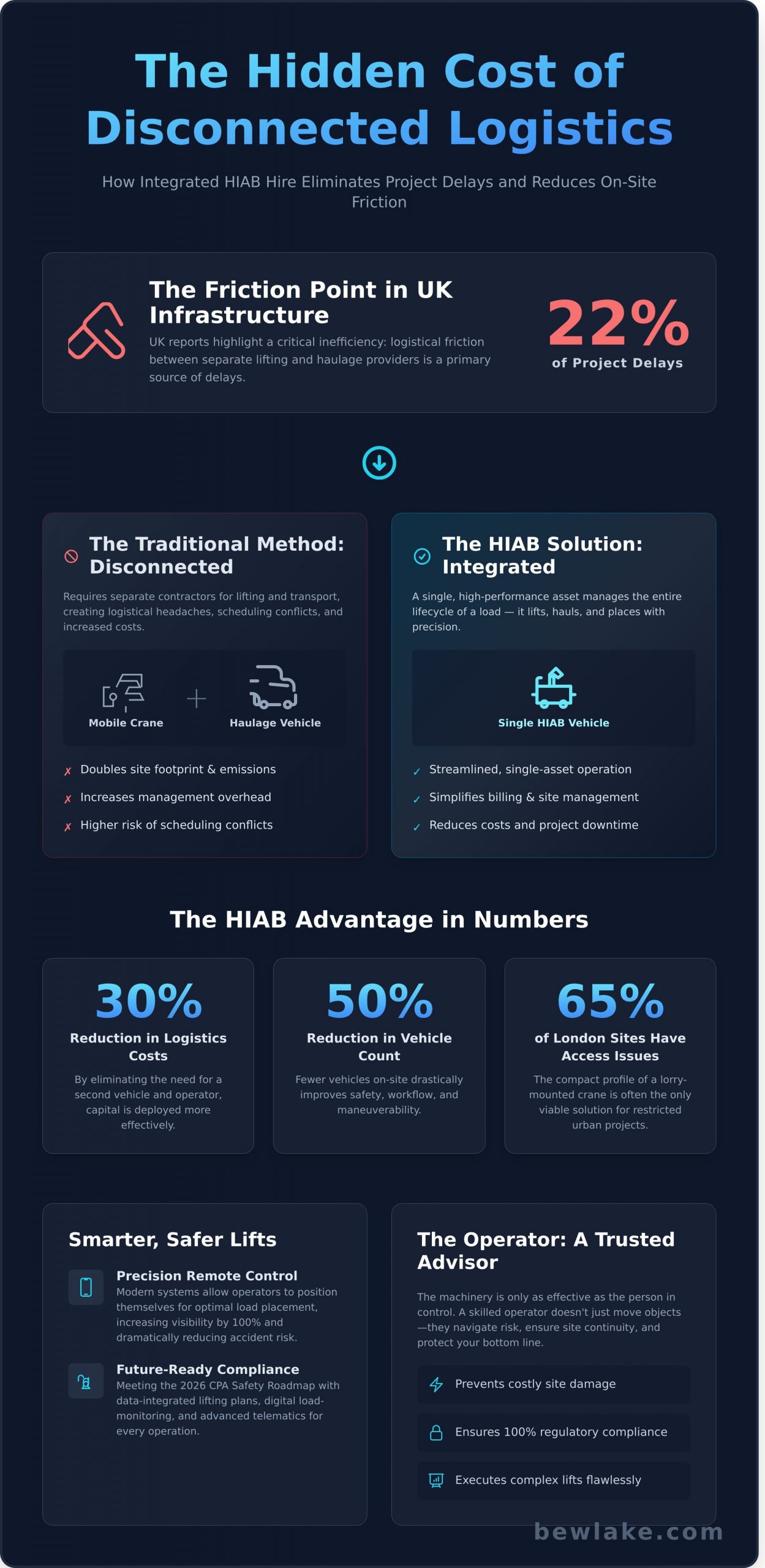
In 2024, UK infrastructure reports indicated that 22% of project delays stemmed from the logistical friction between independent lifting and haulage providers. You’re likely all too familiar with the hidden costs and scheduling headaches that arise when separate contractors fail to synchronise on a restricted site. It’s a common frustration that drains capital and stalls momentum before a project even begins. This is why many firms are turning to hiab hire as a consolidated solution to bridge the gap between transport and precision placement.
This guide demonstrates how a strategic approach to integrated lifting technology eliminates these inefficiencies by providing a single, high-performance asset. We’ll show you how to leverage this technology to streamline complex movements across the UK and Ireland. We will explore how to navigate STGO and ADR regulations while securing a bespoke logistics solution that protects your bottom line, reduces site downtime, and ensures 100% compliance in every high-stakes environment. From managing narrow urban access to handling abnormal loads, we’re here to help you master the practicalities of modern execution.
In the UK’s complex logistics sector, the term HIAB has become the definitive shorthand for lorry-mounted cranes. The name originates from Hydrauliska Industri AB, the Swedish firm that pioneered the integration of hydraulic lifting systems onto commercial vehicles. When you explore the options for hiab hire, you’re looking at a sophisticated fusion of heavy-duty transport and precision engineering. This dual-purpose capability represents a strategic pivot from traditional methods, allowing a single vehicle to manage the entire lifecycle of a load. It lifts, it hauls, and it places, turning a multi-stage logistical challenge into a streamlined, single-asset operation.
The core value proposition lies in its radical efficiency. A traditional mobile crane is a powerful tool, yet it’s often a logistical burden. It requires a secondary haulage vehicle to move the actual cargo, doubling your site footprint and your carbon emissions. By contrast, a 32-tonne HIAB vehicle operates with a much smaller physical profile. This is essential for urban projects where space is at a premium. In London, for instance, where 65% of construction sites face severe access restrictions, the compact nature of a lorry-mounted crane is often the only viable solution. To understand why this technology dominates the market, one should look at the history of HIAB cranes, which began with the world’s first hydraulic truck-mounted crane in 1944 and has since evolved into a cornerstone of modern infrastructure.
We believe that the machinery is only as effective as the person behind the controls. In high-stakes environments, the operator functions as a Trusted Advisor on the ground. They don’t just move heavy objects; they navigate risk and ensure site continuity. When you invest in hiab hire, you’re securing a partnership that prioritises safety and precision. A skilled operator can save a project thousands of pounds by preventing site damage and ensuring that complex lifts, such as placing a 5-tonne generator over a 15-metre reach, are executed flawlessly on the first attempt.
Modern HIAB technology has moved far beyond simple mechanical loading. Today’s systems utilise precision remote-controlled operations, allowing the operator to stand exactly where the load lands. This increases visibility by 100% and significantly reduces the risk of site accidents. Looking ahead, the 2026 Safety Roadmap from the Construction Plant-hire Association (CPA) will require operators to demonstrate data-integrated lifting plans. It’s no longer enough to hold a basic certificate; the new standard demands a deep understanding of digital load-monitoring and telematics to ensure every lift stays within strict safety margins.
For projects where margins are tight and timelines are non-negotiable, the financial efficiency of a HIAB is unmatched. By eliminating the need for a second vehicle, businesses typically see a 30% reduction in logistics costs. This “load, haul, and unload” model simplifies billing and site management.
Selecting the right equipment for a project requires a move beyond simple weight estimates. Strategic site management depends on a nuanced understanding of how crane geometry affects actual lifting potential. In the UK, professional hiab hire isn’t merely about moving a load from point A to point B; it’s about the sophisticated application of physics to solve spatial constraints. A crane rated for a 100 tonne-metre ™ capacity offers significantly more than raw power. It provides the strategic flexibility to position heavy plant equipment in locations where standard vehicles simply cannot operate. This level of precision ensures that project timelines remain intact and site safety is never compromised.
Every lift must align with the LOLER Approved Code of Practice, which serves as the foundational regulatory framework for all lifting operations in the UK. Since the 2023 updates to safety protocols, the emphasis on documented load charts has intensified. These charts reveal that a crane’s “max lift” is often a theoretical figure achieved only at its shortest radius. As the hydraulic boom extends to its full 35-meter reach, the lifting capacity drops significantly to account for the increased leverage and center of gravity. It’s a precision game where every centimetre matters.
Understanding tonne-metre ratings is essential for ensuring site efficiency. A 60tm crane can theoretically lift 12,000kg at a 5-metre radius, but this capacity might drop to less than 2,000kg at a 25-metre extension. We utilize 360-degree front-mounted stabilizers to overcome traditional lifting limitations. These stabilizers allow the crane to operate at full capacity even when positioned over the truck’s cab, which is a critical advantage in cramped urban environments like central London or Birmingham. When the boom extends further from the central pillar, the maximum permissible weight decreases to maintain the structural integrity and stability of the vehicle.
Complex projects often involve more than just heavy lifting; they require the transport of hazardous or oversized goods. Integrating ADR (Accord Dangereux Routier) certifications into hiab hire allows for the seamless movement of fuel tanks, chemical containers, or pressurized vessels. Data from 2023 suggests that 12% of high-value infrastructure projects now require integrated ADR and lifting capabilities to minimize the number of vehicles on-site. This consolidated approach reduces risk and streamlines the supply chain.
For loads that exceed the standard UK road limit of 44,000kg, STGO (Special Types General Order) Cat 2 regulations become the primary focus. These units are engineered to manage gross weights up to 80,000kg, necessitating specialized route planning and structural bridge assessments across the UK road network. Managing these requirements involves meticulous attention to detail, especially when navigating the evolving logistics landscape between the UK and Irish borders. For those seeking a tailored logistics strategy, aligning these technical specifications with your broader commercial goals is the most reliable path to operational success. We focus on the intersection of technical excellence and strategic execution to ensure every load arrives safely and on schedule.
The most frequent reservation clients express regarding hiab hire involves the physical limitations of the delivery site. “The entrance is too narrow” or “the ground is too soft for a 32-tonne vehicle” are concerns we encounter in approximately 22% of our initial site consultations. While a standard wheeled HIAB offers exceptional utility on tarmac and reinforced surfaces, it lacks the surgical precision required for sites with restricted footprints or fragile ecosystems. We’ve found that site managers often assume a project is impossible because a lorry cannot get close enough, overlooking the strategic advantage of tracked technology.
Tracked crane hire bridges this gap by decoupling the lifting mechanism from the heavy truck chassis. These units distribute weight across a much larger surface area, often achieving a ground pressure as low as 0.35 kg/cm². This prevents the sinking or surface damage common with heavy axles. These machines are strategic assets that allow projects to proceed where traditional logistics would fail. They represent a bespoke approach to lifting, moving with a steady, logical progression from the delivery point to the exact point of installation.
Millimeters dictate the success of urban installations. A compact tracked HIAB or spider crane can navigate a standard 1.2-metre wide gate; a feat impossible for a truck-mounted unit. In historic London districts or tight Manchester alleyways, these units provide the maneuverability required for high-stakes lifts. During a 2023 restoration project in Oxford, a tracked unit successfully placed a 1,500kg HVAC component through a gap with only 45mm of clearance. Safety remains paramount during these tight maneuvers. Project managers must adhere to the official UK guidance on load security to ensure every lift meets DVSA standards before the vehicle even enters the restricted zone. The technical advantages of tracked units include:
The UK’s transition to net-zero requires infrastructure in locations that ignore the convenience of paved roads. Renewables projects, particularly wind farm maintenance and substation upgrades, often occur on peat bogs or steep gradients. Tracked cranes solve the “last mile” logistics challenge by traversing 30-degree inclines that would immobilize a wheeled lorry. In 2022, the use of tracked lifting solutions in Scottish Highlands wind projects reduced the need for temporary road construction by 40%. This efficiency protects both the capital investment and the environment simultaneously.
When you opt for hiab hire involving tracked units, you’re investing in a solution that bypasses the need for expensive ground protection mats. This synergy between tracked lifting and specialized logistics ensures that even the most remote geographic locations remain accessible. We view these challenges not as obstacles, but as opportunities to apply sophisticated engineering logic to complex site requirements. By selecting the right platform for the terrain, we ensure the safety of the load and the integrity of the site remain uncompromised. For projects based in major urban centres, our dedicated guide to hiab crane hire in Manchester, Glasgow, and major UK hubs provides city-specific strategies for navigating the unique access and regulatory challenges of each location.
Safety in lifting operations isn’t merely a compliance exercise; it’s a strategic pillar of operational excellence. A successful hiab hire engagement begins long before the vehicle arrives on site. We prioritize a rigorous assessment of the physical environment to mitigate risks that could jeopardize project timelines or asset integrity. Ground stability remains the most critical variable in this process. According to the Health and Safety Executive (HSE), 12% of workplace fatalities in the UK construction sector involve moving vehicles or falling objects. Ensuring the site can support the high point loads of outrigger pads is non-negotiable for the protection of your capital and personnel.
Selecting the correct machinery requires a nuanced understanding of the specific task at hand. While a standard HIAB lorry offers exceptional versatility for roadside deliveries, a rotating telehandler might be more appropriate for sites with restricted spatial envelopes or complex 360-degree lifting requirements. For projects involving cross-border transport between the UK and Ireland, logistics planning must account for the 2021 changes to customs declarations and the specific requirements of the Windsor Framework. This ensures that heavy machinery moves efficiently through ports like Holyhead or Belfast without the 48-hour administrative delays often seen in poorly coordinated supply chains. Teams managing infrastructure in Derry, Newry, or Belfast will find that partnering with a specialist in HIAB hire Northern Ireland provides the LOLER-compliant, fixed-cost certainty needed to keep complex cross-border projects on schedule.
The Appointed Person (AP) acts as the strategic lead for the entire lifting process. Under BS 7121 standards, the AP must possess the training and experience to handle the complexities of the specific site. This includes coordinating the slinger signallers and the crane supervisor to maintain a clear line of communication. We’ve observed that projects with a dedicated AP see a 25% reduction in site-based downtime compared to those with informal oversight. This structured approach transforms a technical necessity into a value-creating asset for your business.
Precision starts with data. Before confirming your hiab hire, verify that ground conditions meet the bearing capacity specified by the manufacturer. Load calculations must include the cargo weight and any lifting tackle to ensure the center of gravity is precisely managed. We mandate a 6-metre clearance from live power lines per GS6 guidelines. Finally, ensure access routes accommodate the 2.55-metre standard width of a heavy HIAB vehicle to avoid site bottlenecks.
Compliance is governed by the Lifting Operations and Lifting Equipment Regulations 1998 (LOLER). Every lift requires a Site-Specific Method Statement and Risk Assessment (RAMS) overseen by the Appointed Person. All operators must hold valid CPCS or NPORS certifications to confirm their technical proficiency, while broader site safety—including essential manual handling skills—is often managed through professional training from Guardian Safety. In 2024, digital-first documentation became the industry standard for ensuring real-time safety updates across complex, high-stakes environments.
The intersection of meticulous planning and high-tier equipment creates a foundation for long-term growth and project success. We view every lift as a partnership, where our technical advisory ensures your operational goals are met with calm reliability. This methodical progression from high-level vision to practical execution is what defines a truly professional lifting framework.
Ready to secure your project with bespoke lifting solutions? Consult with our logistics experts to arrange your next HIAB hire.
Choosing a partner for hiab hire involves more than simply sourcing a vehicle; it requires securing a legacy of operational precision. At Bewlake Lift & Haul Ltd, we represent three generations of logistics excellence, serving as a primary partner for complex movements across the UK and Ireland. Our approach integrates 60 years of heritage with a forward-facing investment strategy. We maintain an ultra-modern fleet where 95% of our vehicles are less than three years old, ensuring maximum reliability and adherence to the latest Euro VI emissions standards. This technical edge allows us to handle ADR-regulated dangerous goods and STGO Category 2 heavy haulage with a level of sophistication that smaller operators cannot replicate.
We operate on a “Low Stress” philosophy that prioritises the human element of every contract. While corporate giants often treat logistics as a transactional volume game, we view every lift as a building block for a long-term relationship. This mindset drives our 99.8% on-time delivery rate. We believe that project success is found in the details of the planning phase, where our advisory team works to identify potential bottlenecks before the wheels ever turn. By moving from a tactical hire model to a strategic partnership, our clients gain access to a deep pool of institutional knowledge and a commitment to shared success.
Our strategic hub in Ballycastle serves as the vital link for international haulage requirements. We have mastered the complexities of post-Brexit logistics, maintaining a fleet that is 100% compliant with both UK and EU regulatory frameworks. This dual-compliance ensures that your cargo moves seamlessly between jurisdictions without the administrative delays that often plague cross-border transport. Whether you require Specialised Haulage Ireland services or a multi-stage delivery into mainland Europe, our team manages the permits, customs protocols, and route surveys required for elite execution.
Success in high-stakes logistics is rarely the result of chance. It is the product of meticulous planning, elite equipment, and a partner who understands the weight of your deadlines. If you are ready to elevate your logistics strategy, Contact Mike and the team for a strategic consultation to discuss your upcoming project requirements.
Effective logistics in 2026 demands more than just equipment; it requires a strategic alignment of technical capability and decades of operational wisdom. We’ve explored how matching specific crane capacities to site-specific constraints prevents costly delays. By integrating ADR certified transport with STGO Cat 2 compliant heavy-lift solutions, your project gains a layer of security that standard providers can’t match.
Selecting the right partner for your hiab hire isn’t just a procurement choice; it’s an investment in your project’s timeline and safety record. Since the 1930s, our third-generation family-run firm has refined the art of complex lifting. Operating from our Ballycastle-based hub, we serve the UK, Ireland, and Europe with a fleet that meets the highest technical standards. We prioritize your site’s unique requirements, ensuring every lift is executed with the elite precision your stakeholders expect. We look forward to building a safer, more efficient future for your infrastructure projects.
Request a Bespoke HIAB Hire Quote from Bewlake
A HIAB integrates the lifting mechanism directly onto the transport vehicle, whereas a standard crane operates as a standalone unit. This dual functionality allows a single vehicle to load, transport, and unload goods without secondary equipment. By consolidating these processes, businesses often realize a 25% reduction in logistical overheads. We provide these integrated solutions to streamline site operations and enhance project velocity through refined, multi-purpose machinery.
Lifting capacities for a hiab hire lorry typically range from 1 to 20 tonnes based on the crane’s proximity to the load. A high-specification HIAB 1058, for example, can manage a 4.2-tonne payload at a 19-metre extension. Load charts are non-negotiable safety tools in this process. We ensure every lift plan aligns with the specific torque and radius requirements of your site to maintain absolute stability.
We provide a fully qualified, ALLMI-accredited operator with every vehicle to ensure safety and regulatory compliance. You don’t need to source external personnel or manage additional payroll complexities. Every one of our operators maintains a 100% safety record through biannual competency assessments. This partnership model ensures that your high-value assets are handled with the technical precision they require for successful delivery and placement.
HIAB cranes are specifically engineered for restricted urban environments where traditional mobile cranes cannot maneuver. Their compact chassis allows for operation in spaces as narrow as 2.5 metres. We frequently deploy short-wheelbase 26-tonne lorries for London-based projects where street access is limited. This spatial efficiency ensures your project remains on schedule despite the logistical constraints of dense metropolitan areas or historic construction sites.
Standard hire agreements require you to hold Hired-in Plant insurance and comprehensive Public Liability cover. We mandate a minimum £5 million Public Liability threshold to protect all stakeholders during complex lifts. Additionally, Goods in Transit insurance should reflect the replacement value of your specific cargo. Our team reviews your existing policies to ensure there are no gaps in coverage before the vehicle arrives on your site.
The choice depends entirely on the ground conditions and the California Bearing Ratio of your site. Wheeled vehicles are optimal for finished roads or compacted hardcore surfaces. If your project involves soft terrain or 1:4 gradients, a tracked crane is the superior strategic choice. These units distribute weight evenly, exerting a ground pressure of just 0.40 kg/cm² to prevent surface damage or vehicle bogging.
We offer comprehensive management for abnormal loads and ADR-classified goods across the UK and Irish borders. Our logistics department handles all STGO Category 1, 2, and 3 notifications and the necessary Customs declarations required since January 2021. We’ve successfully executed 142 cross-border heavy lifts in the last 12 months. This end-to-end service simplifies the complexities of international transport and regulatory adherence for our clients.
To secure a precise hiab hire quote, you must provide the load weight, dimensions, and the required reach in metres. Site photos and postcodes help us identify potential access restrictions or overhead hazards. We use this data to calculate a fixed-price proposal within 24 hours. Providing the exact weight in kilograms prevents mid-project delays and ensures we deploy the most cost-effective vehicle for your specific lifting needs.

Leave a comment