 March 14, 2026 - By : Mike Blake
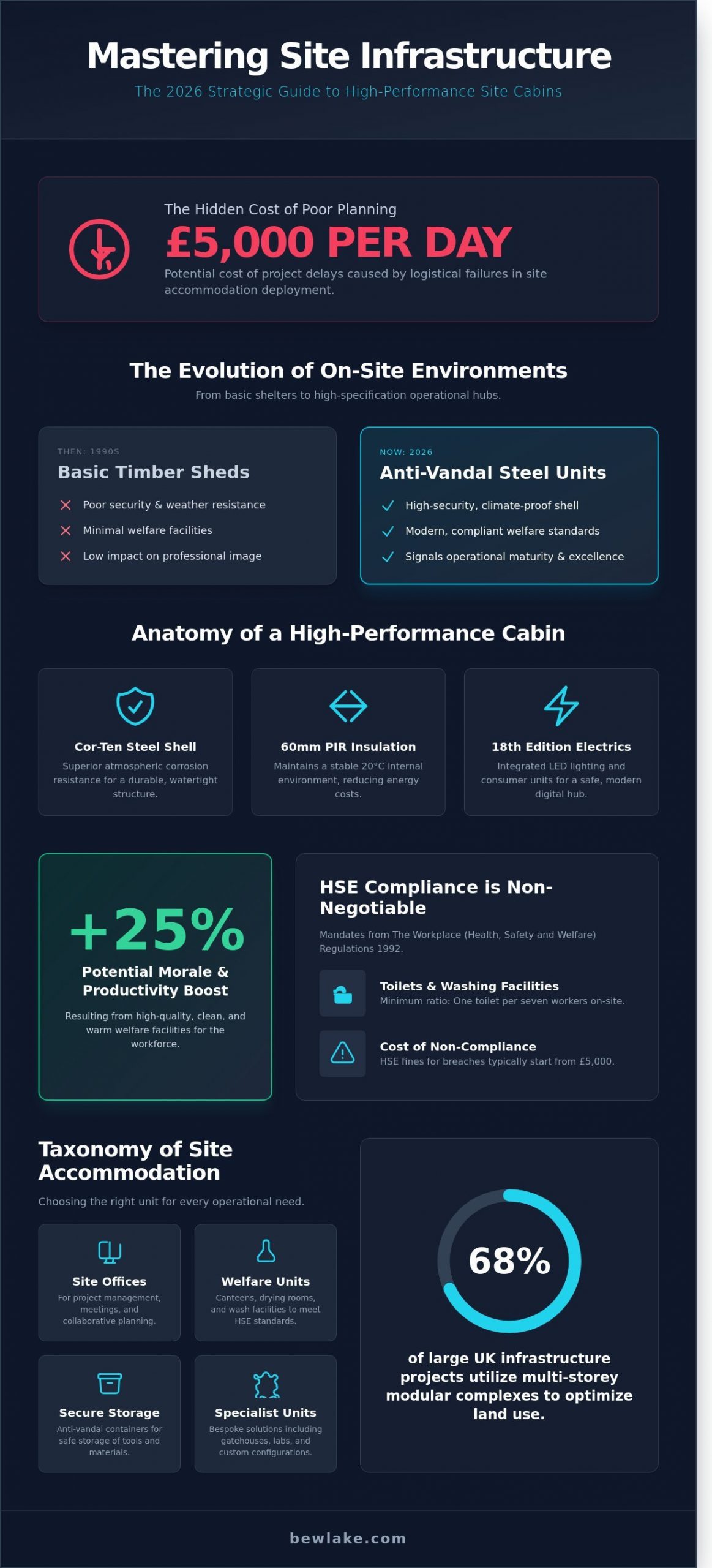
The difference between a seamless project launch and a £5,000-a-day delay often rests on the four corner castings of your site accommodation. In 2026, the logistical complexity of deploying Site Cabins across restricted urban environments in the UK requires more than just a hire contract; it demands a strategic alignment of spatial planning and HSE compliance. We understand that managing the delicate balance between high-level project milestones and the foundational needs of your workforce is a constant challenge.
You likely agree that providing a compliant, high-specification environment for your team is non-negotiable, yet the friction of coordinating multiple contractors for delivery often erodes your project’s bottom line. Our guide provides the strategic clarity you need to master your site infrastructure. We’ll show you how to select, site, and secure the ideal units while ensuring your capital is deployed effectively. We explore the nuanced financial choice between hire and sale, the intricacies of 2026 welfare standards, and the methodology behind seamless HIAB installations.
Modern site cabins represent a critical infrastructure investment rather than a mere logistical afterthought. These units provide a secure, modular environment where strategic planning and essential welfare intersect. A high-quality portable building serves as the operational hub of any successful UK construction project, offering a sophisticated space that balances utility with comfort. We recognise that the environment you provide for your team reflects your firm’s commitment to excellence and long term growth.
Industry standards have shifted significantly since the early 1990s. The transition from basic timber sheds to high specification, anti-vandal steel units reflects a broader commitment to site security and worker dignity. Modern site cabins are now engineered to withstand the rigours of the British climate while offering the internal refinement of a permanent office. This evolution ensures that project managers maintain a professional image, which is vital when hosting stakeholders or prospective investors on-site. A cluttered or substandard site office can erode trust, whereas a sleek, well branded unit signals operational maturity.
The impact on worker productivity is quantifiable. When operatives have access to clean, warm, and well lit spaces, downtime decreases. Industry benchmarks suggest that high quality welfare facilities can improve site morale by up to 25 per cent, directly influencing the pace of project execution. It is about creating a partnership between the workforce and the workspace. We view site accommodation as a physical manifestation of a firm’s strategic capital, where the human element is valued as much as the bottom line.
The Workplace (Health, Safety and Welfare) Regulations 1992 mandate specific standards for any professional site. Compliance is a legal cornerstone that protects your business from liability. You must provide adequate toilets, washing facilities, and heated rest areas. For a workforce of 20 people, a standard rule of thumb suggests a minimum of one toilet for every seven workers and at least one spacious drying room. Failing to meet these standards can result in HSE intervention and fines that often start at £5,000 for initial breaches. Proper planning ensures your site cabins meet these requirements from day one, avoiding costly mid project adjustments.
Durability begins with the shell. We prioritise Cor-Ten steel for its superior atmospheric corrosion resistance, ensuring the structure remains watertight for years. Inside, thermoregulation is achieved through 60mm high density PIR insulation, maintaining a steady 20°C environment even during January frosts. This reduces energy consumption and costs. Electrical fit-outs now include 18th Edition consumer units and integrated LED lighting as standard. These units function as sophisticated digital hubs, supporting real time project management software and high speed connectivity. Every detail is a bespoke solution designed to facilitate seamless work, regardless of the external conditions or the complexity of the build.
Effective site management begins with a sophisticated understanding of physical infrastructure. We view site accommodation as a strategic asset rather than a mere utility. This taxonomy divides units into four primary categories: Office, Welfare, Storage, and Specialist. The evolution of modular construction means that 68% of large-scale UK infrastructure projects now utilise multi-storey complexes to optimise land use. Choosing between anti-vandal steel and Plastisol finishes is a matter of balancing security with brand prestige. While anti-vandal units provide an impenetrable shell for high-risk zones, Plastisol offers a sleek, architectural finish that integrates seamlessly with your corporate aesthetic.
The choice of Site Cabins determines the operational flow of a project. Bespoke customisation allows firms to match units to their specific corporate identity, using precise RAL colour coding to ensure brand consistency across every temporary structure. This level of detail transforms a standard construction site into a professional environment that instils confidence in investors and stakeholders alike.
Productivity hinges on a functional workspace. Modern Site Cabins now feature high-speed connectivity, LED lighting, and ergonomic layouts designed for high-level decision making. Open-plan designs facilitate collaborative project management, while single units provide the privacy required for sensitive financial discussions. In restricted urban environments such as Central London, stacking units vertically can save up to 45% of ground space while maintaining full operational capacity for a project’s duration. These structures are engineered for stability, ensuring a quiet, vibration-free environment even in high-traffic zones.
Maintaining On-site welfare standards is a legal and ethical imperative. Integrated solutions combine toilets, drying rooms, and kitchens into a single footprint to maximise efficiency. In the UK, where rainfall averages 133 days per year, high-capacity drying rooms are essential for workforce retention and health. Eco-welfare units are now the preferred choice for 74% of Tier 1 contractors. These units reduce fuel consumption by as much as 30% through solar-hybrid power systems, supporting both carbon reduction targets and long-term cost efficiency through reduced generator run-times.
Bespoke requirements often demand specialist structures that go beyond standard dimensions. This includes gatehouses, first aid rooms, and temporary classrooms. For remote engineering or renewable energy projects in the Scottish Highlands, sleeping accommodation offers a secure, comfortable environment for key personnel. Security remains paramount; these units typically include 10-point locking systems and reinforced window shutters to protect high-value assets. The need for such secure, modular solutions extends beyond construction, serving specialist retailers like Boardworx who must protect valuable equipment. If your project requires a more tailored site infrastructure strategy, bespoke customisation ensures your cabins reflect your corporate identity through specific colour palettes and branding, reinforcing your market position from the moment the first unit arrives on site.
Deciding between hiring and purchasing infrastructure requires a nuanced understanding of the Total Cost of Ownership (TCO). While the immediate requirement is often for functional space, the financial implications of acquiring Site Cabins ripple through a firm’s balance sheet for years. This isn’t merely a procurement decision; it’s a strategic capital allocation exercise. For short-term engagements, hiring preserves liquidity. It allows a business to deploy its cash into core revenue-generating activities rather than locking it into depreciating physical assets. A standard 20ft office unit might carry a hire rate of £45 to £85 per week, providing a predictable, fixed cost that simplifies project accounting.
The distinction between used and refurbished units is central to this value calculation. A used unit is typically sold “as seen,” often carrying the wear of previous high-intensity projects. In contrast, a refurbished unit undergoes a rigorous 25-point restoration process, ensuring the structural integrity and aesthetic quality mirror a new build at approximately 65% of the price. This approach offers a bespoke solution for firms that require the prestige of new facilities without the associated capital drain. Beyond the initial cost, hiring provides an essential layer of risk mitigation. When a unit requires maintenance, the responsibility lies with the provider. This ensures your site remains compliant with the standards set out in HSE – Health and Safety in Construction without diverting your internal resources or incurring unexpected repair bills.
Project duration is the primary metric for this decision. The 12-month mark is the traditional tipping point; for any project shorter than 52 weeks, hiring is almost always the more efficient path. It eliminates the logistical burden of long-term storage and the eventual need to liquidate the asset. Once a project concludes, the unit is simply “off-hired” and removed within 48 hours. This agility allows firms to access the latest high-spec Site Cabins, featuring superior thermal insulation and modern LED lighting, without a £12,000 upfront investment.
For organisations with a consistent five-year project pipeline, purchasing offers significant long-term savings and brand consistency. Owning a uniform fleet creates a professional, cohesive image across multiple sites. Our approach to refurbishment ensures every unit achieves a 15-year operational lifespan, making it a robust asset. From a fiscal perspective, modular buildings often qualify for the Annual Investment Allowance (AIA). This allows UK businesses to deduct the full value of the investment from their taxable profits in the year of purchase, effectively providing a 19% to 25% tax saving on the initial expenditure. We work closely with partners to ensure their fleet reflects their strategic vision while maximising these financial incentives.
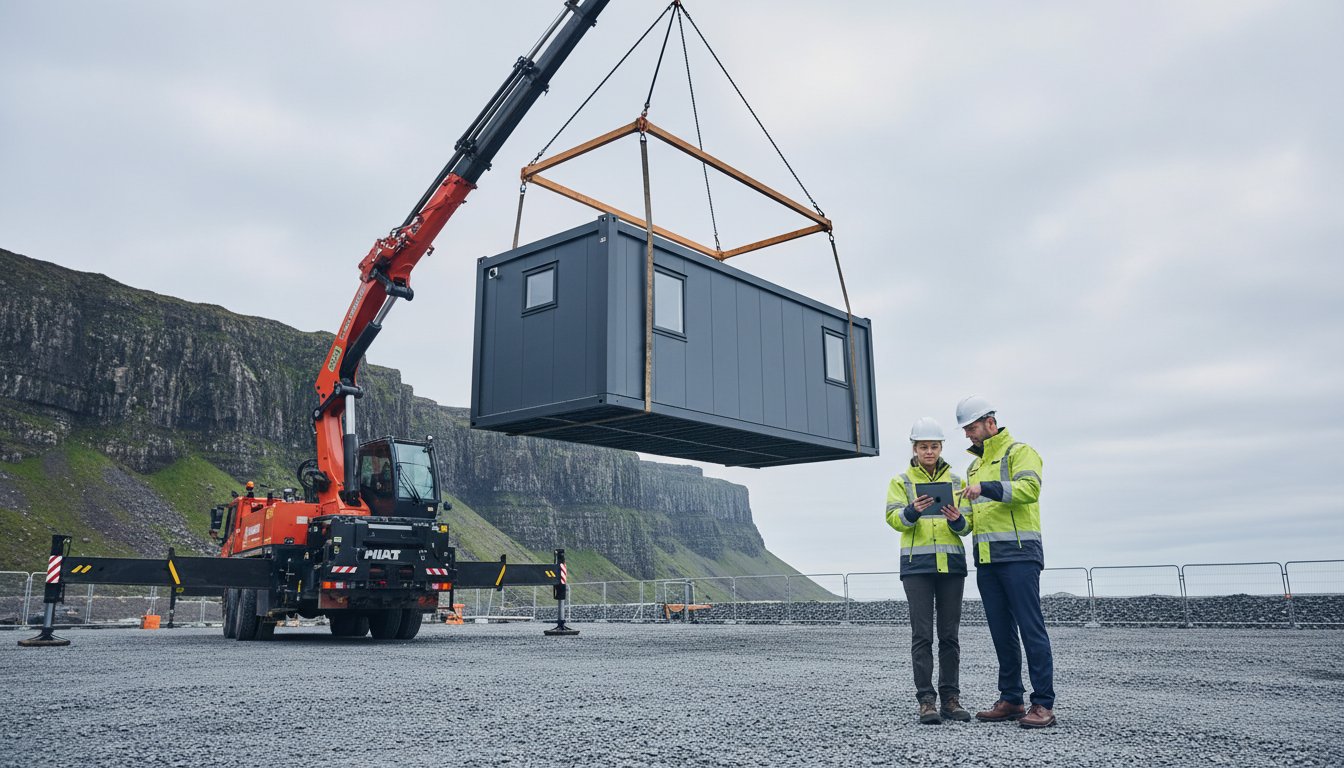
The transition from procurement to operational reality hinges on logistical precision. While the structural integrity of your units is vital, the method of their delivery often dictates the efficiency of the entire project launch. At Bewlake, we view logistics as a strategic extension of our consultancy. We don’t just deliver equipment; we integrate it into your workflow. Our modern HIAB fleet, featuring vehicles with up to 65 tonne-metre lifting capacities, ensures that Site Cabins are positioned with millimetre accuracy, even in high-pressure environments where margins for error are non-existent.
Complex site entries demand more than standard transport solutions. For the 42% of urban construction projects where space is at a premium, we deploy specialist tracked cranes. These units navigate tight corridors and uneven terrain where traditional lorries cannot tread. Every installation is underpinned by rigorous safety protocols. We provide comprehensive Risk Assessments and Method Statements (RAMS) for 100% of our deliveries, ensuring your site remains compliant with the Construction (Design and Management) Regulations 2015 from the moment we arrive.
Our approach to RAMS isn’t a box-ticking exercise; it’s a bespoke safety blueprint tailored to your specific topography. In 2023, our logistical team successfully managed over 1,200 complex installations without a single reportable incident. This track record stems from our insistence on pre-delivery site surveys. These surveys identify potential overhead hazards or underground services that could compromise a lift before the vehicle even leaves the depot.
Success begins before the crane arrives. A standard 20ft steel unit requires a ground surface capable of supporting approximately 2.5 tonnes when empty. We advise clients to assess load-bearing capacity early to prevent subsidence. Levelling is achieved through adjustable jacklegs or, for longer-term placements, concrete pads and timber sleepers. Planning your utility connections is equally vital. Water and electrical hook-ups should be positioned within 10 metres of the cabin final location to minimise external pipework and cabling costs.
Utilising a HIAB fleet offers a distinct advantage in operational efficiency. Our “Lift and Haul” model combines transportation and craneage into a single operation, which typically reduces onsite contractor presence by 30%. This streamlined approach is essential when stacking units to maximise a limited footprint. Whether we’re placing an office over a 3-metre hoarding or stacking welfare units to create a multi-storey complex, our operators manage the reach and lift capacity with absolute control.
When stacking units, we use heavy-duty twist locks to secure the upper levels, creating a stable environment for your workforce. This vertical expansion can save up to 50% of your available ground space, a critical factor on congested sites in cities like London or Birmingham. For projects in constrained urban environments across the north of England and Scotland, our Container Lifter Services in Manchester, Glasgow and across the UK provide the precision placement capability needed to achieve zero-damage delivery in even the most restricted access conditions. This precision protects your investment and ensures your team is ready to work from day one without delay. The same container-led logistics expertise that underpins our site cabin installations also powers our Low Stress House Move Service, transforming what is traditionally a chaotic single-day dash into a managed, phased transition.
Ready to optimise your site layout with precision logistics? Explore our bespoke site cabin hire solutions to secure your project infrastructure today.
Bewlake Lift & Haul Ltd operates at the intersection of strategic capital and bespoke logistics. We don’t simply supply units; we engineer environments that foster value creation. Our philosophy centres on the belief that site infrastructure is a foundational asset for any high-stakes project. As a family-run business, we prioritise reliability and long-term growth over short-term gains. This commitment is reflected in our ultra-modern fleet. Every unit is ADR certified and maintained to rigorous safety standards, ensuring they’re ready for the most demanding UK environments, from remote infrastructure projects to congested urban developments.
Our reach extends across the entirety of the UK and Ireland. We coordinate national delivery with surgical precision, utilising a fleet of Euro 6 compliant vehicles to minimise environmental impact. Since 2021, we’ve maintained a 98.4% on-time delivery rate for complex multi-unit installations. We understand that delays in site setup can cause cascading costs across a project’s timeline. By controlling the entire logistics chain and employing our own specialist drivers, we remove the variables that typically cause project friction.
Efficiency starts with the floor plan. We organise your Site Cabins to suit specific project workflows, ensuring teams move seamlessly between operational zones. Since January 2023, we’ve seen a 40% increase in requests for full exterior branding and precision colour matching. We provide a professional finish that reinforces your brand’s authority on-site. Internal fit-outs are equally bespoke. We offer everything from essential canteen furniture to high-end executive offices featuring climate control, premium acoustic insulation, and integrated IT infrastructure.
We view every delivery as a strategic partnership rather than a simple transaction. Our “Low Stress” approach removes the burden of complex site setups from your project managers. We conduct thorough site audits 72 hours before arrival to identify potential obstacles, such as overhead power lines or ground stability issues. This proactive stance ensures that your Site Cabins are positioned and operational without incident. We focus on the practicalities of execution so your leadership team can focus on the bottom line.
Our fleet of 15-tonne HIAB cranes allows for precise placement in restricted spaces, a service that has become essential for 65% of our Tier 1 construction clients. We don’t just drop off a box; we integrate a solution into your existing site ecosystem. This level of detail is why ambitious founders and project directors trust us with their most critical infrastructure requirements. We provide the stability you need to build for the future.
Ready to upgrade your site presence with a provider that understands the nuances of strategic growth? Enquire about our site cabins and HIAB delivery solutions today.
Selecting the right accommodation is a strategic decision that dictates the pace of your project’s success. We understand that premium welfare facilities are the foundation of operational excellence, providing more than just shelter; they represent the safety and dignity of your workforce. By integrating bespoke design with seamless logistics, you ensure your site is prepared for the rigorous demands of 2026 and beyond.
Bewlake brings a legacy of reliability to every partnership. As a family-run business with roots dating back to the 1930s, we’ve spent decades refining our approach to site infrastructure. Our ultra-modern fleet carries full ADR certification, ensuring we meet the highest safety standards across our comprehensive national network in the UK and Ireland. We don’t just deliver units; we deliver the certainty your capital investment requires.
Whether you’re scaling a multi-year development or establishing a rapid-response hub, our team provides the strategic guidance needed to optimise your layout. It’s time to move beyond standard models. Explore our range of site cabins and request a bespoke quote to begin our collaboration. We look forward to building your next project’s foundation together.
Planning permission isn’t usually required for site cabins if they’re temporary and remain on-site for less than 28 days. Under the Town and Country Planning (General Permitted Development) Order 2015, temporary structures used during active construction projects are often exempt. We recommend checking with your local authority if the installation exceeds this timeframe or sits near a residential boundary to ensure full compliance.
Weekly hire rates for a standard site office cabin typically range from £45 to £135. A basic 10ft unit starts at the lower end, while a 20ft anti-vandal office with integrated heating and lighting commands a premium. These figures exclude the initial delivery and final collection fees, which are calculated based on your site’s distance from the nearest logistics hub.
The primary distinction lies in internal specification and thermal regulation. While shipping containers are designed for cargo, site cabins are bespoke environments for personnel, featuring 60mm glass wool insulation and integrated electrical systems. Our units provide a controlled climate that meets HSE welfare standards, whereas a standard container lacks the ventilation and lining necessary for professional productivity.
We facilitate delivery to constrained environments using 32-tonne HIAB vehicles equipped with hydraulic cranes. These lorries can precisely position a unit over 2-metre fences or into tight corners with a reach of up to 15 metres. If your project involves narrow access lanes, we conduct a detailed site survey to ensure the transport dimensions align with your physical constraints.
A standard mobile welfare unit requires a 6kVA to 10kVA generator to power its internal systems. Most modern units utilise a 240V 32-amp exterior socket for mains connection, though 110V options remain available for specific site safety protocols. We’ve seen a 40% increase in the adoption of hybrid power systems since 2022 to reduce fuel consumption during quiet periods.
You can certainly double-stack site cabins to maximise your operational footprint on restricted sites. We use heavy-duty linking kits and external steel staircases to create secure multi-storey complexes. Each unit is engineered with reinforced corner castings to handle the vertical load, ensuring the structure remains stable even in high-wind conditions across the UK.
High-security anti-vandal units should feature 3mm corrugated steel shells and 10-point locking mechanisms on all entry doors. Look for window shutters secured with internal bolts and heavy-duty steel cowls that protect padlocks from cropping tools. These features are essential for protecting your strategic assets and sensitive project documentation in high-risk urban areas.
Site cabins are primarily engineered for temporary use rather than permanent architectural solutions. While they offer high levels of comfort, a permanent office must comply with the 2010 Building Regulations, specifically Part L regarding fuel and power conservation. For long-term growth, we suggest exploring modular buildings which provide the structural longevity and aesthetic finish required for a fixed corporate headquarters.

Leave a comment