 April 1, 2026 - By : Mike Blake
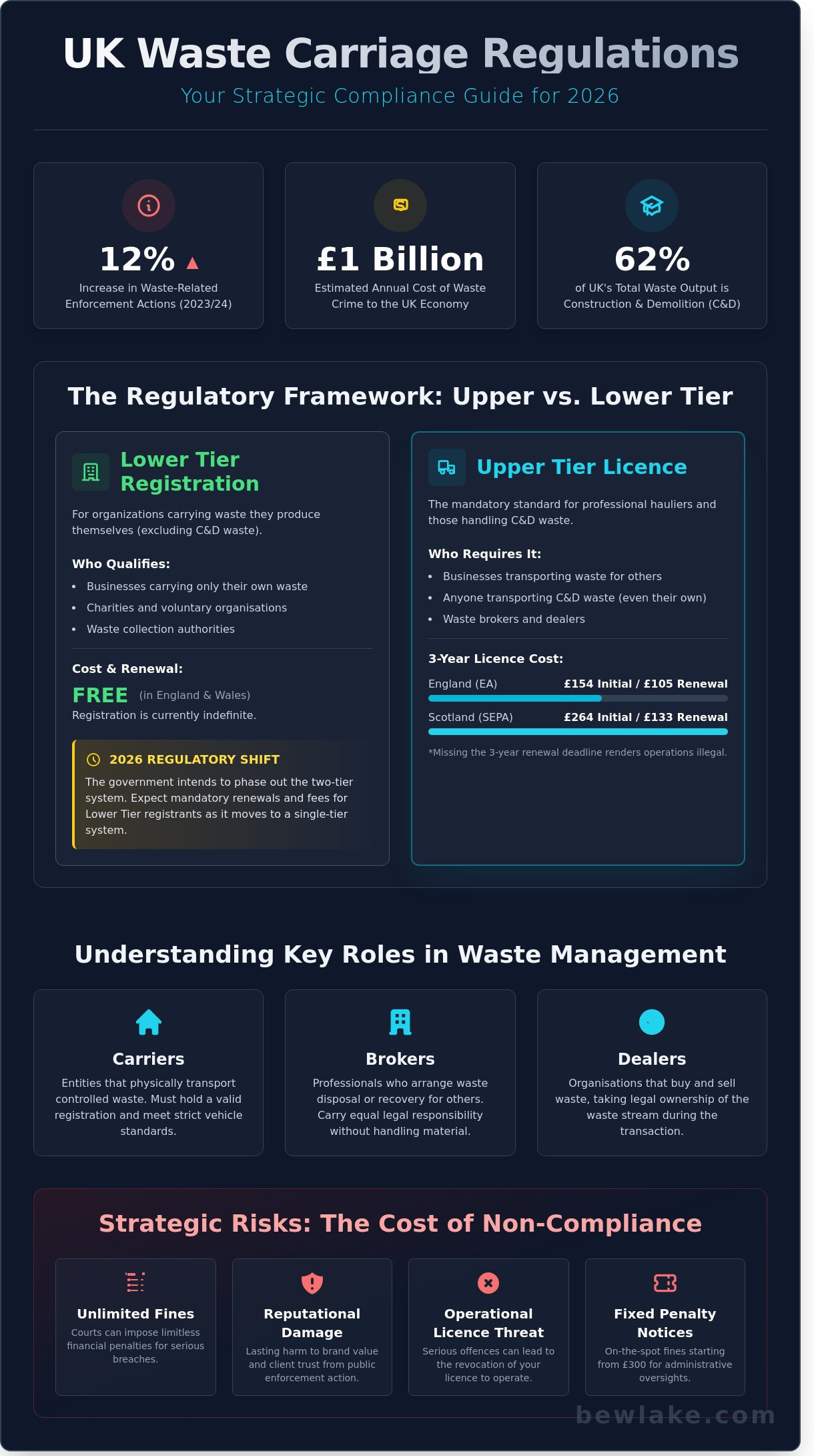
The Environment Agency’s 2023/24 performance report confirmed a 12% increase in waste-related enforcement actions, signaling that the margin for error in logistics has effectively vanished. It’s a sobering reality. A single administrative oversight in your waste carriage documentation can now trigger an unlimited fine and lasting reputational damage. We understand that the shifting landscape of UK environmental law feels like a moving target, especially when categorising construction waste against general business waste across the distinct regulatory demands of the EA, SEPA, and the NIEA.
You deserve a perspective that treats compliance as a strategic asset rather than a mere checkbox. We’ve designed this guide to help you master the complexities of licensing tiers and regional mandates, ensuring your logistics projects remain legally robust through 2026. You’ll gain a clear understanding of the distinctions between Upper and Lower tier requirements and a step-by-step path for urban logistics that secures your firm’s value and long-term growth.
Waste carriage refers to the legal transportation of controlled waste as a core component of business operations. In 2026, this definition has moved beyond simple logistics; it’s now a pillar of corporate governance. The Environment Agency’s digital waste tracking system, fully implemented in April 2025, means that every movement of material is recorded in real-time. For firms operating across the UK, waste carriage is no longer a peripheral concern but a central risk management priority.
The haulage industry faces unprecedented scrutiny. Waste crime costs the UK economy an estimated £1 billion each year according to 2024 data. Consequently, enforcement agencies in logistics hubs like Manchester and Leeds have intensified roadside inspections by 25% over the last eighteen months. Failing to verify the credentials of your transport partners doesn’t just invite fines. It threatens your operational licence and brand reputation.
The 2026 regulatory framework requires a clear understanding of three distinct roles. We help our partners distinguish these to ensure bespoke compliance strategies:
Controlled waste encompasses household, commercial, and industrial materials. Construction and demolition (C&D) waste requires the highest level of oversight because it accounts for 62% of the UK’s total waste output. Managing these complex streams often involves cross-border logistics. This is where specialised haulage Ireland becomes a vital strategic link for firms moving material between the UK mainland and Irish markets. We view waste management as a value creation opportunity rather than a mere cost centre. By prioritising compliance, firms secure long-term growth and protect their strategic capital from the volatility of regulatory fines.
The UK regulatory framework for Waste Carriage is built upon a two-tier hierarchy designed to segment risk and professionalise the industry. Managed by the Environment Agency in England, SEPA in Scotland, and Natural Resources Wales, this system demands precise categorisation to avoid the heavy financial penalties associated with non-compliance. Understanding where your business sits within this architecture is a matter of both legal necessity and strategic risk management.
Businesses that transport waste for others as their primary activity, or those handling construction and demolition materials, must register for an Upper Tier licence. This is the mandatory standard for professional hauliers and any entity generating profit from the movement of third-party refuse. In England, the entry cost is £154 for the first three years, followed by a £105 renewal fee. Scottish operators face a steeper entry point of £264 via SEPA, with a £133 renewal every three years. The three-year renewal cycle is a critical compliance milestone; missing this deadline effectively renders your operations illegal and can lead to fixed penalty notices of £300 or unlimited fines in a magistrate’s court.
Lower Tier registrations apply to charities, waste collection authorities, and businesses carrying only waste they’ve produced themselves, provided that waste isn’t from construction or demolition activities. While these registrations are currently free and indefinite in England and Wales, the 2023 Defra consultation response indicates a major shift. By 2026, the government intends to transition to a single-tier system to close loopholes used by illicit operators. This change will likely introduce mandatory renewals and fees for those previously exempt, requiring a more proactive approach to Waste Carriage documentation.
Businesses often mistakenly assume that carrying their own waste provides a total exemption. This isn’t the case for the construction sector. Any business transporting rubble, soil, or treated timber must hold an Upper Tier licence, regardless of who produced the material. Reputable firms like WillsByrne Construction & Landscaping LTD build their operational models around this compliance. Data from the Environment Agency suggests that misclassification of construction materials accounts for a significant portion of regulatory breaches. Maintaining a bespoke compliance framework ensures your business avoids these common legal traps while fostering a reputation for operational integrity and long-term growth.
In the high-stakes environment of UK logistics, non-compliance represents a direct threat to your strategic capital. The financial reality is sobering. Under current UK regulations, magistrates’ courts possess the power to impose unlimited fines for severe breaches of the Environmental Protection Act 1990. For logistics directors operating in Birmingham and London, the stakes extend far beyond a balance sheet entry. Blue-chip clients now conduct rigorous audits of their carriers to safeguard their own corporate reputations. A single failure in Waste Carriage documentation can result in immediate exclusion from major infrastructure frameworks, where transparency is non-negotiable.
This risk profile becomes even more complex when waste movements intersect with ADR transport. If hazardous materials are misclassified or handled without the correct technical oversight, the legal and environmental consequences escalate into the realm of criminal liability. We see this frequently in urban development projects where improper documentation can halt a site’s progress for several days, costing developers upwards of £15,000 per day in liquidated damages.
Your legal obligation dictates that waste must only be transferred to an authorised person who holds a valid carrier registration. Every individual movement requires a detailed Waste Transfer Note (WTN) that accurately classifies the cargo using the correct European Waste Catalogue (EWC) code. These records are your primary legal shield. You must legally retain standard WTNs for 24 months. If the movement involves hazardous waste, the retention period extends to 36 months. Precise record-keeping is the difference between a seamless audit and a catastrophic legal challenge.
Data for 2026 indicates that the Environment Agency and DVSA have increased roadside interventions by 18% compared to 2024 levels. These checks are increasingly data-led, targeting vehicles linked to sites with poor compliance histories. Many logistics managers mitigate this risk by employing on-site repair services like LC Mobile Mechanics Ltd to ensure their fleet remains in peak condition for any inspection. This heightened scrutiny has a direct impact on the insurance market. Underwriters now view Waste Carriage violations as a leading indicator of broader operational risk, often resulting in premium hikes of 22% or more for flagged hauliers.
Case Study: The Cost of a Failed Audit
Successful waste carriage in the UK’s metropolitan hubs requires more than just a permit. It demands a strategic understanding of shifting local mandates and physical constraints. Glasgow’s Low Emission Zone (LEZ) became fully operational for all vehicles on 1 June 2023, imposing a £60 penalty for non-compliant entries. In Manchester, while the Clean Air Zone remains under review, the logistics of moving industrial waste through the city centre requires precise scheduling to avoid peak congestion and local authority restrictions. We see a growing need to align these movements with Oversize Load Transport requirements, particularly when decommissioned plant machinery or large-scale structural debris is involved. For projects involving exceptionally heavy loads, understanding the obligations under STGO Cat 2 Haulage is equally critical to maintaining compliance when moving 80-tonne loads through urban corridors.
Compliance isn’t a uniform process across the four nations. Each jurisdiction maintains its own database and enforcement priorities:
Failure to register with the correct body or mismanaging the transfer note system can lead to summary convictions and fines exceeding £5,000 per instance.
Urban density creates physical barriers for waste carriage. The narrow wynds of Edinburgh or the historic cores of Chester and Leeds weren’t built for standard heavy goods vehicles. Data suggests that 40% of delays in urban waste removal stem from inadequate site access planning. This is where Dedicated Transport Solutions provide a competitive edge. They allow for the deployment of specialised fleets, such as skip loaders with extendable arms or smaller transit vans, that navigate tight corners without compromising the volume of material removed. Whether you’re operating in the industrial heartlands of Birmingham or the expanding commercial sectors of Rugby, your logistics partner must account for these micro-level geographic hurdles.
If you’re managing complex logistics across multiple UK cities, contact Bewlake for a strategic consultation on your waste carriage obligations.
Bewlake Lift & Haul Ltd treats logistics as a form of strategic capital. We don’t just move materials; we manage the liability and precision required for high-stakes lifting projects. By integrating HIAB crane hire with professional Waste Carriage, we remove the operational friction between site clearance and transport. Our team ensures every lift adheres to LOLER 1998 regulations while simultaneously meeting the strict Duty of Care requirements under the Environmental Protection Act 1990. This dual-layered compliance protects your corporate reputation and your bottom line.
Our methodology moves with a steady, logical progression from high-level strategy to the practicalities of execution. We operate as a peer to ambitious site managers and developers, providing the intellectual sharpness needed to solve complex logistical puzzles. It’s about creating a seamless workflow where the removal of waste is as precise as the delivery of the initial assets.
Our ultra-modern fleet consists of Euro 6 compliant vehicles, ensuring access to London’s Ultra Low Emission Zone (ULEZ) without incurring the £100 daily charges that often burden older fleets. We provide ADR-certified drivers who are qualified to handle hazardous waste streams, ensuring that 100% of your materials move through legal channels. For infrastructure projects requiring the movement of heavy plant or structural components alongside waste clearance, our capabilities extend to STGO Cat 2 Haulage, delivering the axle-load precision and police notification compliance that high-value contracts demand. As a family-run business, we’ve built our reputation on reliability and precision. We don’t offer one-size-fits-all models; we deliver bespoke solutions rooted in our values of absolute compliance and shared success.
Comprehensive project management must include a rigorous audit of your current Waste Carriage strategy. Data from a 2023 industry report indicates that approximately 20% of construction firms face potential fines due to inadequate waste transfer documentation. We mitigate this risk through our “Trusted Advisor” model, framing technical haulage services through the lens of relationship-building.
To secure your logistics chain, you can request a compliance-led haulage quote that covers every variable of your project. Mike and Claire Blake are available to provide bespoke advice, ensuring your strategy is both efficient and legally robust. Contact us to align your waste management with your broader commercial goals.
The transition toward the 2026 regulatory standards marks a pivotal moment for UK industry. Compliance is no longer a mere checkbox; it’s a strategic asset. With the Environment Agency increasing enforcement, failing to secure the correct Upper Tier licensing can result in fines exceeding £50,000 and immediate operational halts. Success in complex urban hubs like Manchester and Glasgow depends on precise execution and a deep understanding of the evolving legal framework.
Bewlake provides the calm reliability your business needs in high-stakes environments. As a family-run firm with 3rd generation expertise, we operate an ultra-modern, 100% ADR certified fleet across the UK, Ireland, and Europe. We integrate sophisticated advisory processes with practical haulage to ensure your Waste Carriage requirements are met with absolute precision. Our team focuses on creating long-term value by mitigating risk and streamlining your distribution network. It’s vital to align your operations with a partner who values your brand’s integrity as much as you do.
Consult with our logistics experts on your waste carriage requirements
We’re ready to help you navigate these shifts and build a more resilient, profitable future for your business.
You’re legally required to register as a lower-tier waste carrier if you transport your own business waste on a regular basis. This rule applies to most commercial entities in England under the Control of Pollution (Amendment) Act 1989. Whether you’re moving office paper or landscaping clippings, holding the correct registration ensures your business remains compliant with national environmental standards.
The distinction depends on whether you transport waste for others or carry specific materials like construction debris. Upper-tier registration is mandatory for businesses that transport third-party waste or their own construction and demolition waste. Lower-tier registration is designed for those only moving their own professional waste, excluding building materials, or for specific organisations like charities and waste collection authorities.
Registering as an upper-tier waste carrier in England costs £154 for the initial three-year period as of 2026. Renewals are priced at £105, provided they’re completed before the existing registration expires. If you’re applying for a lower-tier registration, there’s currently no charge, and the registration doesn’t expire unless your business model changes or the Environment Agency revokes it.
You can face an unlimited fine if you fail to verify that your chosen waste carriage provider is properly registered. Under the Duty of Care regulations, the legal burden sits with the waste producer to ensure their refuse is handled by a licensed professional. In 2023, local authorities issued over 3,000 fixed penalty notices to businesses that didn’t perform these essential background checks.
Upper-tier registrations are valid for exactly three years and must be renewed to avoid legal disruption. It’s vital to track this date, as operating with an expired licence can lead to a £5,000 fine. Lower-tier registrations are indefinite. They stay active as long as your business details remain accurate and you don’t transition into activities that require an upper-tier status.
You must carry a Waste Transfer Note (WTN) for every load of non-hazardous waste you move across the UK. This document identifies the waste type using a 6-digit code and must be kept on file for at least two years. For hazardous materials, you’ll need a consignment note instead. These records are vital for demonstrating your strategic commitment to environmental responsibility during an inspection.
A waste carrier registration issued by the Scottish Environment Protection Agency (SEPA) is fully valid for waste carriage activities in England. The UK’s environmental regulators operate a mutual recognition agreement that simplifies operations for firms working across borders. You don’t need to pay for a separate Environment Agency registration if your SEPA or Natural Resources Wales licence is current and covers your specific waste types.
You’re required to notify the Environment Agency within 28 days if your business name, address, or management structure changes. Failing to update your record can invalidate your registration, leaving you open to a £1,000 fine. We suggest reviewing your registration details every quarter. This proactive approach ensures your legal protections remain robust while your business scales and evolves in a competitive market.

Leave a comment