 March 27, 2026 - By : Mike Blake
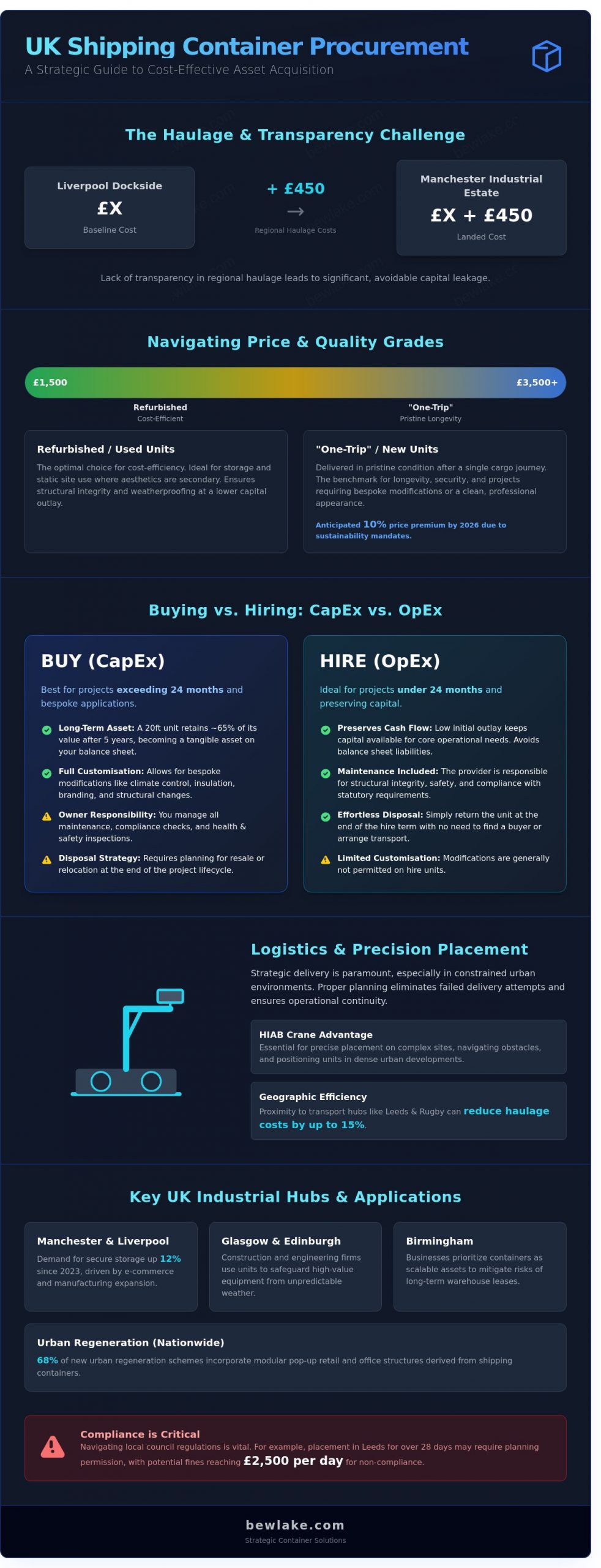
Why does an identical 20ft steel unit cost £450 more to land in a Manchester industrial estate than it does at a Liverpool dockside? For many UK operations, shipping containers represent a significant investment in strategic infrastructure, yet the lack of transparency in regional haulage and grading often leads to avoidable capital leakage. We recognise that managing site access in congested hubs like Glasgow requires more than just a purchase order; it demands a partnership built on logistical precision and clear technical standards.
This guide delivers a rigorous comparison of procurement strategies, helping you navigate the £1,500 to £3,500 price range for various container grades with absolute confidence. You’ll gain a clear framework for deciding between long-term hire and outright purchase, alongside a checklist for HIAB crane requirements that eliminates the risk of failed delivery attempts. We’ve distilled the complexities of the UK market into a strategic roadmap, ensuring your next asset acquisition is both cost-effective and operationally seamless.
The UK industrial landscape relies on the tactical deployment of Shipping Containers to maintain operational fluidity. In hubs like Manchester and Liverpool, the demand for secure storage has risen by 12% since 2023, driven by the rapid expansion of e-commerce and manufacturing sectors. Birmingham follows a similar trajectory, where businesses prioritise these units as scalable assets that mitigate the risks associated with long-term, fixed-site warehouse leases. We view these structures not merely as boxes, but as strategic tools for capital preservation.
Engineering and construction firms in Glasgow and Edinburgh utilise these robust units to safeguard high-value equipment against the unpredictable Scottish climate. The industry has moved beyond basic storage. We’re seeing a sophisticated shift toward high-specification welfare units and modular offices. This evolution reflects a broader trend in value creation where physical assets must serve multiple strategic functions. Adherence to intermodal container standards ensures these units remain compatible with global logistics chains while meeting stringent local safety requirements.
Efficiency in this market is often a matter of geography. Proximity to major transport nodes in Leeds and Rugby can reduce haulage costs by up to 15%. Selecting a unit located near these arterial routes isn’t just a matter of convenience; it’s a calculated move to protect the bottom line. Our approach focuses on this intersection of location and utility to ensure long-term growth for our partners.
High-density projects in city centres, such as the Manchester Victoria North development, require site offices that maximise limited footprints. In rural Scotland and parts of Ireland, 20-foot Shipping Containers provide essential security for renewable energy components. Data from 2024 shows that 68% of new urban regeneration schemes now incorporate pop-up retail structures. These modular units allow brands to foster community engagement and test market viability before permanent construction begins.
Port proximity in Liverpool directly influences unit availability and baseline pricing. By 2026, we anticipate a 10% price premium on new “one-trip” units compared to refurbished stock as corporate sustainability mandates tighten. Navigating local council regulations is vital for compliance. For instance, temporary placement in Leeds city centre often requires specific planning permissions if the unit remains on-site for more than 28 days. We advise clients to secure these clearances early to avoid unnecessary project delays and potential fines reaching £2,500 per day.
The decision to acquire shipping containers represents a pivotal intersection of capital allocation and operational necessity. Choosing between Capital Expenditure (CapEx) and Operational Expenditure (OpEx) dictates a firm’s balance sheet health and its long-term agility; for those looking to manage these financial commitments effectively, I Need Cash provides a gateway to various loan products that can assist with asset acquisition. For many UK enterprises, the primary driver is the anticipated duration of use. If a project spans less than 24 months, the flexibility of a hire agreement often outweighs the benefits of ownership. Conversely, permanent installations or long-term storage requirements favour a direct purchase to avoid the compounding costs of monthly rentals.
Maintenance liability is a critical factor in this financial analysis. When hiring, the provider typically assumes responsibility for the unit’s structural integrity. This includes ensuring the equipment adheres to statutory container requirements regarding safety and plating. Owners must manage these compliance schedules independently. This requires a disciplined approach to asset management to preserve the unit’s condition and eventual resale potential.
Purchasing is the superior strategy for projects with a horizon exceeding two years. A standard 20ft unit purchased in 2024 for approximately £2,200 often retains 65% of its value after five years of service. This residual value provides a tangible asset on the balance sheet. Ownership also permits bespoke modifications. Whether you require internal climate control or brand-specific RAL paint finishes for a multi-site rollout in Liverpool or Glasgow, purchasing allows for total customisation. If your operational goals involve permanent infrastructure, we can assist you to evaluate your container strategy for maximum ROI.
Hiring provides a high-velocity solution for rapid site expansion in growing hubs like Manchester or Birmingham. It eliminates the logistical headache of storing empty units between contracts. With urban industrial land prices in the North West seeing a 7% increase in the last 12 months, avoiding unnecessary storage is a strategic advantage. Monthly costs remain predictable and transparent. This model is ideal for 12-month construction phases where scalability is paramount. You can scale your fleet up or down as project demands shift without the friction of asset disposal.
Selecting the right asset requires a nuanced understanding of grade specifications. In the UK market, the distinction between a “One Trip” unit and a refurbished container often dictates the long-term ROI of your project. Each grade serves a distinct strategic purpose, whether you are prioritising capital preservation or aesthetic excellence. We focus on aligning the technical specifications of Shipping Containers with your specific operational environment to ensure a bespoke fit.
One Trip units represent the pinnacle of quality for Shipping Containers available in the United Kingdom. These assets are manufactured in Asia and arrive at ports like Liverpool or Felixstowe carrying a single cargo load. They offer a 15-year lifespan before any significant maintenance is required. In the volatile climates of Northern Scotland, where wind speeds frequently exceed 80mph, the superior seal integrity and 2.0mm CORTEN steel construction provide an essential barrier against corrosion. For customer-facing hubs in Manchester’s city centre, the lack of structural dents and the factory-standard paint finish align with high-end brand expectations.
For industrial storage or construction site security, refurbished units offer a pragmatic alternative that preserves strategic capital. At Bewlake, our refurbishment protocol involves a rigorous 3-stage process. We grind back surface oxidation, apply a marine-grade zinc-rich primer, and finish with a high-build RAL paint. This standardises the unit’s appearance and extends its utility by 8 to 10 years. This process typically yields a 35% cost saving compared to purchasing new stock.
Buyers in Leeds or Liverpool must inspect the CSC (Convention for Safe Containers) plate. A valid plate confirms the unit meets the structural standards for international transport, which is a requirement for 100% of units intended for sea freight or rail logistics. Common wear patterns to monitor in used units include floor delamination and seal degradation; for professional-grade maintenance, using high-performance sealants and application equipment from Bondrite Adhesives Ltd ensures a watertight finish. Data suggests that 12% of units over 12 years old show signs of corner casting wear, which we address through precision welding before any unit leaves our depot. This ensures your investment remains structurally sound and secure against the elements.
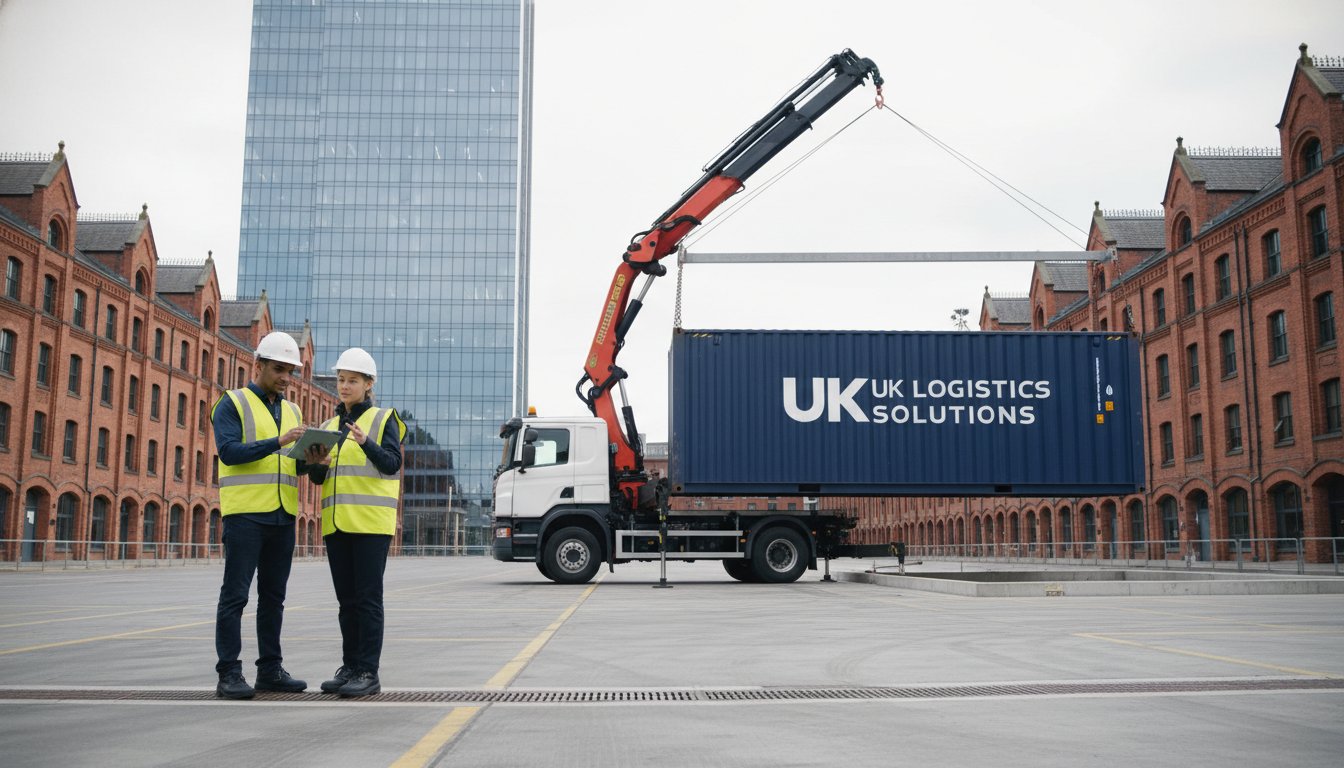
Successful delivery of Shipping Containers hinges on the final few metres of the journey. Standard flatbed haulage often falls short in the dense urban corridors of Manchester or Glasgow, where space is a premium asset. We utilise HIAB crane hire to bridge the gap between transport and precision installation. A lorry-mounted crane eliminates the need for secondary plant hire; this typically reduces total project costs by 15% for urban deployments. Precision is not a luxury. It’s a requirement for operational safety.
Stability is the foundation of long-term utility. A standard 20ft unit exerts significant point pressure at each corner. We require ground that is level to within 50mm across the entire footprint to ensure doors remain operable. Without a stable, level base, the structural integrity of the frame can shift. This leads to racking and jammed locking bars. Safety remains our primary metric. All lifts adhere strictly to LOLER 1998 regulations. In high-footfall areas like Liverpool’s Baltic Triangle, we deploy marshals and physical barriers to secure a 10-metre exclusion zone during every lift.
Tracked cranes provide the necessary solution for sites with soft ground or narrow entries that would defeat a standard 32-tonne vehicle. In 2023, 22% of our city-centre deliveries required direct coordination with local councils for temporary road closures. We don’t leave these variables to chance. A professional site survey is mandatory to identify overhead obstructions like power lines or low bridges. This foresight ensures that the delivery day proceeds without costly delays or aborted attempts. For complex urban placements in Manchester and Glasgow, our specialist container lifter services are engineered to achieve zero-damage delivery even in the most constrained site environments.
Our fleet is engineered for strategic efficiency. We maintain ADR-certified transport for clients requiring specialised Shipping Containers for hazardous goods or chemical storage. This ensures full compliance with the Carriage of Dangerous Goods Regulations. By utilising modern, Euro VI-compliant engines, we reduce site disruption and meet the stringent requirements of Manchester’s Clean Air Zone. Our operators focus on precision placement. This allows you to maximise your site footprint and maintain clear access for other essential services.
Secure your logistics strategy with a partner who understands the complexities of urban delivery. Consult with our logistics team today to schedule your professional site survey.
Bewlake doesn’t simply trade in steel; we architect strategic infrastructure. By unifying the sale and hire of shipping containers with our in-house fleet of elite HIAB logistics vehicles, we provide a seamless end-to-end service. Our family-run foundation means we approach every contract with the mindset of a trusted advisor, focusing on relationship-driven success rather than transactional volume. We currently manage a fleet that serves 150+ active sites across the UK, Ireland, and Europe. This geographic reach allows us to deliver reliability where others see complexity, ensuring your assets arrive exactly when and where they’re required.
Our commitment to excellence is reflected in our 98% client satisfaction rate. We understand that a container is often the backbone of a larger operation. Whether you’re managing a local site in Manchester or a multi-national rollout, our team provides the sophisticated oversight necessary to keep your project on track. We don’t just supply equipment; we offer a partnership built on calm reliability and technical precision.
High-stakes industries require more than standard storage. In 2023, we supported a nationwide telecoms project by engineering 45 bespoke units equipped with thermal insulation and advanced security features. For the renewables sector, we provide modular hubs that house sensitive electrical components for wind farm installations. These solutions aren’t just boxes; they’re high-performance assets. Our engineering team reduces site setup times by 25% through pre-configured internal layouts, allowing your staff to start work the moment the unit is placed. This “low stress” approach to containerised relocation ensures that your transition between sites is handled with surgical efficiency.
Determining the right container strategy requires a balance of operational need and capital preservation. Our experts guide you through the financial implications of long-term hire versus outright purchase, ensuring your choice aligns with your 2024 growth targets. We provide transparent, itemised quotes that cover everything from the shipping containers specification to the final HIAB placement on your site. To move your project forward with a partner that values precision as much as you do, contact Bewlake to organise your container solution today and let’s discuss your specific requirements. We’re ready to translate your vision into a robust, tangible reality.
Securing the right assets in Manchester, Glasgow, or Liverpool demands a blend of strategic capital and logistical precision. Choosing between new or refurbished units isn’t merely a procurement decision; it’s a commitment to long-term value creation. By leveraging our three generations of family-run expertise, you gain access to a partnership that understands the nuances of UK industrial hubs. We’ve refined our delivery process using an ultra-modern HIAB crane fleet, ensuring every one of your Shipping Containers is placed with absolute accuracy, regardless of site constraints.
Our operations remain fully ADR certified and STGO Cat 2 compliant, providing the heavy-lift capabilities required for complex site requirements. We don’t believe in one-size-fits-all models. Instead, we focus on bespoke solutions that align with your specific growth trajectory and operational demands. We’re here to ensure your infrastructure supports your ambition at every stage of the journey.
Request a Bespoke Container & Haulage Quote
We’re ready to help you build a more resilient future.
Most shipping containers are classified as temporary structures, meaning they often don’t require formal planning permission if they remain on-site for less than 28 days. However, Manchester City Council typically requires a full application if the unit is permanent or affects the visual amenity of a residential area. We recommend consulting the National Planning Policy Framework updated in December 2023 to ensure your specific site meets the current criteria for permitted development.
A 20ft unit provides 33.2 cubic metres of internal volume, while a 40ft container offers 67.5 cubic metres of space. Small-scale Manchester sites often prefer the 20ft model because it occupies just 14.8 square metres of ground area. Larger industrial projects in Liverpool benefit from the 40ft variant, which provides double the storage capacity for approximately 25% more in capital outlay. This makes the larger unit a more cost-effective solution for high-volume inventory management.
A standard HIAB crane cannot safely lift a fully loaded shipping container due to weight distribution and boom reach limitations. Most lorry-mounted cranes are rated to lift approximately 4 tonnes at a 10-metre radius, whereas a fully laden 20ft unit can exceed 24 tonnes. Attempting to lift a loaded container risks hydraulic failure and structural damage. We require all units to be empty or contain only light, secured materials before our logistics team begins the lifting process.
You must ensure the ground is level and capable of supporting a 2.2-tonne tare weight on four specific corner points. In Glasgow, where soft ground is common, we recommend 150mm thick concrete pads or railway sleepers placed under each corner. This prevents the unit from sinking and ensures the doors remain perfectly aligned for easy operation. A level base prevents the steel frame from racking, which can cause 5mm of misalignment, making the locking bars difficult to turn.
In addition to structural stability, keeping the area around your unit hygienic is essential for professional site management; for those in Lanarkshire, Scot Pooper Scoopers provides professional waste removal services to keep commercial and residential grounds clear.
Our containers feature factory-fitted lock boxes made from 6mm thick steel to shroud the padlock from bolt croppers. We provide CISA Grade 4 padlocks as standard, which are specifically designed to resist drilling and picking attempts. The 2mm thick Corten steel walls offer a high-tensile barrier against forced entry. These integrated security measures ensure your high-value assets remain protected in even the most challenging urban environments across the UK.
Delivery costs to Liverpool or Leeds typically range from £250 to £450 depending on the specific postcode and site access requirements. We calculate these fees based on a standard rate of £2.50 per mile from our nearest regional depot. If your site requires a specialised 360-degree crane arm or extended reach, an additional surcharge of £75 may apply. We provide a fixed-price quote within 24 hours to ensure your project budgeting remains precise and transparent.
You can customise your unit using any of the 250 available shades in the RAL Classic colour chart. We use high-performance marine-grade paint that provides a 10-year lifespan against corrosion and UV fading. Selecting a specific colour, such as Slate Grey (RAL 7015) or Moss Green (RAL 6005), helps the unit blend into its surroundings. This bespoke finish is applied in our controlled spray booths to ensure a professional, uniform appearance that reflects your corporate identity.
Relocating your container is a straightforward process that we manage through our specialist HIAB transport network. You must ensure the unit is completely empty and accessible for a 32-tonne vehicle to pull alongside it. We typically require 48 hours’ notice to schedule a transfer between sites in the North West or Scotland. Our team handles the lifting and securing, providing a seamless transition that maintains the continuity of your operations without the need for third-party contractors.

Leave a comment