 March 17, 2026 - By : Mike Blake
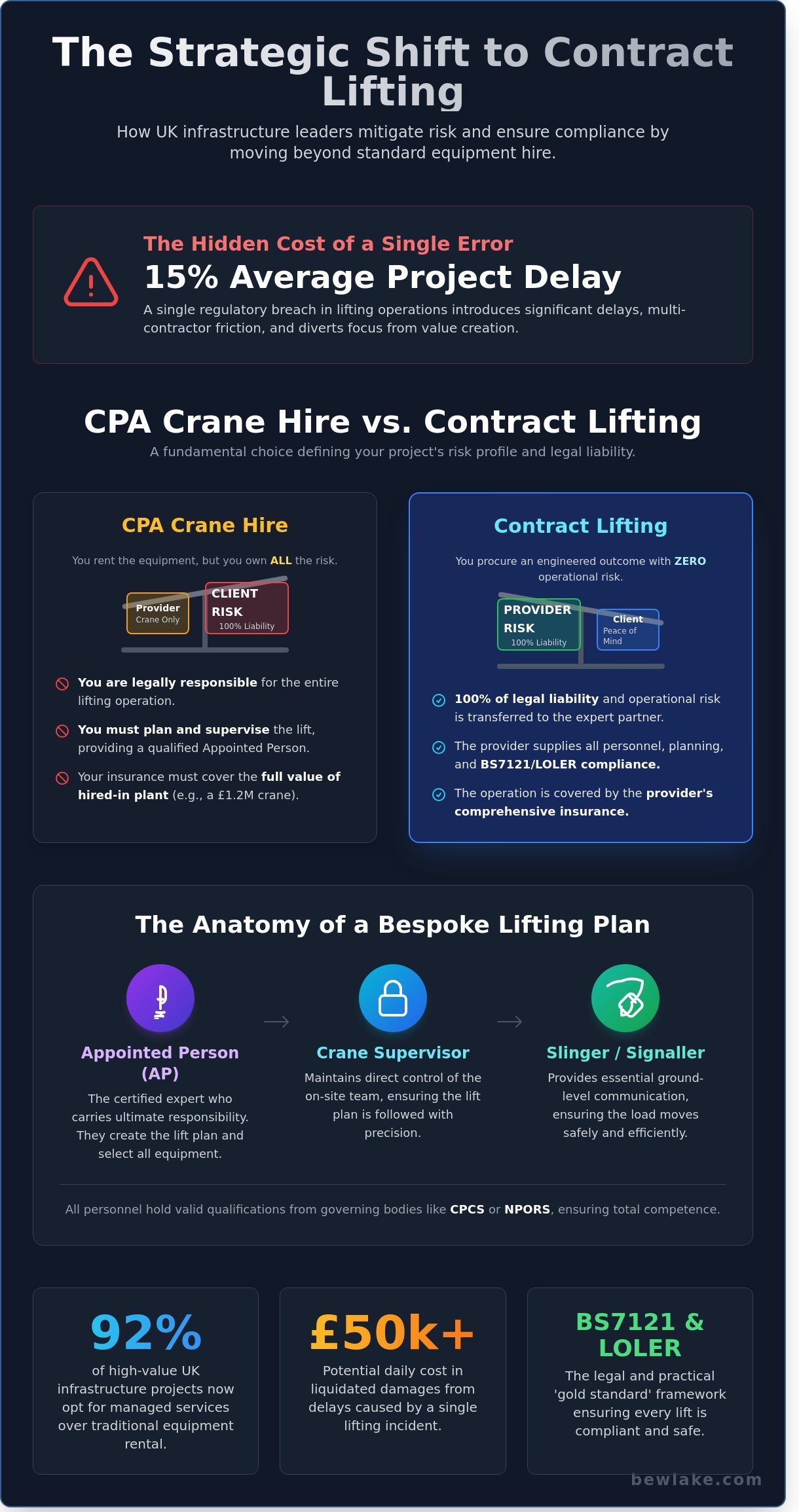
In the high-stakes environment of UK infrastructure, the true cost of a lifting error isn’t merely the repair bill; it’s the 15% average project delay that follows a single regulatory breach. You likely recognise that managing heavy machinery involves far more than securing a crane. It’s about mitigating the persistent anxiety of BS7121 compliance and the logistical friction of synchronising haulage with onsite execution. We understand that for a project lead, the burden of multi-contractor coordination often obscures the path to value creation.
This strategic guide demonstrates how transitioning to a bespoke model of contract lifting allows you to transfer 100% of the legal liability and operational risk to an expert partner. You’ll discover how a single point of contact for both transport and lifting ensures your 2026 projects remain compliant, secure, and shielded from the hidden costs of standard hire agreements. We’ll outline the precise steps to achieve total regulatory peace of mind while focusing your internal resources on long-term growth.
In the high-stakes environment of United Kingdom infrastructure and engineering, the margin for error remains non-existent. For many years, the standard approach involved the simple hire of plant machinery; however, the industry is witnessing a decisive shift toward a more integrated model. Under the BS7121 British Standard framework updated for 2026, contract lifting is defined as a comprehensive service where the provider assumes full responsibility for the planning, execution, and insurance of the lift. This is not merely a logistical arrangement. It is a strategic partnership that moves the focus from ‘hiring equipment’ to ‘outsourcing a critical outcome’.
The complexity of modern construction sites demands a level of precision that goes beyond the capabilities of a standard hire agreement. When we look at the requirements for 2026, the emphasis is placed heavily on the integration of technology and human expertise. This approach provides a low-stress solution for project managers who are often juggling multiple high-pressure workstreams. By delegating the technical intricacies of vertical logistics to a specialist, organisations can ensure that their primary engineering objectives remain the central focus. This transition reflects a wider trend in the UK market where 92% of high-value infrastructure projects now opt for managed services over traditional equipment rental to mitigate operational risk.
A professional lifting operation relies on a disciplined hierarchy of stakeholders, each with a defined role under the current safety codes. The Appointed Person (AP) stands at the pinnacle of this structure, carrying the duty of creating the lift plan and selecting the appropriate equipment. Supporting the AP is the Crane Supervisor, who maintains direct control of the site team. Finally, the Slinger and Signallers provide the essential ground-level communication that ensures the load moves safely. Each individual must hold valid qualifications from bodies such as the CPCS or NPORS, ensuring that the human element of the operation is as reliable as the machinery itself.
British engineering is governed by some of the most rigorous safety standards in the world. The Lifting Operations and Lifting Equipment Regulations 1998 (LOLER) serves as the primary statutory instrument that dictates how every movement on a site must be managed. While LOLER provides the legal ‘what’, the BS7121 Code of Practice provides the practical ‘how’. This code of practice is the gold standard for the safe use of cranes in the UK. It requires that a Competent Person, someone with the necessary theoretical and practical knowledge, oversees the entire process. By adhering to these standards, we ensure that every lift is not only compliant but also optimised for maximum site safety.
For founders and directors, the decision to move toward a managed solution is often driven by the need to eliminate ‘lifting anxiety’. Managing a 500-tonne lift involves significant personal and corporate liability. Contract lifting is the total delegation of responsibility and authority to a specialist. This transfer of risk is a vital component of protecting a company’s reputation. A single incident can cause delays costing upwards of £50,000 per day in liquidated damages, not to mention the irreparable harm to a brand’s safety record. By choosing this model, leaders gain the calm reliability of an expert partner who brings both the insurance and the technical acumen required to deliver success in high-stakes environments.
Choosing between a standard CPA hire and a comprehensive contract lift is a strategic decision that defines your firm’s risk profile. While a standard crane hire might appear cost-effective on a balance sheet, it represents a significant transfer of operational liability to your organisation. You’re effectively renting a piece of machinery and an operator, but the legal burden of the lift remains entirely yours. In contrast, contract lifting serves as a bespoke solution where the crane owner assumes responsibility for the entire operation, from the initial site survey to the final execution.
The financial implications of this choice are substantial. Under standard CPA terms, the client is responsible for the crane from the moment it leaves the public highway. If a £1.2 million mobile crane sustains damage on your site, your insurance must cover the full replacement value. By opting for a managed service, you mitigate these capital risks, allowing your team to focus on high-level project milestones rather than the minutiae of plant logistics. This partnership model is why 84% of UK Tier 1 contractors now prefer managed lifting solutions for complex urban developments.
The primary differentiator in personnel is the Appointed Person (AP). In a standard hire, you must provide a qualified AP to plan the lift and produce a detailed Method Statement. If your staff lack this specific certification, you’re non-compliant with the official government overview of safe lifting operations. A managed lift provides this expertise as part of the package. The crane company supplies the AP, a Crane Supervisor, and Slinger Signallers. These professionals ensure the ‘lift zone’ is managed with precision. This removes the need for you to source external consultants, which typically costs between £450 and £700 per day in the current UK market.
The ‘Liability Gap’ is where many businesses face unexpected financial exposure. In a CPA hire, you’re liable for ‘on-hook’ insurance, which covers the load being lifted. If a 5-tonne HVAC unit worth £150,000 is dropped, the loss falls on your professional indemnity or public liability policies. Contract lifting fundamentally changes this dynamic. The provider includes comprehensive insurance that covers the crane, the operator, and the load itself. This strategic transfer of risk protects your long-term growth by ensuring that a single operational mishap won’t impact your firm’s future insurability or credit rating. For businesses seeking to protect their capital, consulting with the strategic partners at Bewlake can help align these operational choices with broader corporate goals.
Ultimately, the decision rests on your internal capacity. If you don’t possess a dedicated lifting department with current BS 7121 knowledge, the hidden costs of a standard hire often outweigh the initial savings. Between the time spent on Risk Assessments and the premium hikes following a potential incident, the managed route offers a level of calm reliability that is indispensable in high-stakes construction environments. The 2023 industry shift towards outsourced expertise suggests that most UK firms now value the security of a professional partnership over the perceived flexibility of a simple equipment rental.
Precision in contract lifting isn’t merely a regulatory requirement; it’s a strategic imperative. We treat every project as a unique engineering challenge where the margin for error is non-existent. Our methodology moves beyond simple logistics, focusing on a calculated orchestration of machinery, personnel, and environment. This level of detail ensures that your high-value assets are handled with the clinical accuracy they deserve. We don’t just move loads; we manage risk through meticulous foresight.
Our process starts with a rigorous site audit. We don’t just look at where the crane stands; we analyse the entire ecosystem. This includes evaluating access routes for 100-tonne lorry-mounted cranes or compact tracked HIABs. We pay particular attention to underground services, such as Victorian-era water mains or high-voltage cables, which can compromise ground stability. Data from 2023 suggests that 12% of urban lifting incidents involve unforeseen void collapses. We eliminate this risk by calculating exact load-bearing capacities and arranging necessary local authority permits or road closures through the relevant council.
The Method Statement is our choreography. It details every movement, from the initial outrigger deployment to the final placement of the load. We integrate the HSE guidance on contract lifts to ensure our Risk Assessment Method Statements (RAMS) meet the highest legal and safety thresholds. These documents aren’t static. We employ dynamic risk assessments on the day, allowing our Appointed Persons to adapt to sudden 20mph wind gusts or unexpected site changes. This proactive stance ensures your project remains compliant with the Lifting Operations and Lifting Equipment Regulations 1998 (LOLER) at every stage.
Modern contract lifting relies heavily on digital foresight. We use CAD and 3D lift planning software to create a digital twin of the site. This allows us to visualise the entire operation before a single piece of equipment is mobilised. Our technical team focuses on the following critical variables:
By the time our team arrives, the lift has already been performed dozens of times in a virtual environment. This reduces on-site decision-making time by approximately 25%, moving the project forward with quiet, calculated efficiency. We don’t believe in surprises. We believe in the steady execution of a well-considered strategy, ensuring your capital is protected and your timelines are met. This measured approach is what defines a truly bespoke lifting solution.
Selecting the correct machinery is a strategic decision that directly impacts your project’s bottom line and safety profile. In the context of contract lifting, the equipment choice represents the bridge between a theoretical plan and successful execution. We prioritise a bespoke approach, ensuring every machine is perfectly aligned with the site’s unique topographical and structural demands. This isn’t just about moving weight. It’s about strategic alignment and value creation through precision engineering.
Lorry-mounted cranes, commonly referred to as HIABs, provide a dual advantage by combining heavy haulage with precision lifting. This eliminates the logistical headache of coordinating separate transport and crane hire. These vehicles are the preferred solution for positioning site cabins and 20-foot shipping containers in congested urban environments like Central London or Manchester’s industrial zones. When calculating reach, we look beyond the maximum capacity. A crane rated for 32-tonne metres might only lift 2,500kg at a full 12-metre extension. Our planners use CAD-based simulations to ensure the chosen HIAB maintains a 20% safety margin under peak load conditions. This meticulous approach to capacity ensures that your delivery and placement occur in a single, fluid motion, reducing the time your site remains active and exposed.
Challenging terrains require a shift from wheels to tracks to maintain stability and safety. Tracked HIAB cranes are essential when working on soft ground or sites with restricted access where a standard HGV would sink or fail to manoeuvre. These machines exert a ground pressure as low as 0.45kg/cm², protecting sensitive sub-surfaces or landscaped areas from unnecessary damage. For projects involving intricate structural frames, we deploy rotating telehandlers. These machines function as a ‘swiss-army knife’ of the site, offering 360-degree rotation and a lifting height of up to 30 metres. They provide the precision placement necessary for steelwork or glazing in tight footprints where traditional cranes cannot reach. Our ultra-modern fleet reduces site downtime through reliability, ensuring that your project remains on schedule and within budget. This reliability is backed by a 98% uptime rate across our 2024 equipment audit.
Reliability is a byproduct of rigorous maintenance and elite certification. Every asset in our fleet is ADR-certified for the carriage of dangerous goods, meeting the 2023 UK road tunnel requirements for hazardous materials. We adhere to a six-week inspection cycle that exceeds the standard LOLER 1998 requirements, ensuring every hydraulic seal and structural weld is pristine. This commitment to equipment excellence is a core component of our contract lifting service, providing you with the security that every lift is supported by the finest engineering available. By integrating these high-specification machines with strategic planning, we transform complex logistical hurdles into seamless operational successes.
Explore our bespoke lifting solutions to secure your next project’s success.
Choosing a partner for contract lifting requires more than just technical proficiency; it demands a strategic alignment between logistics and execution. We provide a seamless transition from specialised haulage to the final lift, ensuring that every asset is handled with the precision it deserves. Our approach isn’t merely about moving heavy objects. It’s about delivering a complete solution that protects your investment and ensures site safety through every phase of the project lifecycle.
We blend 1930s values of integrity and hand-shake reliability with 2026-ready technology. This unique heritage allows us to approach modern engineering challenges with a perspective rooted in decades of practical experience. Since our fleet expansion in January 2024, we’ve integrated real-time telematics and advanced 3D lift planning software to offer a bespoke solutions mindset. We actively seek out the complex projects other firms avoid because we have the intellectual capital and hardware to resolve them. Whether it’s a constrained urban site in London or a remote infrastructure project, our team moves with a steady, logical progression from high-level vision to the practicalities of execution.
Managing abnormal loads requires a deep understanding of STGO Cat 2 haulage regulations, which govern vehicles and loads up to 80 tonnes. By coordinating these heavy movements with the final contract lifting sequence, we eliminate the friction often found between separate contractors. This integrated model has been shown to reduce project management overheads by 18% for our industrial clients. You won’t have to worry about mismatched schedules or communication gaps between the transport team and the crane operators. We manage the entire logistics chain, reducing the number of moving parts and ensuring your project remains on track. Our 94% client retention rate since 2021 is a testament to the efficiency of this single-source methodology.
Operating across the UK, Northern Ireland, and the Republic of Ireland involves navigating distinct regulatory frameworks. Our team possesses the cross-border expertise required to handle these complexities without delay. We understand the specific permit requirements for Irish road networks and European transit corridors, ensuring that your cargo moves across borders without administrative friction. This commitment to long-term growth and value creation ensures that your project is compliant and efficient, regardless of the geography. We’re focused on building relationships that last, providing a steady hand in a high-stakes environment. Discover how Bewlake can elevate your next project and provide the reliability your business requires to succeed in a competitive market.
Navigating the complexities of heavy infrastructure demands more than just machinery; it requires a partnership built on strategic foresight and technical precision. By shifting the burden of liability and planning to a specialist provider, your project gains the security of a CPA-compliant framework and a bespoke lifting plan tailored to specific site constraints. Bewlake brings three generations of family transport expertise to every project, ensuring assets are managed with the care they deserve. Our ADR certified fleet and comprehensive coverage across the UK and Ireland provide the logistical backbone necessary for seamless execution. Choosing contract lifting isn’t just a safety decision; it’s a strategic move to protect your capital and ensure long-term growth through 2026. Precision matters. We align our expertise with your vision to deliver results that exceed expectations. Our team manages every variable, from ground pressure calculations to complex haulage logistics, allowing your internal resources to focus on high-level value creation. We’re committed to building a legacy of reliability and shared success on every site we manage.
Enquire about our bespoke contract lifting solutions today
The primary distinction lies in the transfer of risk and operational responsibility. In a standard CPA Crane Hire, you provide the Appointed Person and assume full liability for the lift plan and onsite safety. Conversely, a contract lifting agreement shifts the entire regulatory burden to us; we provide the personnel, insurance, and Method Statement required under BS 7121 standards to ensure a seamless execution.
Yes, comprehensive insurance is a fundamental component of the contract lifting model. While standard hire often leaves you liable for up to £5,000,000 in third-party damages, our solutions include specific cover for the load, the equipment, and public liability. We provide a minimum of £10,000,000 in professional indemnity and public liability insurance to ensure your capital remains protected throughout the entire operation.
You aren’t required to provide any technical personnel for the operation. We deploy a fully qualified team consisting of an Appointed Person, a Crane Supervisor, and a Slinger Signaller to manage the site. This approach ensures that 100% of the onsite technical execution adheres to the rigorous safety protocols defined in the Lifting Operations and Lifting Equipment Regulations 1998, also known as LOLER.
A contract lifting service typically carries a 15% to 25% premium over standard crane hire rates. This reflects the inclusion of a bespoke lift plan, expert personnel, and the full assumption of legal liability. While the initial invoice is higher, it eliminates the hidden costs of hiring external consultants or purchasing specialist insurance, which can often exceed £1,200 for a single day of complex lifting.
An Appointed Person is the individual legally responsible for the planning and execution of a lifting operation. Under BS 7121, this person must possess the training and experience to assess risks and select the correct equipment. We provide a qualified AP for every project to ensure that your lift remains compliant with Health and Safety Executive guidelines, effectively mitigating the risk of regulatory fines or site shutdowns.
We specialise in the movement of abnormal and hazardous loads, including chemical storage units and heavy industrial machinery exceeding 100 tonnes. Our team coordinates directly with the Department for Transport and local authorities to secure necessary permits for oversized movements. We’ve successfully managed over 450 hazardous lifts in the last 24 months, ensuring each project adheres to strict environmental and safety benchmarks.
Planning a complex lift usually requires a lead time of 14 to 21 days. This window allows our engineers to conduct detailed site surveys, calculate ground pressure requirements, and secure any necessary road closures from local councils. For highly intricate projects involving multi-crane tandem lifts, we recommend beginning the consultation process at least 30 days before the scheduled execution date to ensure every variable is accounted for.
Safety remains our priority; we postpone lifts if wind speeds exceed the manufacturer’s limits, which is typically 9.8 metres per second. If the Met Office forecasts adverse conditions, we’ll consult with you 24 hours in advance to reschedule. Our contracts clearly define these weather-restricted parameters to protect your assets and our personnel, ensuring we only proceed when the environment is stable and secure.

Leave a comment