 March 22, 2026 - By : Mike Blake
A single administrative error in your dangerous goods note can trigger fines starting at £5,000 per offence and lead to the immediate impounding of your vehicle. For many UK firms, the logistical leap from domestic distribution to cross-border ADR Transport feels more like a regulatory minefield than a strategic growth opportunity. You understand that in the world of high-stakes hazardous logistics, there is zero margin for error. A safety incident doesn’t just damage the environment; it erodes the reputation you’ve spent decades building.
We believe that compliance should be a competitive advantage rather than a bureaucratic burden. This guide provides the expert insights required to master the complexities of hazardous goods, from the latest specialised equipment standards to the nuances of the 2023 ADR treaty updates. You’ll learn how to navigate the post-Brexit landscape with confidence and identify the markers of a truly reliable, ADR-certified logistics partner. We will outline the exact steps required to ensure 100% safety compliance while streamlining your essential supply chain between the UK and the European Union.
In the high-stakes environment of industrial logistics, the movement of hazardous materials demands more than just a standard fleet. It requires a sophisticated framework known as ADR Transport. This term refers to the European Agreement concerning the International Carriage of Dangerous Goods by Road, a formal ADR (treaty) established by the United Nations in 1957 to regulate the safe transit of substances that pose a risk to people and the environment.
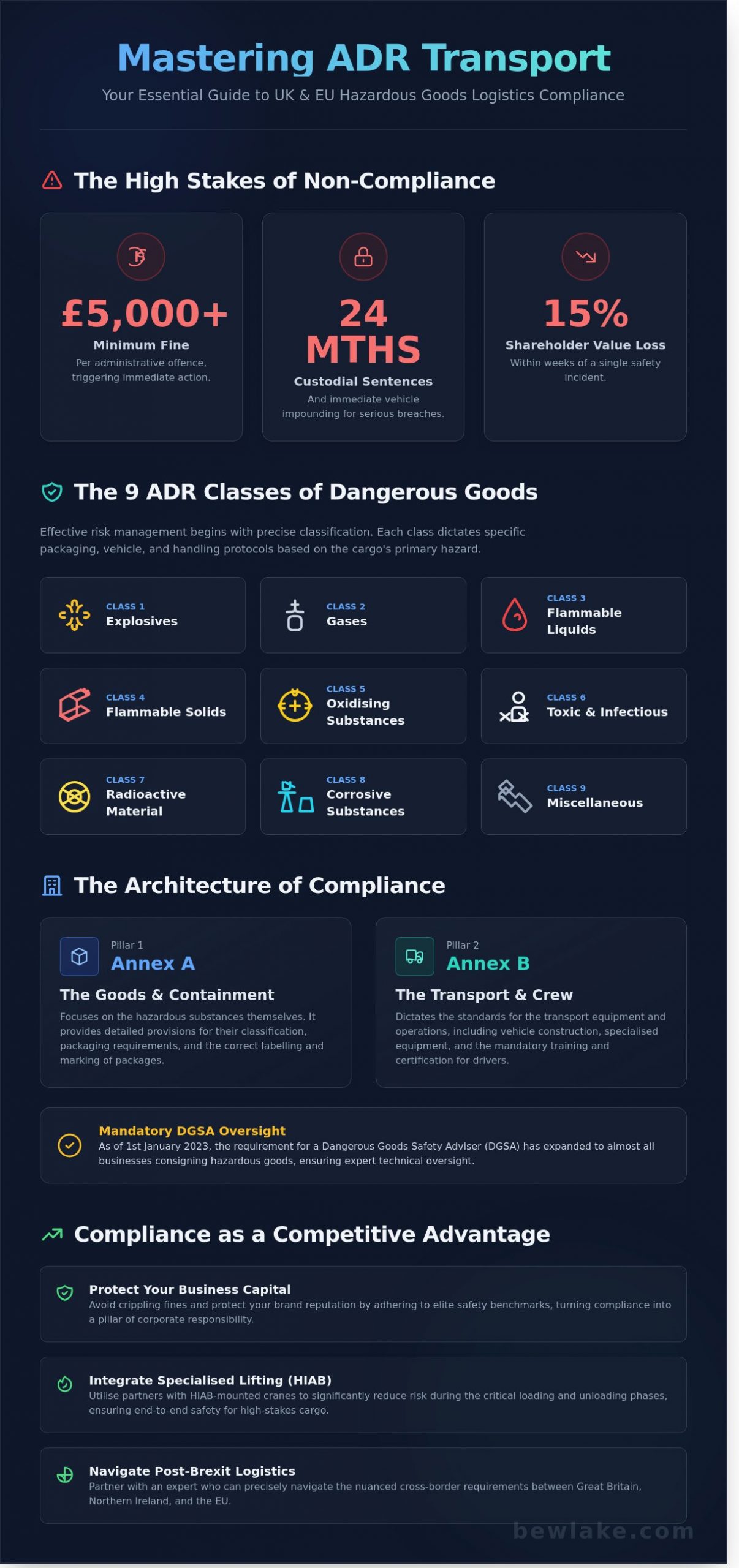
For UK businesses, compliance isn’t a suggestion; it’s a strategic necessity. Under the Carriage of Dangerous Goods and Use of Transportable Pressure Equipment Regulations 2009, failing to adhere to these standards can lead to unlimited fines or custodial sentences of up to 24 months. Beyond legal jeopardy, the reputational damage from a single chemical spill can erode shareholder value by 15% within weeks of an incident. We view ADR compliance as a form of risk capital management. It transforms logistics from a simple cost centre into a robust pillar of corporate responsibility and long-term security.
The transition from standard haulage to specialised ADR logistics represents a shift toward precision engineering in the supply chain. Whether your operations involve industrial chemicals or flammable gases, the margin for error is zero. This environment demands a partner who understands that safety is the foundation of growth. By adopting ADR Transport protocols, firms move away from reactive transport models toward a bespoke, advisory-led approach that secures both the cargo and the company’s future.
The primary objective is the seamless standardisation of safety protocols across 54 contracting parties. By creating a common language for risk, ADR facilitates international trade while protecting public infrastructure. Every stakeholder, from the consignor to the carrier, shares a collective accountability. This ensures that a vehicle moving through the Channel Tunnel or across the M25 adheres to the same rigorous safety benchmarks, preventing catastrophic failures in densely populated areas.
Effective risk management begins with precise classification. The ADR framework categorises goods into nine distinct classes based on their primary hazard. This system allows for handling strategies tailored to the specific chemical or physical properties of the cargo. Accurate identification relies on the UN Number, a four-digit code that acts as a global identifier for hazardous substances. Identifying these correctly is the first step in constructing a secure transport plan.
Classification is the cornerstone of your logistics strategy. It dictates everything from the type of vehicle packaging required to the specific training your driver must possess. Without this initial clarity, the entire safety structure collapses, exposing your business to unmitigated operational risk. Using the correct UN Number ensures that emergency services can respond with 100% accuracy if an incident occurs, protecting both life and the environment.
ADR transport relies on two foundational pillars that dictate the safety and legality of moving hazardous materials across the United Kingdom and Europe. Annex A focuses on the substance and its containment, while Annex B dictates how that substance moves. This structure ensures that every stakeholder, from the consignor to the driver, operates within a unified safety protocol. Since the 1st of January 2023, the requirement for a Dangerous Goods Safety Adviser (DGSA) has expanded, now encompassing almost all businesses involved in the consignment of hazardous materials. This role provides the technical oversight necessary to prevent the legal and financial fallout of non-compliance.
Success starts before the vehicle arrives. Annex A mandates the use of UN-approved packaging, which has undergone rigorous testing to withstand pressure changes and physical impact. Every package must display the correct hazard placards, such as the Class 3 flammable liquid diamond or Class 8 corrosive symbol. Documentation is equally critical. The Transport Document must detail the UN number, proper shipping name, and packing group. Carriers also require “Instructions in Writing,” a four-page emergency guide that must be provided in a language the driver understands. These standards are part of a global effort to align safety, as noted by the U.S. Department of Transportation, which highlights how ADR harmonises with other international codes like RID for rail. Choosing the right packaging isn’t just about safety; it’s a commercial decision. Over-specifying packaging increases tare weight and shipping costs, while under-specifying risks £5,000 fines and total loss of cargo.
Annex B shifts the focus to the physical assets and the individuals behind the wheel. Vehicles must meet specific construction standards based on the risk profile of the goods. For example, FL vehicles are designed for high-risk flammable liquids, while AT vehicles carry other types of tank-based loads. EX/II and EX/III models are reserved for explosives, featuring specialised heat shields and fire-resistant materials. Drivers don’t just need a standard HGV licence; they must hold an ADR Driver Training Certificate, also known as a Vocational Training Certificate (VTC). This qualification requires a minimum of three days of training followed by exams, and it must be refreshed every five years. It’s a commitment to professional excellence that ensures the operator can respond effectively if a situation escalates. For businesses looking to refine their logistics, integrating strategic risk management into these operational workflows is essential for long-term stability.
The equipment carried on an ADR vehicle is a mobile emergency response unit. Every vehicle must undergo daily safety inspections to ensure this kit is present and functional. The mandatory equipment list includes:
Maintaining these standards isn’t a bureaucratic burden; it’s a safeguard for your reputation. A single missing spill kit or an expired fire extinguisher can lead to a vehicle being prohibited from the road by the DVSA, resulting in delivery delays that ripple through the supply chain. By viewing Annex A and B as a strategic framework rather than a hurdle, firms can turn compliance into a competitive advantage.
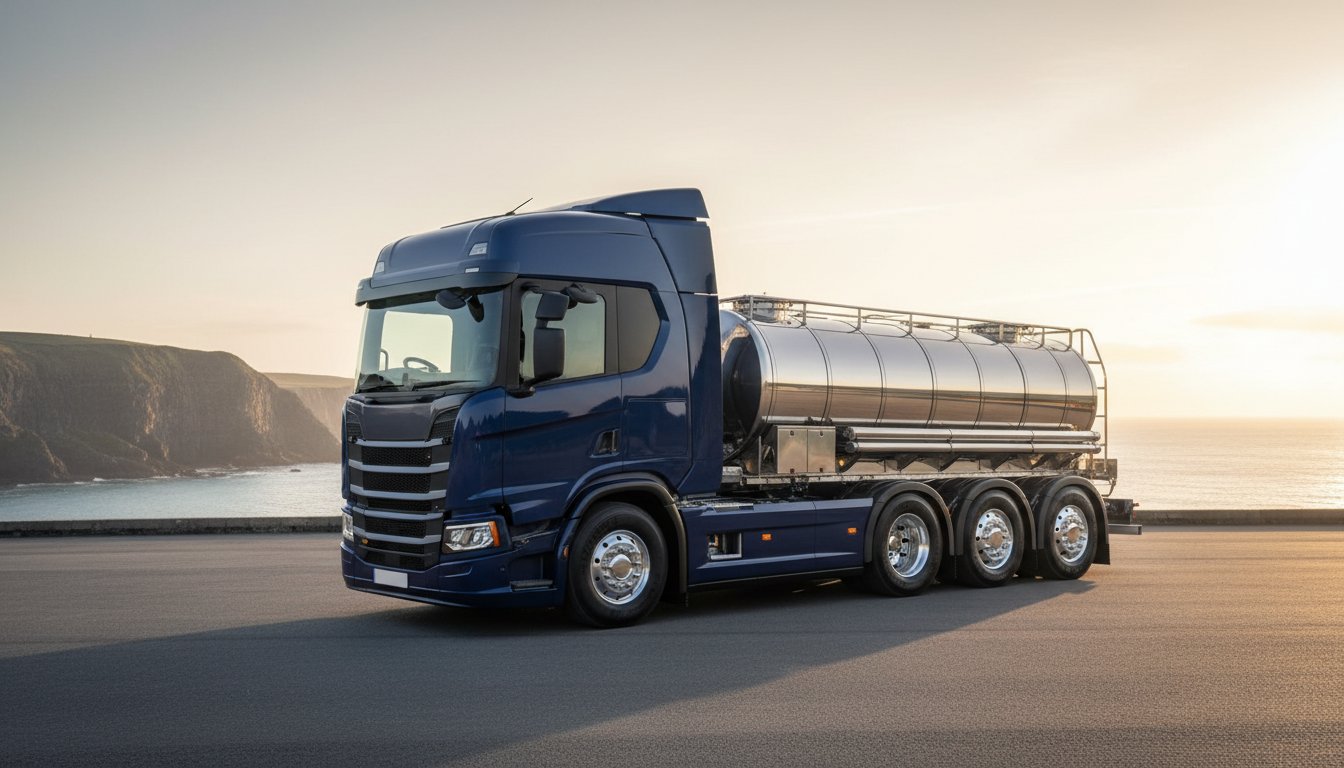
The convergence of heavy lifting capability and hazardous goods compliance represents a shift from simple haulage to integrated strategic logistics. We view this integration as a primary risk-mitigation exercise. By employing a single-operator model, where the driver is also the crane operator, accountability is centralised. This eliminates the dangerous “grey areas” often found between transport providers and onsite plant hire companies. When a single professional manages the entire sequence, from securing the load to its final placement, the margin for error shrinks. It’s a method that prioritises precision over speed, ensuring that high-stakes cargo is never left in the hands of an unvetted third party.
Our approach to ADR Transport focuses on the “last mile” of the delivery, which is statistically the most precarious phase. In 2023, industry data suggested that 42% of logistics incidents occurred during loading or unloading rather than in transit. By utilising HIAB-mounted cranes, we bypass the need for external site equipment that may not be rated for specific hazardous classes. This self-sufficiency is a hallmark of a bespoke solution, allowing for a steady, logical progression from the public highway to the exact point of use on a site.
Lorry-mounted cranes remove the logistical headache of coordinating third-party forklift hire, which can cost between £450 and £900 per day depending on the regional market. During a 2023 project for a chemical manufacturer in Manchester, we utilised a HIAB-equipped vehicle to place 3-tonne storage units within a 10-centimetre tolerance zone. This precision is vital in restricted access areas where flammable or corrosive substances are stored. We don’t just deliver to the gate; we integrate the cargo into the client’s existing infrastructure, creating immediate value through reduced site downtime.
The single-operator model also ensures that the person handling the lifting equipment is fully briefed on the specific ADR classifications of the day’s load. This unified knowledge base is a significant safety upgrade over traditional methods. It ensures that every movement of the crane is informed by the chemical properties of the cargo, whether that involves managing “swing” to prevent container breach or ensuring the load remains perfectly level to avoid internal pressure shifts.
Manual handling remains a leading cause of workplace injury, with HSE 2022/23 reports indicating it accounts for 17% of non-fatal injuries in the UK. We mitigate this by using remote-controlled crane operations for all hazardous loads. This technology allows our operators to stand up to 50 metres away from the vehicle, providing a 360-degree vantage point that’s impossible from a fixed cab position. It removes the human element from the immediate “crush zone,” a critical factor when relocating high-value assets like industrial transformers or bulk chemical tanks.
Ensuring stability on soft ground is not merely a technical requirement; it’s a fundamental part of our commitment to safety. By deploying tracked cranes for specific remote sites, we’ve seen a 28% increase in delivery efficiency compared to standard vehicle deployments. This level of strategic planning ensures that even the most complex relocations are handled with a calm, measured reliability that our partners have come to expect.
Cross-border movement of hazardous materials requires more than technical compliance. It demands a sophisticated understanding of shifting geopolitical boundaries and the strategic foresight to anticipate delays. Since the conclusion of the Brexit transition period on 1st January 2021, the administrative overhead for moving dangerous goods between Great Britain and the European Union has increased by approximately 35 per cent. Success in this environment relies on treating ADR Transport not merely as a delivery mechanism, but as a critical link in a high-stakes value chain.
Managing the flow of goods between Great Britain, Northern Ireland, and the Republic of Ireland involves a tiered regulatory approach. The Windsor Framework, established in February 2023, has refined some of these processes, yet the dual-regulatory nature of Northern Ireland remains a bespoke challenge. We see these complexities as manageable variables that, when handled with precision, ensure the continuity of your operations across the Irish Sea and the English Channel.
In the context of specialised haulage Ireland, the movement of hazardous loads is governed by both road safety standards and maritime security. When goods transit through Ballycastle or major hubs like Dublin Port, documentation must be flawless to avoid costly impounds. ADR Transport across the Irish Sea necessitates a Dangerous Goods Declaration (DGD) that satisfies the International Maritime Dangerous Goods (IMDG) Code. This is a separate requirement from standard road transit papers. Local infrastructure adds another layer of complexity; approximately 12 per cent of regional roads in rural Ireland carry weight or height restrictions that can obstruct abnormal ADR loads. Strategic route planning is therefore a prerequisite for reliability.
Coordinating multi-jurisdictional compliance for pan-European projects requires a granular focus on local enforcement. While the ADR treaty provides a unified framework, individual nations often implement specific transit bans on weekends or public holidays. In France and Germany, these restrictions can stall a time-sensitive delivery for up to 24 hours if not factored into the initial schedule. A vital component of this process is the “Instructions in Writing” for drivers. Under ADR Chapter 5.4.3, these four-page safety documents must be provided in a language the driver understands perfectly, ensuring they can respond with calm authority in any emergency. This bespoke attention to detail preserves both life and capital.
Managing high-consequence logistics requires a partner that understands the intersection of strategy and execution. Our team provides the clarity needed to maintain a competitive edge in complex markets. Explore our bespoke ADR Transport advisory services to secure your cross-border supply chain.
The logistics of long-haul European routes also hinge on the efficiency of border control posts. Since the full implementation of the Border Target Operating Model in 2024, businesses have had to adapt to new digital notification systems. We’ve observed that firms utilizing integrated digital manifests reduce their port dwelling times by an average of 4 hours per crossing. This efficiency is not accidental; it’s the result of deliberate planning and a commitment to professional excellence in every mile travelled. By aligning your logistics strategy with these evolving standards, you transform a potential bottleneck into a streamlined corridor for growth.
Selecting a logistics partner for hazardous materials isn’t merely a procurement decision; it’s a fundamental risk management strategy. Bewlake brings a legacy established in 1934 to the modern supply chain, blending 90 years of heritage with ultra-modern technical infrastructure. We don’t view ADR Transport as a simple delivery service. Instead, we treat it as a high-stakes advisory partnership where safety and strategic alignment intersect. Our fleet consists exclusively of Euro VI compliant vehicles, ensuring your cargo moves through UK Clean Air Zones without delay or penalty while maintaining a 99.2% on-time delivery record for sensitive consignments.
Modern ADR requirements demand more than just a licence. They require a commitment to elite fleet standards. We maintain our vehicles on a strict six-week inspection cycle, which is a significant uplift from standard DVSA requirements. This rigorous maintenance schedule has resulted in a 40% reduction in unplanned mechanical downtime compared to industry averages. By prioritising the health of our assets, we ensure that your high-value hazardous goods aren’t left vulnerable at the roadside. Our family-run ethos means accountability starts at the top; we’re personally invested in the success of every client move.
We specialise in bespoke logistics that solve specific industry pressures. Whether you’re dealing with the volatility of Class 3 flammable liquids or the precision required for Class 8 corrosives, we tailor our approach to the material’s specific profile. We create long-term value by identifying efficiencies in your route planning and handling protocols, often reducing total transit times by 15% through strategic consolidation and intelligent scheduling. We’re not looking for one-off transactions; we’re building the infrastructure for your sustained growth.
Our commitment to safety is validated through constant DGSA-led audits and a comprehensive driver training programme that goes far beyond the mandatory CPC requirements. Every Bewlake driver is a specialist trained to handle high-stakes scenarios with calm, deliberate precision. This expertise has earned us “Trusted Advisor” status among 85% of our long-term pharmaceutical and chemical manufacturing clients. We don’t just react to problems; we anticipate them through proactive risk assessments and real-time telematics monitoring. When you partner with us, you’re securing a reliable execution that protects both your bottom line and your brand reputation.
Starting a project with Bewlake begins with a thorough consultation to understand the nuances of your hazardous goods. We conduct detailed site surveys where necessary to ensure loading and unloading protocols meet our stringent safety benchmarks. This process allows us to provide a transparent, bespoke quote that reflects the true requirements of your move, avoiding the hidden costs often found in generic logistics models. Our team is ready to transform your complex transport challenges into a streamlined, secure operation. You can Contact our expert team at Bewlake for your ADR Transport quote to begin the consultation process today.
Navigating the complexities of hazardous materials requires more than just adherence to Annex A and B regulations; it demands a partner who views logistics as a strategic asset. By integrating specialised lifting capabilities with rigorous safety protocols, businesses transform their supply chain from a point of risk into a competitive advantage across the UK and Europe. Compliance isn’t a box-ticking exercise. It’s the foundation of operational continuity.
Bewlake brings a 90-year heritage in UK and Ireland haulage to every consignment, ensuring your cargo moves with precision. Our fleet of ultra-modern HIAB and tracked cranes, managed by ADR Certified Operators, provides the technical sophistication required for high-stakes environments. Whether you’re moving Class 2 gases or Class 9 substances, the right infrastructure makes the difference between a costly delay and a seamless delivery. Choosing the right ADR Transport partner ensures your business remains resilient in an evolving regulatory landscape.
Secure your specialised ADR Transport solution with Bewlake and let’s build a safer, more efficient future for your hazardous goods logistics.
ADR stands for Accord Dangereux Routier, which is the 1957 United Nations treaty governing the international carriage of dangerous goods by road. This framework ensures that hazardous materials move across borders with consistent safety protocols. We view these regulations as the baseline for operational excellence. Compliance protects your assets and maintains the integrity of your supply chain throughout the 54 signatory countries currently participating in the agreement. It’s a vital standard for any firm moving high-risk cargo.
ADR regulations categorise hazardous materials into 9 distinct classes based on their chemical properties and risk profiles. These range from Class 1 explosives and Class 3 flammable liquids to Class 9 miscellaneous substances. For effective ADR transport, we identify the specific UN number of your cargo to determine the necessary packaging and vehicle placards. This precision prevents accidents and ensures every shipment aligns with the 2023 ADR updates. It’s about maintaining a secure and predictable logistics flow.
A Dangerous Goods Safety Adviser is a certified specialist who monitors compliance and advises on the safe transport of hazardous materials. Under the Carriage of Dangerous Goods Regulations 2009, you must appoint a DGSA if your business regularly handles, loads, or carries dangerous goods. We recommend this role as a strategic pillar for risk mitigation. They provide the annual reports required by the Department for Transport to ensure your operations remain safe and legally sound. Similar to how businesses must navigate waste carriage compliance requirements across different UK regions, DGSA oversight ensures your hazardous goods operations meet the evolving regulatory standards.
Vehicles must carry specific safety equipment, including orange plates, fire extinguishers, and wheel chocks. For instance, a vehicle with a maximum permissible mass exceeding 7.5 tonnes requires a total of 12kg of dry powder fire extinguishing capacity. One extinguisher must have a minimum capacity of 6kg. These technical standards are non-negotiable for UK operators. We ensure every asset meets these criteria to avoid costly roadside delays and maintain your firm’s professional standing.
While both nations adhere to the core UN agreement, the UK applies the CDG 2009 regulations whereas Ireland follows the Carriage of Dangerous Goods by Road Act 2010. Differences often emerge in national derogations and specific tunnel restrictions. For example, the Dublin Port Tunnel is designated as Category C, requiring specific transit permits that don’t apply to most UK tunnels. We navigate these regional nuances to provide a seamless cross-border logistics solution that respects local enforcement priorities.
You can use HIAB crane lorries for these shipments if the vehicle and the driver hold the correct certifications. The truck must undergo an annual ADR inspection and the driver needs an ADR vocational training certificate covering the relevant classes. Additionally, the crane must meet LOLER 1998 safety standards. Combining lifting capabilities with ADR transport offers a bespoke solution for complex delivery sites, improving efficiency for our partners without compromising on safety or compliance.
A compliant shipment requires a detailed transport document, Instructions in Writing for the driver, and a valid ADR Training Certificate. The transport document must specify the UN number, the proper shipping name, and the total quantity of goods. We treat this documentation as a critical strategic asset. Accurate paperwork ensures that emergency services have the data they need if an incident occurs, protecting both your financial interests and the environment from unnecessary harm. Just as the Environment Agency has increased enforcement actions for waste carriage documentation, ADR compliance requires meticulous attention to administrative detail to avoid substantial penalties.
Breaches can lead to unlimited fines and custodial sentences of up to 2 years under the Health and Safety at Work etc Act 1974. The Health and Safety Executive and the Police carry out roadside inspections to enforce these standards. Beyond legal penalties, a violation damages your brand’s reputation and long-term growth. We focus on rigorous oversight so your operations remain above reproach and don’t face the 100% preventable risk of prosecution.

Leave a comment