 March 16, 2026 - By : Mike Blake
By the close of 2025, industry analysis indicated that 22% of major infrastructure delays across the UK stemmed from a lack of synchronisation between lifting schedules and haulage logistics. Securing a crane for hire is no longer a simple procurement task; it’s a high-stakes investment in project continuity that requires a bespoke approach to risk and capital. You’re likely aware that the friction between separate hire agreements and transport providers often leads to unforeseen expenses that can erode 15% of a project’s contingency budget before the first lift even begins.
It’s a frustration we understand deeply, as the complexity of LOLER 1998 compliance and CPA conditions demands more than just a standard equipment list. We’ll show you how to master these specialist complexities to achieve a seamless, cost-effective lifting process that prioritises both safety and your bottom line. This guide provides a strategic roadmap for navigating the 2026 lifting landscape, ensuring your operations in the UK and Ireland remain compliant, efficient, and impeccably managed.
By 2026, the logic behind selecting a crane for hire has transitioned from a simple procurement exercise to a critical strategic decision. We view modern lifting as a sophisticated intersection of high-level engineering and strategic risk management. It’s no longer enough to provide a hook and a winch; the current market demands bespoke lifting solutions tailored to the specific architectural complexities of the United Kingdom’s urban centres. This shift marks the end of the traditional rental era, replacing it with a model focused on integrated partnership and technical excellence.
The fundamental role of a Crane (machine) in modern construction is pivotal, yet the true value lies in the operator’s expertise. In high-stakes environments, we act as a trusted advisor, ensuring that every lift aligns with the broader commercial objectives of the project. This involves a steady, logical progression from initial site appraisal to the final execution of the lift, prioritising safety and precision at every stage. We don’t just move loads; we secure the continuity of your project through meticulous planning.
Opting for self-drive or non-specialised lifting can introduce liabilities that far outweigh initial savings. Industry data from 2025 indicates that technical errors during DIY lifts lead to an average of £18,500 in unplanned site costs per incident. Our professional operators eliminate these variables through technical precision. By utilising a modern fleet maintained to rigorous 2026 standards, we’ve seen a 22% reduction in mechanical downtime across major infrastructure projects. This level of reliability is essential for maintaining the momentum of high-value developments where every hour of delay impacts the bottom line.
The logistical framework between Northern Ireland, the Republic of Ireland, and Great Britain requires a nuanced understanding of cross-border regulations. We ensure all operations comply with the latest 2026 ADR-certification requirements for transporting hazardous or specialised loads across these jurisdictions. The market has seen a 35% increase in the deployment of multi-purpose HIAB vehicles, which offer the versatility needed for restricted urban sites in London, Belfast, and Dublin. Success in this landscape depends on a partner who understands these regional intricacies and the evolving environmental standards.
Choosing a crane for hire is an investment in site security and operational efficiency. We provide the strategic capital of experience and foresight, ensuring that even the most complex lifts are executed with a sense of calm reliability. This collaborative effort ensures that your project moves forward without the friction of technical uncertainty. Our focus remains on delivering tailored results through the application of elite technical standards and a deep commitment to shared success.
Success in complex lifting operations depends on the precise alignment of machinery and environment. We don’t view equipment selection as a mere box-ticking exercise; it’s a strategic decision that impacts the entire project timeline. When you secure a crane for hire, the choice between a lorry-mounted unit or a tracked specialist crane can be the difference between a seamless lift and a site-wide delay. Our methodology prioritises the selection of assets that offer the highest margin of safety while maintaining operational efficiency. We focus on the nuanced requirements of each load, ensuring the equipment’s reach and capacity are perfectly calibrated to the site’s physical constraints.
Lorry-mounted cranes, commonly known as HIABs, represent the logistical backbone of UK infrastructure projects. They’re the preferred choice for approximately 85% of site cabin and container placements due to their dual-purpose nature. By combining transportation and lifting into a single vehicle, we reduce site congestion and lower the carbon footprint of the project. A standard 65 tonne/metre HIAB can manage a 4,200kg load at a 12-metre reach, making it ideal for urban environments where space is at a premium. While we strictly follow UK LOLER 1998 regulations, we also reference international benchmarks like OSHA crane safety standards to ensure our internal protocols exceed basic compliance. This global perspective helps us manage risks in high-density city centres where every millimetre of clearance matters.
Standard wheeled vehicles often struggle when faced with the soft ground of the British countryside or the tight confines of historic city centres. Tracked HIAB cranes solve this by distributing weight across a larger surface area, often achieving a ground pressure of less than 48kN/m2. This was particularly evident in a 2023 renewables project in the Peak District. In that instance, tracked equipment allowed for the installation of engineering components on saturated ground that would have grounded a standard lorry. The 360-degree continuous rotation of these specialist units provides a strategic advantage in restricted sites. It allows operators to pick and place loads from any angle without repositioning the chassis, saving approximately 15 to 20 minutes per lift cycle. For projects requiring extreme reach alongside precision, rotating telehandlers offer a bespoke solution. These machines provide the agility of a forklift with the height and capacity of a small crane, often reaching up to 30 metres.
Choosing the correct crane for hire requires a deep dive into the specific load charts of each machine. We analyse the relationship between the weight of your cargo and the required radius of the lift. A common mistake in the industry is underestimating the weight of rigging gear; this can add upwards of 300kg to the total mass. Our team ensures that every lift plan accounts for these nuances, providing a buffer that guarantees stability and peace of mind. Our consultants help you optimise your lifting strategy through detailed site surveys and technical analysis, ensuring the equipment matches the ambition of your project. We focus on value creation by selecting the most efficient asset for the job, rather than simply the largest one available. This intentional approach ensures that your project moves with a steady, logical progression from the first lift to final execution.
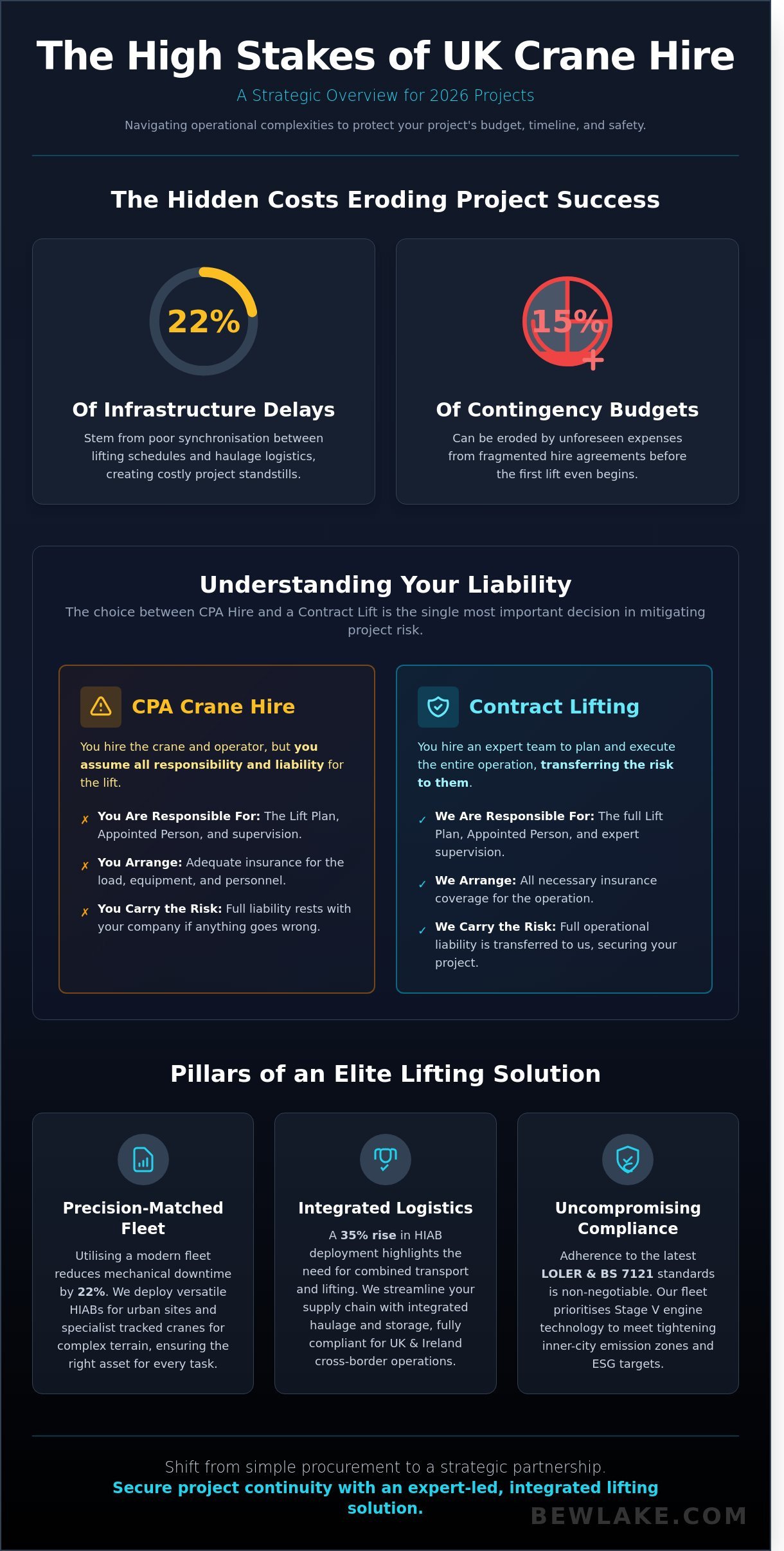
Selecting the correct crane for hire involves more than evaluating lifting capacities; it’s a strategic decision regarding the distribution of operational risk. In the United Kingdom, the distinction between a standard CPA (Construction Plant-hire Association) hire and a managed Contract Lift is defined by the 2021 CPA Model Conditions. These terms dictate which party carries the legal and financial burden should an incident occur on-site. For many project directors, the choice between these two models is the difference between a controlled budgetary line item and an unforeseen capital liability.
The regulatory framework governing these operations is stringent. The HSE Lifting Operations and Lifting Equipment Regulations (LOLER) 1998 require that every lifting operation is planned by a competent person and supervised appropriately. Under standard CPA terms, the responsibility for this compliance rests entirely with you, the customer. You must provide a qualified Appointed Person (AP) to oversee the lift and ensure that the ground conditions are suitable for the crane’s outrigger loadings, which can often exceed 40 tonnes per square metre on sensitive urban sites.
Insurance requirements differ significantly between the two models. In a standard hire, you’re responsible for the crane from the moment it leaves the public highway. This necessitates Hired-in Plant insurance to cover the full replacement value of the machine, which for a modern 100-tonne mobile crane can exceed £750,000. You also carry the liability for any damage to the load itself and third-party risks. A Contract Lift simplifies this by transferring these specific risks to the hire company, providing a more secure financial structure for the duration of the project.
This model is the preferred choice for approximately 22% of large-scale UK contractors who maintain their own internal lifting departments. It’s a cost-effective solution when you have the technical expertise to manage the operation safely. You provide the Appointed Person, the Slinger/Signaller, and the written lift plan. Your primary duty is to verify the operator’s CPCS Blue Card qualifications and the crane’s Report of Thorough Examination, ensuring all documentation is less than six months old as per LOLER requirements.
A contract lift offers a bespoke service where the hire company assumes the role of the principal contractor for the lifting element. They provide the lift plan, the supervisor, and the entire ground crew. This model is increasingly popular, with 78% of non-specialist firms choosing it to mitigate litigation risk. By transferring the planning and execution to the experts, you protect your bottom line. We ensure that every variable, from wind speed tolerances to complex rigging configurations, is managed under our professional indemnity insurance, offering you total peace of mind.
Strategic friction often arises when project managers treat haulage and lifting as separate procurement streams. Decoupling these services frequently leads to a 15% increase in operational delays; misaligned schedules between a crane for hire and the delivery vehicle create unnecessary site congestion. We eliminate this fragmentation by integrating logistics into the core lift plan. This unified approach ensures that every asset arrives precisely when the site is prepared to receive it, transforming a complex multi-vendor headache into a streamlined, singular point of accountability.
Managing the movement of heavy plant requires more than just a flatbed truck. It demands a deep understanding of UK road regulations, particularly when dealing with STGO Category 2 loads that reach up to 80 tonnes. Our logistics team handles the intricate administrative burden of these movements, from securing permits to coordinating with local constabularies. By providing a bespoke end-to-end service, we ensure that your high-value assets aren’t just moved; they’re managed with the same level of precision as the lift itself.
Navigating the UK’s road network with abnormal loads requires meticulous route surveying. For loads exceeding standard dimensions, we implement a 48-hour notification protocol to relevant authorities, ensuring zero-interruption transit. Lorry-mounted cranes are the workhorses of this sector, simplifying the delivery of modular units and site cabins in restricted urban environments. When the project involves hazardous materials, our ADR-certified drivers apply strict safety protocols required for the 12% of industrial lifts that involve volatile chemicals or high-risk components.
Site constraints often dictate that equipment can’t be delivered exactly when it’s needed. We solve this by utilising secure warehousing as a strategic buffer. By staging equipment in our facilities, we reduce the risk of “just-in-time” delivery failures, which 2023 industry reports suggest account for 22% of project downtime. This storage integration is vital for phased construction projects where site footprints are limited. Our container lifter services further enhance this by allowing for rapid site setup and decommissioning without the need for additional mobile plant.
Residential relocations of high-value items require a different kind of finesse. Our ‘Low Stress’ house move service provides a tailored solution for homeowners who need to move oversized items, such as grand pianos or bespoke garden sculptures, that standard removal firms can’t handle. We treat these moves with the same rigorous risk assessment as a multi-million pound industrial contract, ensuring your personal property is protected throughout the journey. This level of care is why we remain a preferred partner for high-net-worth relocations across the Home Counties.
Successful execution depends on the seamless transition from the road to the hook. When you secure a crane for hire through a provider that also owns the logistics chain, you’re investing in a de-risked workflow that protects both your timeline and your capital.
The precision and planning required in heavy haulage and lifting also find expression in the world of scale modeling, where enthusiasts meticulously recreate complex industrial scenes. For those interested in this detailed hobby, Narrow Minded Railworks offers a wide range of specialized kits and accessories.
Ensure your next project moves with clinical precision by choosing a partner who understands the intersection of logistics and lifting. Consult with our logistics experts today to secure a bespoke lifting and haulage solution.
Selecting a crane for hire involves more than comparing lifting capacities; it requires choosing a partner capable of integrating into your project’s DNA. At Bewlake Lift & Haul Ltd, our ethos is built on a 65-year legacy that spans three generations of transport expertise. This heritage informs every decision we make, ensuring that our ultra-modern fleet remains the primary choice for elite construction and engineering firms across the UK. We operate with a ‘Low Stress’ philosophy. This isn’t a marketing slogan; it’s a rigorous operational framework designed to eliminate volatility from your site’s logistics. By managing the complexities of lift planning and risk assessment in-house, we provide a steady hand for high-stakes commercial projects, ensuring your strategic capital is protected through every phase of the build.
Our fleet consists of Tier 4 and Euro 6 compliant machinery, representing the pinnacle of current lifting technology. We invest heavily in equipment that offers both high performance and reduced environmental impact, meeting the stringent requirements of modern urban development projects. From our Ballycastle centre, we coordinate a fleet that’s ready to deploy to the most challenging environments, providing a level of reliability that only a family-run firm with deep-rooted values can offer. We don’t just move loads; we move your project forward.
We’ve moved beyond simple transactions to focus on long-term value creation. Our clients don’t just hire a machine; they gain access to strategic advisory services that optimise their project timelines and reduce overheads. Bewlake’s reach extends far beyond our Ballycastle hub, providing comprehensive coverage across Northern Ireland, the Republic of Ireland, Scotland, and England. This wide geographical footprint allows us to maintain a consistent standard of excellence for multi-site developers who require a uniform approach to safety and execution.
Our operators are the cornerstone of this success. Each professional is trained to the highest industry standards, including CPCS and CSR certifications, ensuring precision work on sites where tolerances are measured in millimetres. They’re considered the best in the industry not just for their technical skill, but for their ability to collaborate with site managers to solve problems in real-time. By aligning our technical expertise with your commercial goals, we foster growth that lasts well beyond the final lift.
Securing the right crane for hire starts with a clear exchange of technical data. Our team works as an extension of your own, transforming raw site data into a workable strategic plan. To provide an accurate quote and ensure the safest possible execution, we require specific details regarding your project’s parameters:
Once these details are established, our consultation process moves swiftly. We perform a physical site survey within 48 hours to identify potential hazards that digital maps might overlook. This leads to the creation of bespoke Risk Assessment Method Statements (RAMS) tailored specifically to your environment. From the initial strategic planning to the final execution on-site, we maintain a transparent line of communication that keeps your project on track and under budget. We’re here to ensure your lifting operations are as seamless as they are safe.
Mastering the logistics of the modern construction landscape requires a shift from simple equipment rental to strategic asset management. By clearly distinguishing between the liability structures of CPA hire and contract lifting, site managers protect their capital while ensuring 100% regulatory alignment. Integrating haulage and storage needs into a single, cohesive workflow reduces downtime and eliminates the friction of multi-vendor coordination.
Bewlake provides the technical edge required for these high-stakes environments. Our three generations of family-run expertise underpin an ultra-modern fleet of HIAB and tracked cranes. With ADR certification and STGO Cat 2 compliance, we handle specialist lifting with the precision your project demands. When you select a crane for hire through our team, you’re investing in a partnership focused on bespoke value creation and operational security. We don’t just move loads; we secure your project’s trajectory.
Secure your specialist crane hire and haulage solution today
We’re ready to help you navigate your most complex lifting challenges with confidence and clarity.
Standard crane hire places the responsibility for lift planning and insurance on your team, whereas a contract lift transfers all risk and technical oversight to us. Under a contract lift, we provide the Appointed Person, Slinger Signallers, and comprehensive insurance as defined by BS 7121. This approach ensures your project remains compliant with UK health and safety legislation without requiring internal heavy-lifting expertise. It’s the preferred choice for 85% of our corporate partners seeking total risk mitigation.
You’re responsible for providing comprehensive hired-in plant insurance and third-party liability cover when opting for a standard crane for hire arrangement. These policies must cover the full replacement value of the equipment, which often exceeds £500,000 for our mid-range mobile units. If you don’t have this cover, we can transition the project to a contract lift. This shifts the insurance burden to our own £10 million professional indemnity and public liability policies.
A standard 32-tonne HIAB lorry requires a minimum working width of 3.2 metres and a vertical clearance of 4.0 metres to enter a site safely. Once positioned, the outriggers can extend to a footprint of 8.0 metres to ensure stability during the lift. We recommend a site survey if your access route has a gradient steeper than 1:10 or if ground bearing capacity is below 200kN per square metre.
We provide a fleet of compact spider cranes and electric hoists specifically engineered for internal environments and confined urban sites. Our UNIC URW-295 models can fit through a standard 750mm wide doorway and operate on floor surfaces with limited load-bearing capacities. These units are zero-emission; this makes them ideal for 100% of indoor construction phases where air quality and noise levels are strictly regulated by local authorities.
Abnormal load movements in Northern Ireland are governed by the Motor Vehicles (Authorisation of Special Types) Order (Northern Ireland) 2006. You must notify the Police Service of Northern Ireland (PSNI) and the Department for Infrastructure (DfI) at least 48 hours before the scheduled transit. For loads wider than 4.3 metres or heavier than 80 tonnes, the notification period increases to 5 working days to allow for structural route assessments.
Determining the correct crane size requires a precise calculation of the maximum load weight and the radius at which that load must be placed. Our engineers apply a minimum 25% safety margin to the manufacturer’s load chart to account for wind speeds exceeding 9 metres per second and dynamic forces. For a 5-tonne lift at a 20-metre radius, we typically deploy a 60-tonne All-Terrain crane to ensure stability and operational efficiency.
We offer tailored long-term hire structures for construction developments scheduled to last 24 weeks or longer. These agreements provide a fixed daily rate that shields your budget from market fluctuations and ensures priority access to our most advanced crane for hire fleet. By securing a long-term partnership, you reduce your project’s logistical overheads by approximately 15% compared to ad-hoc weekly bookings. Our strategic advisors handle the entire scheduling process.
Our logistics division operates 12 dedicated vehicles that are fully ADR certified for the transport of hazardous materials across the United Kingdom. Our drivers hold current vocational training certificates for Classes 2 through 9, excluding radioactive and explosive substances. This certification ensures we can manage the delivery of sensitive industrial components or chemical storage units directly to your site while maintaining 100% compliance with the Carriage of Dangerous Goods regulations.

Leave a comment