 March 20, 2026 - By : Mike Blake
What if the success of your multimillion-pound infrastructure project hinged not on the engineering of the machinery, but on the 12-week lead time for a single Special Order movement permit? We understand that the logistical landscape of Oversize Load Transport across the UK and Ireland feels increasingly fragmented as we approach 2026. You likely recognise that a single administrative oversight in STGO Category 3 compliance can lead to £150,000-a-day delays or structural risks that your timeline cannot afford. It’s a high-stakes environment where the margin for error has narrowed since the regulatory shifts of late 2024.
Moving an abnormal load across the United Kingdom is a high-stakes exercise in precision engineering and regulatory mastery. It’s not merely a logistical task; it’s a strategic operation that requires a bespoke approach to risk mitigation. At Bewlake, we treat the planning phase as the foundation of project success, ensuring that your strategic capital isn’t compromised by avoidable delays or structural oversights. These logistical principles are universal; for a passenger-focused example, you can find out more about Keflavík Airport (KEF) – Reykjavík Transfer. However, success in Oversize Load Transport hinges on the meticulous alignment of physical route capabilities and statutory obligations.
We’ve designed this guide to replace that operational friction with strategic clarity and calm reliability. You’ll master the nuances of the 2026 regulatory updates, identify the bespoke equipment required for your high-value assets, and secure fixed-cost certainty through sophisticated route planning. We’ll examine the technical requirements for abnormal loads and the exact steps to ensure a compliant, managed service that prioritises project security and professional peace of mind.
In the United Kingdom, the distinction between standard freight and specialised movement is governed by rigorous legal frameworks. We define an abnormal load as any cargo that cannot be broken down into smaller units without undue expense or risk of damage, and which exceeds standard dimensions or weight limits. Specifically, the Road Vehicles (Construction and Use) Regulations 1986 and the Road Vehicles (Authorisation of Special Types) (General) Order 2003 (STGO) dictate these boundaries. Understanding this Oversize Load Definition is the first step in protecting your strategic capital during transit. It’s not merely a logistical hurdle; it’s a matter of national infrastructure safety and legal compliance.
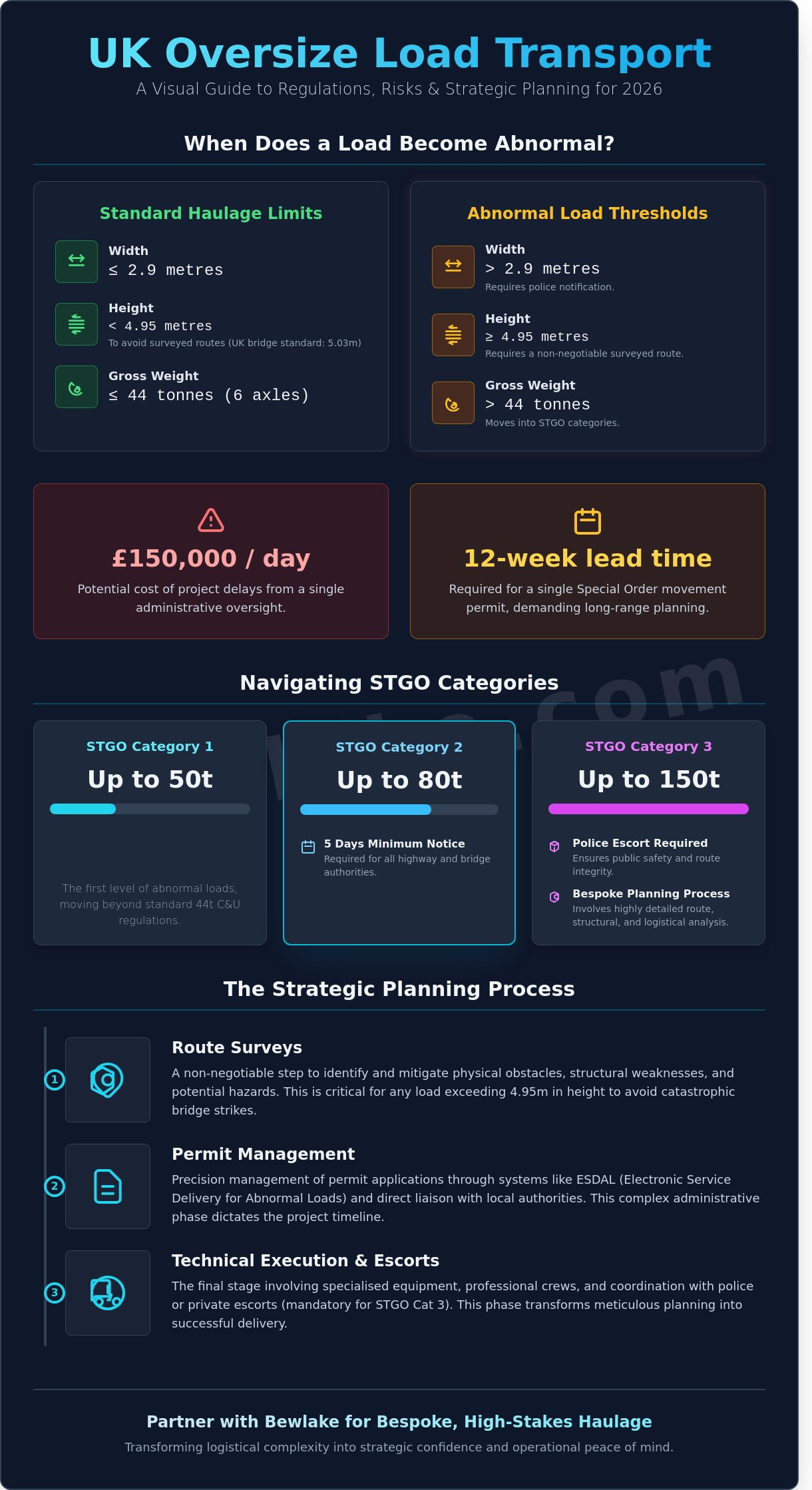
The transition from standard haulage to Oversize Load Transport occurs the moment a vehicle and its load exceed 2.9 metres in width. While most UK motorways accommodate standard traffic, any load wider than this threshold requires formal notification to the police. Length and height present additional complexities. For instance, while there’s no strict legal height limit, the standard minimum clearance for UK motorway bridges is 5.03 metres. Any load exceeding 4.95 metres requires a surveyed route to avoid catastrophic structural strikes. Weight is equally critical. Standard heavy goods vehicles operate at a maximum of 44 tonnes across six axles. Once a load pushes the gross vehicle weight beyond this, it moves into STGO categories:
Standard haulage models are designed for high-volume, uniform cargo like pallets or containers. They lack the engineering depth required for bespoke industrial components, such as 70-metre wind turbine blades or 100-tonne power transformers. For renewable energy firms and engineering primes, these assets represent years of R&D and significant financial investment. The economic impact of a transit failure is rarely limited to the cost of the cargo itself. A delay in delivering a critical component to a £250 million construction site can result in liquidated damages exceeding £40,000 per day. Precision in Oversize Load Transport is therefore a prerequisite for project viability.
We believe the role of the Trusted Advisor is to identify these complexities long before the wheels turn. By engaging in the planning process during the early design phases of a project, we help clients avoid the “one-size-fits-all” trap that leads to budget overruns. Our focus remains on value creation through meticulous risk mitigation. We don’t just move equipment; we ensure the steady progression of your long-term growth by treating every load as a critical link in a much larger strategic chain. This measured, logical approach transforms a high-risk necessity into a streamlined operational advantage.
Operating within the framework of the Road Vehicles (Authorisation of Special Types) (General) Order 2003 is a fundamental requirement for any firm involved in moving heavy assets. This legislation provides the legal basis for Oversize Load Transport that exceeds the standard limits set by the Construction and Use (C&U) Regulations 1986. While standard heavy goods vehicles are restricted to a 44,000kg gross weight, the STGO framework allows for loads up to 150,000kg, provided specific notice periods and escort requirements are met. Understanding the nuances of these UK STGO Regulations is not just a matter of compliance; it’s a strategic necessity to prevent costly roadside delays or legal action.
The transition from C&U to STGO involves three distinct categories, each with escalating layers of complexity. Category 1 covers loads up to 50,000kg, while Category 3 represents the apex of specialised transport, handling weights up to 150,000kg. For stakeholders, the choice of category dictates the speed of the operation. Speed limits drop significantly as weight increases, and the requirement for “Abnormal Load” signage becomes mandatory. We see that 78% of regulatory failures stem from incorrect categorisation, where a load’s gross weight is underestimated, leading to immediate vehicle prohibition by DVSA officers.
Category 2 is often described as the “sweet spot” for 65% of UK construction and infrastructure projects. It facilitates a gross combination weight of up to 80,000kg, which is ideal for transporting large excavators or industrial components. Vehicles in this bracket must carry a specific STGO plate and are restricted to 40mph on motorways and 35mph on dual carriageways. It’s a balanced tier that offers significant capacity without the five-day notice period often required for the heaviest Category 3 movements. Precise planning here allows for rapid deployment of heavy plant across the national network.
Moving cargo across the Dublin-Belfast corridor introduces a dual-regulatory environment that requires meticulous oversight. In Northern Ireland, the Department for Infrastructure (DfI) manages permits, while the Republic of Ireland operates under the Road Safety Authority (RSA) and local council jurisdictions. Since January 2021, customs documentation and ADR considerations for specialised cargo have added layers of administrative friction. Success depends on harmonising UK DVSA standards with Irish “Abnormal Load” permits, which often require different lead times and local police notifications. Integrating these requirements into a broader framework of strategic logistics planning ensures that value is preserved throughout the supply chain.
For businesses managing these international movements, partnering with a freight forwarding specialist like Gateway Cargo can streamline the process, handling customs and ensuring all cross-border logistics are managed efficiently.
Legal responsibility for Oversize Load Transport doesn’t rest solely with the haulier. The consignor shares a significant portion of the risk, particularly regarding the accuracy of weight and dimension declarations. Under the 2003 Order, a haulier must keep digital or physical records of all permits and “Form of Notice” documents for at least 12 months. Failure to produce these during a routine check can result in graduated fixed penalties or, in more severe cases, a summons to the Traffic Commissioner. We recommend a robust record-keeping audit every six months to ensure all third-party partners are maintaining the high standards required for elite-level transport operations. This proactive approach transforms a technical obligation into a reliable pillar of corporate governance.
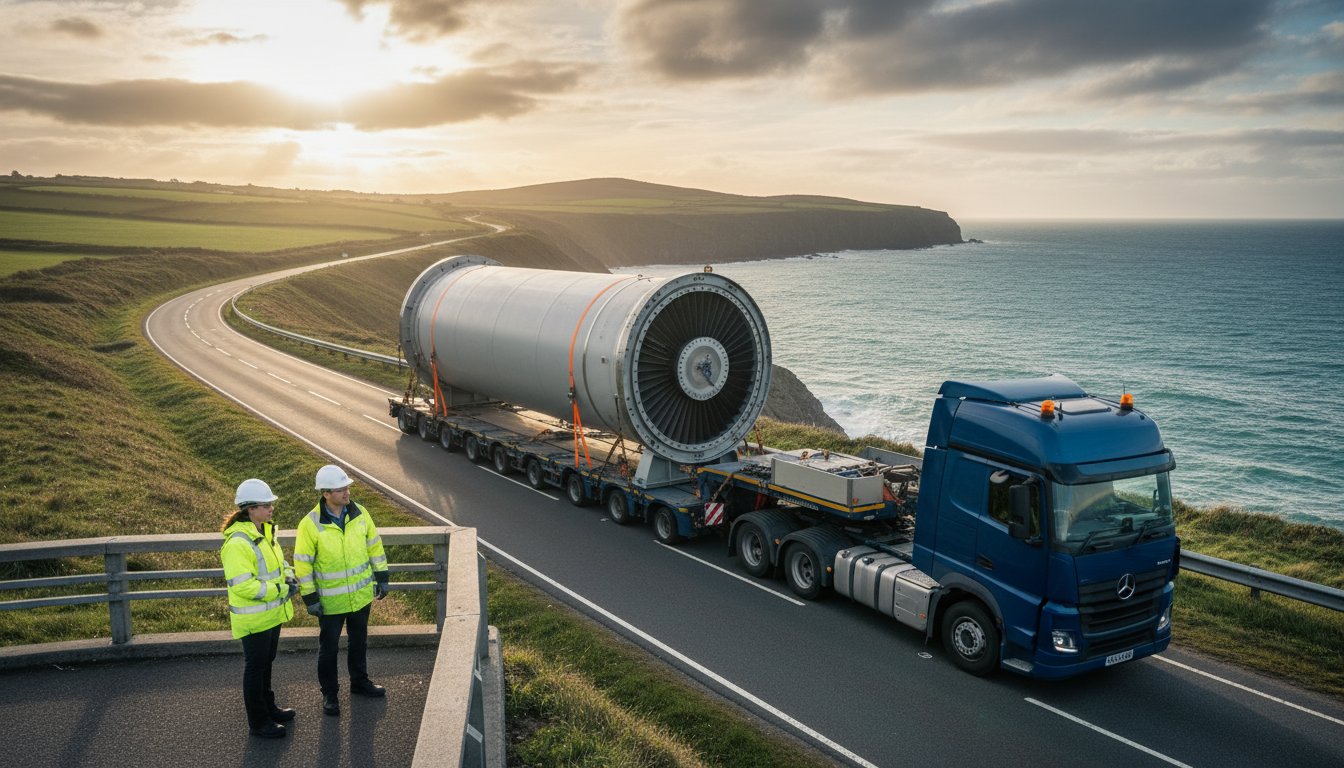
Delivering success in Oversize Load Transport requires more than just heavy horsepower; it demands a surgical approach to equipment selection. We don’t just provide a vehicle. We engineer a movement. Every project begins with a precise analysis of the cargo’s geometry and centre of gravity. Whether it’s a 30-metre structural beam or a 60-tonne industrial transformer, the physical dimensions dictate the asset. Our fleet consists of over 45 specialised units, each maintained to a rigorous six-week safety inspection schedule that exceeds standard DVSA requirements. This commitment to mechanical excellence resulted in a 99.6% fleet availability rate throughout 2023. Reliability is our baseline, not a goal.
For delivery sites with restricted access or unpaved terrain, our tracked cranes provide a distinct strategic edge. These machines offer 360-degree stability on soft ground where traditional outriggers might struggle. We frequently deploy these assets to renewable energy sites in the Scottish Highlands and remote infrastructure projects in the Welsh valleys. By utilising tracked technology, we reduce the need for expensive temporary ground reinforcement, saving clients an average of £3,400 in site preparation costs per delivery. Our approach balances technical capability with fiscal responsibility, ensuring that complex logistics don’t become a drain on project capital.
Modern fleet maintenance serves as the cornerstone of our reputation. Every vehicle in our stable is equipped with Euro VI engines, ensuring full compliance with the Ultra Low Emission Zone (ULEZ) standards in London and Clean Air Zones across the UK. We understand that a breakdown isn’t just a delay; it’s a disruption to a wider industrial chain. By investing £1.2 million annually into fleet renewals and predictive maintenance technology, we ensure our partners’ high-stakes cargo remains in motion. Our role is to act as a steady hand in a high-pressure environment, providing the calm reliability required for national infrastructure growth.
Traditional logistics often encounter friction during the final mile because they rely on third-party lifting contractors. We eliminate this bottleneck. By integrating HIAB cranes with lifting capacities reaching 85 tonne-metres, we provide a completely self-contained transport solution. This removes the requirement for secondary mobile cranes, which typically cost between £1,500 and £3,000 per day. Our operators achieve millimetre-precision when positioning modular buildings or site cabins in confined urban environments. It’s a strategic consolidation of services that reduces site congestion and significantly accelerates project timelines.
Height and length present the most significant logistical hurdles on the UK’s strategic road network. Our low loaders feature deck heights as low as 300mm, which is vital for clearing the standard 5.03-metre bridge height found across most British motorways. For cargo exceeding 16 metres, our extendable trailers provide the necessary structural support without sacrificing the manoeuvrability needed for tight junctions. We also maintain a dedicated fleet of ADR-certified vehicles for Oversize Load Transport involving hazardous materials. When projects require transit to Northern Ireland or the Republic, we align our operational planning with the Irish Abnormal Load Policy to ensure seamless regulatory compliance. This level of detail ensures that your cargo moves across borders without administrative friction or physical delay.
Moving an abnormal load across the United Kingdom is a high-stakes exercise in precision engineering and regulatory mastery. It’s not merely a logistical task; it’s a strategic operation that requires a bespoke approach to risk mitigation. At Bewlake, we treat the planning phase as the foundation of project success, ensuring that your strategic capital isn’t compromised by avoidable delays or structural oversights. Success in Oversize Load Transport hinges on the meticulous alignment of physical route capabilities and statutory obligations.
Route surveys are a non-negotiable prerequisite for any heavy haulage project. We don’t rely on generic mapping software; we conduct physical sweeps to identify “pinch points” that digital data might overlook. In rural Ireland and the narrow urban centres of the UK, a few centimetres make the difference between a seamless transit and a costly standstill. Network Rail reported 1,576 bridge strikes in 2022/23, costing the industry over £12 million in damages and delays. To prevent this, we verify bridge height clearances against the UK standard of 5.03 metres and assess weight capacities on older masonry structures. Our teams utilise high-precision GPS and LiDAR technology to create a digital twin of the intended path, allowing us to simulate the vehicle’s swept path through tight junctions and roundabouts.
The administrative framework for Oversize Load Transport is governed by strict statutory notice periods. We manage these timelines with clinical precision to ensure your project remains on schedule. The notice requirements are categorized by the load’s dimensions and weight:
We act as the central point of liaison between National Highways (formerly Highways England), the Department for Infrastructure (DfI) in Northern Ireland, and An Garda Síochána for cross-border movements. Our team handles the Electronic Service Delivery for Abnormal Loads (ESDAL) applications, managing the 15 to 20 separate notifications often required for a single long-distance journey. This proactive communication ensures all stakeholders are aligned, reducing the administrative burden on your internal teams and fostering a sense of partnership with local authorities.
Managing “street furniture” is the final piece of the strategic puzzle. For wide loads, we coordinate the temporary removal of bollards, traffic signals, and pedestrian railings. This often involves bespoke traffic management plans and the deployment of private escorts. While private pilot cars handle loads up to 4.6 metres wide, any load exceeding this threshold typically requires a police escort to ensure public safety. We synchronise these moving parts to ensure the transit is a measured, quiet success rather than a disruptive event. For construction projects involving material disposal, our expertise extends to waste carriage compliance and environmental regulations to ensure complete regulatory alignment throughout your project lifecycle.
Experience the confidence of a perfectly planned transit with our specialist team. Partner with Bewlake for bespoke transport solutions that protect your project’s timeline and reputation.
Bewlake operates at the precise intersection of strategic capital and logistical execution. We don’t view haulage as a mere transaction; it’s a critical component of value creation within your broader business strategy. Our philosophy is built on the alignment of your commercial objectives with our elite industry standards. As a family-run firm, we offer a rare combination of high-level advisory precision and personal accountability. This ensures that every Oversize Load Transport project we undertake is managed with the rigour of a global financial institution and the tailored attention of a boutique partner. We’re committed to the long-term growth of our clients, acting as a steady hand in high-stakes environments where there’s no margin for error.
Our team understands that successful logistics requires more than just equipment. It requires a deep understanding of the regulatory landscape and a proactive approach to risk management. By integrating our strategic insights into your supply chain, we help you overcome the complexities of the UK transport network. We focus on building lasting relationships, ensuring that our success is directly tied to the seamless execution of your most challenging projects. Whether you’re moving industrial machinery or infrastructure components, we provide the stability and expertise needed to secure your assets and your reputation.
Reliability is the foundation of our service. We provide transparent communication from the moment you request an initial quote until the final delivery is confirmed. You won’t find fragmented layers of management here; instead, you’ll work with experienced operators who act as on-site partners. In June 2023, we demonstrated this approach while moving a 16-metre modular building to a restricted site in central Birmingham. The project involved a 48-hour planning window and coordination with three separate local authorities. By deploying a dedicated pilot vehicle and utilising real-time telemetry, we delivered the units within a precise 30-minute window, achieving a 100% safety rating and zero site downtime. This level of precision is why 92% of our clients return for subsequent specialised transport projects.
Complex Oversize Load Transport often demands more than transit; it requires a comprehensive support infrastructure. Our secure warehousing and container storage facilities in Northern Ireland provide a strategic bridgehead for firms operating across the UK and EU. In the first half of 2024, we expanded our capacity to over 65,000 square feet of high-security space, allowing for the staging of materials before final deployment. This integrated model allows us to manage your inventory and transport under a single strategic umbrella, reducing overall lead times by an average of 18%. We also provide modular buildings and site cabins to establish immediate project infrastructure on-site, ensuring your team has the facilities they need the moment your cargo arrives. For projects involving construction and demolition activities, our comprehensive approach includes expertise in strategic waste carriage compliance to ensure all aspects of your logistics operation meet the evolving regulatory standards of 2026.
To initiate your next specialised transport project, contact our advisory team to discuss your technical specifications and timelines. We’re ready to provide the strategic roadmap your business requires. Enquire about our specialised haulage solutions today to see how we can align our resources with your commercial goals. We don’t just move equipment; we deliver the logistical certainty your business deserves.
Navigating the complexities of Oversize Load Transport in 2026 requires a fusion of technical precision and strategic foresight. Success hinges on mastering STGO Category 2 compliance and executing meticulous route planning that accounts for evolving infrastructure across the UK and Ireland. At Bewlake, we don’t just move cargo; we manage risk through three generations of transport heritage. Our ADR Certified, STGO Cat 2 capable fleet ensures your high-stakes assets are handled with clinical professional care.
We provide comprehensive coverage across the UK, Ireland, and Europe, transforming logistical hurdles into seamless executions. Whether you’re moving industrial components or sensitive machinery, our family-run firm offers the calm reliability your project deserves. We align your logistics with a strategy focused on long-term growth and bespoke excellence. This approach moves beyond simple haulage, positioning your supply chain as a pillar of your business’s wider success.
Contact Mike and the team for a bespoke transport strategy to ensure your next move is executed with absolute precision. We look forward to building a successful partnership together.
An abnormal load is a vehicle that has a weight of more than 44,000kg, an axle load of more than 10,000kg for a single non-driving axle, a width greater than 2.9 metres, or a rigid length exceeding 18.65 metres. These parameters are defined by the Road Vehicles (Construction and Use) Regulations 1986. If your cargo exceeds these specific thresholds, you must follow the STGO rules to remain compliant during transit.
You must provide a minimum of 2 clear working days’ notice to the police for loads over 2.9 metres wide and 5 clear working days’ notice to highway authorities if the weight exceeds 80,000kg. For complex Oversize Load Transport involving widths over 5 metres, the Department for Transport requires a special order permit. This process typically takes 8 to 10 weeks to finalise, so early strategic planning is essential for your project timelines.
Police escorts are generally mandatory in the UK for loads exceeding 4.6 metres in width, while private pilot cars are recommended for any load over 3 metres to manage traffic safety. Each of the 45 territorial police forces in the UK has specific regional guidelines that we navigate on your behalf. We coordinate directly with these authorities to determine if a self-escort is sufficient or if a formal police presence is required.
STGO Category 2 applies to vehicles with a gross combination weight between 80,000kg and 150,000kg. Under these regulations, the vehicle’s restricted to a maximum speed of 40mph on motorways and 35mph on dual carriageways. It’s a critical framework for moving heavy industrial plant machinery that exceeds standard 44-tonne limits. We ensure your equipment is plated correctly to meet these specific legal requirements before it hits the road.
We manage integrated logistics for Oversize Load Transport between Great Britain, Northern Ireland, and the Republic of Ireland using dedicated Ro-Ro services. Our team facilitates transit through key ports like Holyhead and Liverpool while handling the specific customs declarations required since 2021. We secure the necessary permits from the Road Safety Authority in Ireland and local UK councils to ensure a seamless crossing for your heavy cargo.
To provide an accurate bespoke quote, we require the exact dimensions including length, width, and height, along with the total weight and the specific collection and delivery postcodes. We also need to know the nature of the cargo, such as whether it’s a 30-tonne excavator or a 20-metre steel beam. Providing a technical drawing allows our engineers to calculate axle loadings and identify potential pinch points on your route.
We provide a comprehensive contract lift service that integrates mobile crane hire with our transport solutions to offer a single point of accountability. Our team includes Appointed Persons who draft detailed Risk Assessments and Method Statements in accordance with BS 7121 standards. This ensures that your 50-tonne transformer or industrial boiler is handled with precision from the moment it’s lifted until it’s safely positioned at its final destination.

Leave a comment