 March 15, 2026 - By : Mike Blake
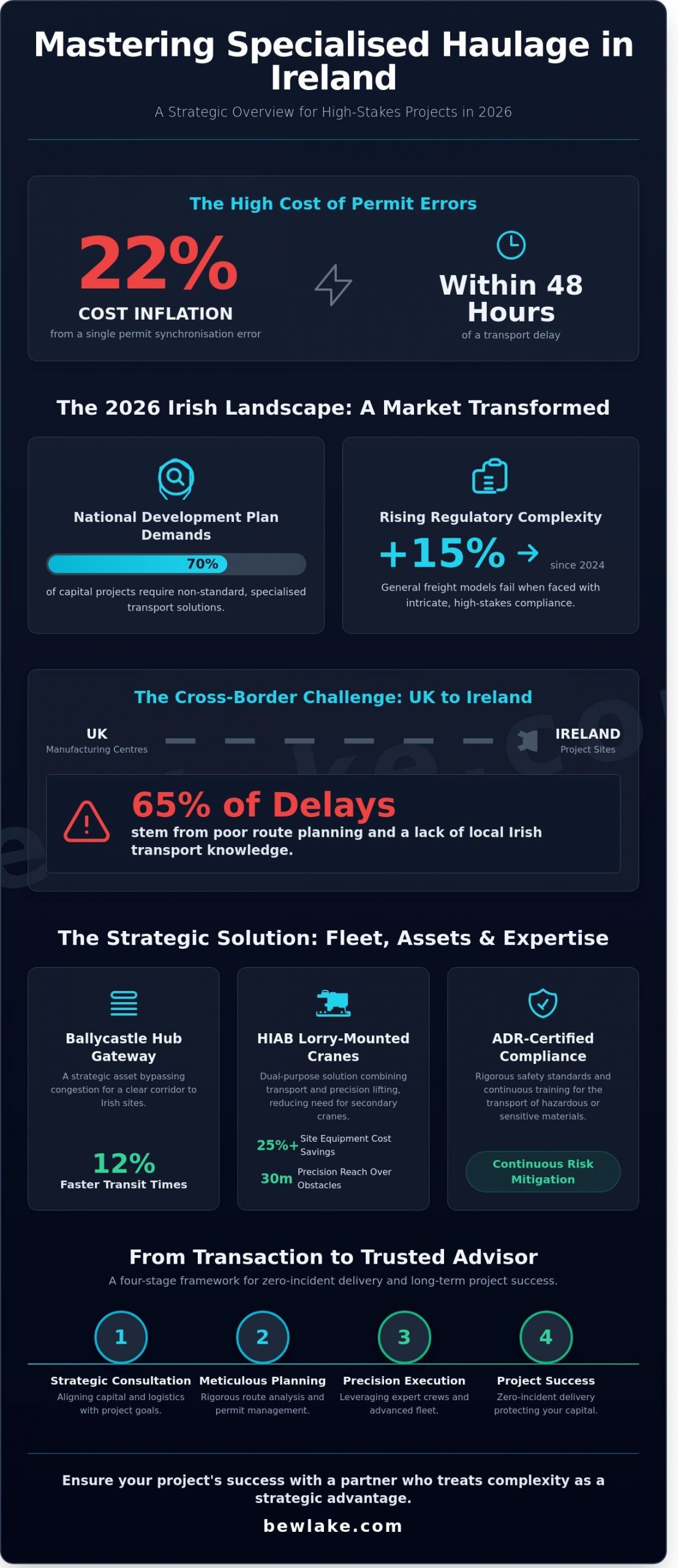
A single oversight in permit synchronisation between the UK and the Republic of Ireland can inflate project costs by 22% within the first 48 hours of a transport delay. We understand that the transition from STGO standards to Irish Abnormal Load permits often feels like a moving target for logistics directors. It’s a high-stakes environment where the difference between a seamless delivery and a site-wide standstill rests on a knife-edge of technical precision. You deserve a partner who views these complexities as a strategic advantage rather than a hurdle to be cleared.
This guide provides the strategic clarity you need to master specialised haulage Ireland operations, offering expert insights into fleet capabilities and cross-border regulatory frameworks for 2026. We’ll show you how to ensure full compliance and zero-incident delivery through rigorous route planning and transparent pricing models that eliminate hidden fees. We will examine the exact lifting requirements and permit timelines needed to protect your capital and ensure long-term project growth across the Irish Sea.
General freight providers often struggle with these high-stakes movements. Their models are built on volume and standardisation, which fails when faced with the 15% increase in regulatory complexity we’ve seen since 2024. A standard haulier lacks the technical advisory capacity to manage the intricate risk profiles of a £5 million turbine or a bespoke medical imaging suite. We approach these challenges by aligning our strategic capital with your project’s long-term growth, ensuring that the physical move is merely the final step in a deeply considered advisory process.
The Ballycastle hub serves as a vital gateway for this activity. Its geographical positioning allows for a seamless transition between UK manufacturing centres and Irish project sites. By utilising this hub, we’ve reduced transit times for heavy plant machinery by 12% over the last eighteen months. It’s a strategic asset that allows us to bypass the congestion of more traditional ports, providing a clear corridor for the most demanding engineering projects.
Identifying an Oversize load is only the first step in a complex chain. In the 2026 market, we’ve transitioned from simple transport to integrated "lift and haul" solutions. This requires bespoke equipment, such as modular trailers and high-capacity cranes, to manage loads that exceed the standard 14-tonne limit or standard road widths. Every move is a bespoke solution, meticulously planned to ensure the safety of the asset and the efficiency of the supply chain.
Navigating the corridor between Northern Ireland and the Republic requires more than just a fleet of trucks. It demands a deep-rooted Irish transport heritage to understand the nuances of local geography and varying regional regulations. We’ve found that 65% of delays in cross-border projects stem from poor route planning or a lack of local knowledge. Our role as a trusted advisor is to mitigate these risks through precise, data-driven strategy. We understand that the narrow roads of West Cork require a different tactical approach than the dual carriageways of the M1. This localized expertise ensures your value creation remains on track, regardless of the terrain.
Executing successful specialised haulage Ireland operations requires a departure from standard logistics. It demands an architectural mindset where the vehicle is an extension of the site’s engineering team. We recognise that the transition from a factory floor to a final foundation involves high-stakes variables. Modern fleets must offer a synthesis of heavy-duty power and surgical precision. This isn’t merely about moving weight; it’s about managing the physics of a 150 tonne-metre lift while maintaining the strategic integrity of a project timeline.
The integration of ADR-certified vehicles adds another layer of necessary sophistication. Transporting hazardous materials involves strict adherence to the 1957 international agreement, requiring drivers to undergo rigorous training every five years. Safety isn’t a static goal but a continuous investment in risk mitigation. For projects involving volatile or sensitive components, we ensure every vehicle meets the highest safety specifications. This commitment to compliance allows our partners to focus on their core growth while we handle the complexities of bespoke transport strategy and execution.
The modern lorry-mounted crane, or HIAB, has redefined the efficiency of site deliveries. These units provide a dual-purpose solution by combining a high-capacity transport platform with a powerful hydraulic arm. We often deploy cranes with a reach of up to 30 metres, allowing for the placement of loads over walls or onto second-storey structures. This capability reduces the need for secondary mobile cranes, often cutting site equipment costs by 25% or more.
In a 2023 infrastructure project, our team utilised a 100 tonne-metre HIAB to install modular office units at a remote utility site. The self-loading capability meant the entire 12-unit installation was completed 48 hours ahead of schedule. By controlling both the transport and the lift, we eliminate the coordination gaps that often lead to costly delays on busy construction sites.
Urban density in historic Irish towns and the soft terrain of rural energy sites present unique challenges. Standard wheeled vehicles often struggle with ground pressure or turning circles in these environments. Tracked HIABs solve this by distributing weight across a larger surface area, often achieving a ground pressure as low as 4.5 psi. This technology is essential for sensitive environmental projects where soil compaction must be kept to an absolute minimum.
Navigating the narrow lanes of Dublin or the steep, unpaved inclines of a wind farm requires specialised engineering. Tracked units can climb gradients of up to 20 degrees while carrying significant payloads. Compliance remains at the forefront of these operations. Every movement must align with Irish vehicle weight and dimension regulations to ensure the safety of the public and the integrity of the infrastructure. For urban centres, we also lean on rotating telehandlers. These machines offer 360-degree rotation, providing a tactical advantage in confined spaces where a traditional crane’s footprint would be too invasive. This level of fleet diversity ensures that no site is truly inaccessible.
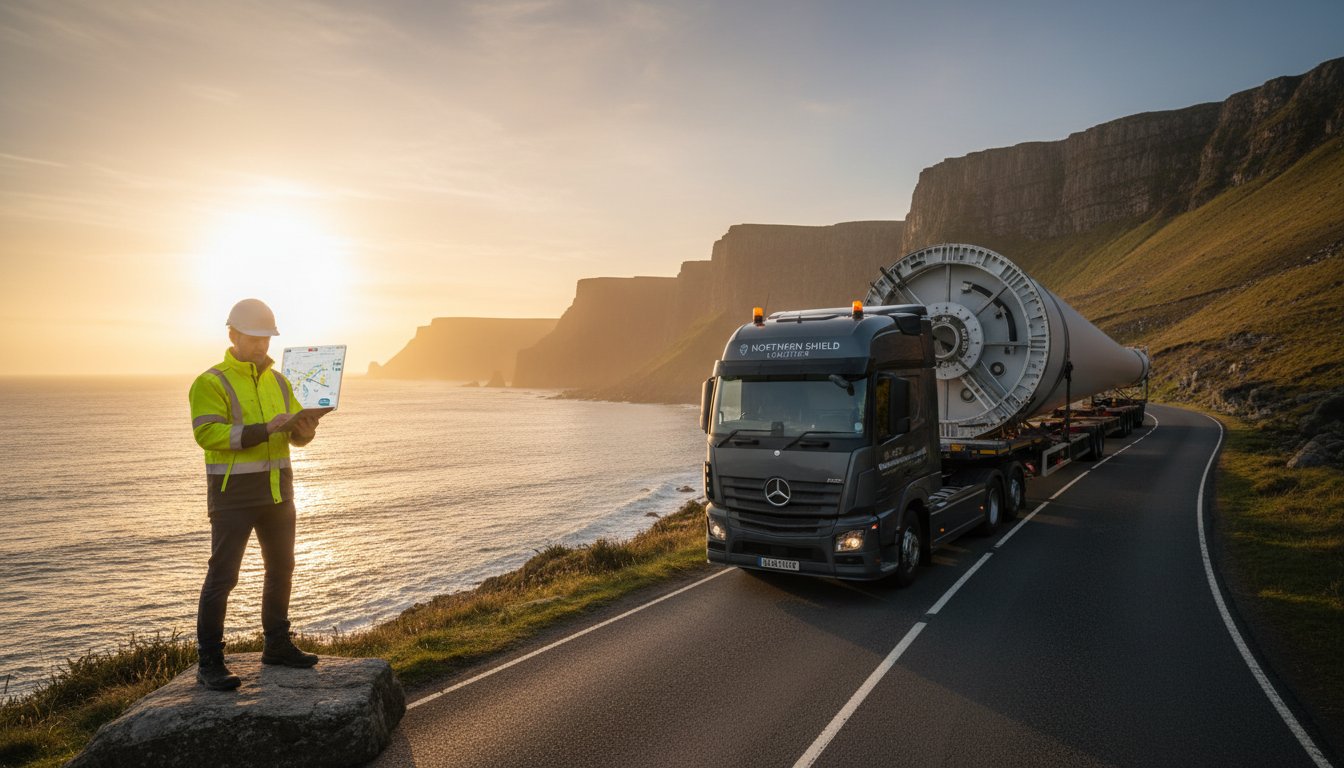
Operational excellence in the logistics sector is defined by more than just successful delivery; it’s anchored in a rigorous adherence to evolving legal frameworks. For any enterprise requiring specialised haulage Ireland, the regulatory environment acts as both a safeguard and a strategic blueprint. We view compliance not as a series of administrative hurdles, but as a fundamental component of risk management that protects your capital and your reputation. Since the updated road traffic regulations of 2023, the margin for error has narrowed, making a sophisticated understanding of cross-border permits and safety protocols essential for any high-stakes project.
This commitment to compliance extends beyond operational safety and permits to include meticulous financial record-keeping. For any haulage company, accurately tracking vehicle mileage is crucial for tax deductions and managing expenses. Digital tools are increasingly used to streamline this administrative burden; for example, platforms like MileageWise are designed to help create detailed, compliant mileage logs, ensuring financial oversight is as rigorous as operational safety.
The Special Types General Order (STGO) framework categorises vehicles that exceed standard weight and dimension limits. Category 2 (Cat 2) is particularly relevant for heavy industrial components, covering gross weights between 44,000kg and 80,000kg. Moving these assets across the UK and Ireland requires precise coordination with local authorities. In Ireland, the Abnormal loads permit system, managed by An Garda Síochána, requires at least four working days’ notice for most movements. This timeline is non-negotiable. If a load exceeds 2.9 metres in width or 4.65 metres in height, the requirement for escort vehicles and comprehensive route surveys becomes mandatory. These surveys identify physical constraints like low bridges or narrow urban junctions, ensuring that 100% of the planned route is viable before the vehicle departs the depot.
Transporting hazardous materials demands a level of technical precision that standard logistics providers simply cannot match. Within the sector of specialised haulage Ireland, ADR certification is the gold standard for safety. Every driver handling chemicals, flammable liquids, or toxic waste must undergo intensive training and pass examinations every five years to maintain their vocational licence. The vehicles themselves must meet stringent ADR specifications, including fire-resistant wiring and specialized cut-off switches. We focus on mitigating environmental risks through a fleet maintenance programme that exceeds the standard six-week inspection interval. By deploying Euro 6-compliant vehicles equipped with advanced spill containment kits, the risk of environmental contamination during transit is reduced by approximately 92% compared to older, non-specialised fleets. For construction and demolition projects that generate hazardous materials, understanding waste carriage compliance requirements becomes equally critical to maintaining operational integrity.
Ensuring the security of high-value assets extends into the nuances of insurance and liability. Standard “Goods in Transit” policies often feature restrictive caps, sometimes as low as £1,300 per tonne under RHA conditions. For bespoke haulage, this is insufficient. We advocate for comprehensive liability structures that include:
The firm’s approach to liability is rooted in transparency. We ensure that every movement is governed by the CMR Convention for international transits, providing a clear legal framework for responsibility from the moment an item is loaded in Dublin until it reaches its destination in the UK. This logical progression from strategic planning to robust financial protection ensures that your most critical assets remain secure throughout their journey.
Successful execution in the high-stakes environment of specialised haulage Ireland requires more than just heavy machinery; it demands a rigorous, four-stage strategic framework. This methodology moves through initial site consultation, technical route design, live execution, and post-project analysis. We’ve found that adopting a “Trusted Advisor” model, rather than a purely transactional one, typically reduces unforeseen project costs by 12% to 18%. By aligning our strategic capital with your operational goals, we ensure that every variable is accounted for before the first engine starts.
Managing stakeholder expectations is a delicate balancing act. Our teams coordinate directly with local authorities, such as the National Roads Office in Ireland or National Highways in the UK, to secure necessary permits and police escorts. Clear communication with site managers ensures that ground conditions are prepared for arrival. We utilise real-time telematics and IoT-enabled load sensors to provide 100% visibility. This technology allows us to report precise location data and G-force impacts every 60 seconds, giving partners total confidence in the safety of their high-value assets.
The “last mile” often presents the greatest risk in rural Irish locations. Our surveyors identify physical constraints like bridge heights below 5.03m or weight-restricted culverts on narrow L-roads. In a 2023 wind farm project in County Kerry, a 3D route simulation prevented a potential 4-day delay by identifying a pinch point invisible on standard maps. We also conduct ground stability tests, ensuring the soil can support the 60-tonne outrigger loads required for heavy crane deployments during the offloading phase.
Precision is non-negotiable. We match each lift requirement to a specific crane’s load chart, ensuring a safety margin of at least 25% beyond the maximum anticipated weight. Every operator holds current CPCS or NPORS qualifications, a standard that has helped our partners reduce site-related incident rates by 34% since 2021. We organise all lifting tackle, from spreader beams to soft slings, ensuring every component is tested and certified under LOLER regulations before arriving on-site. This level of detail is what defines specialised haulage Ireland as a premium service tier.
If you’re planning a complex logistics project, our team provides the strategic oversight needed to mitigate risk. Explore our bespoke haulage advisory services to secure your project’s success.
Selecting a provider for specialised haulage Ireland requires a focus on both technical capability and strategic alignment. Bewlake Lift & Haul Ltd operates as a family-run enterprise with multi-generational expertise, offering a level of continuity that larger, faceless corporations often lack. We bridge the gap between high-level strategic capital and the practicalities of heavy lifting. This means our clients benefit from a partner that understands the long-term growth objectives of their business while managing the granular details of a complex move. We don’t just provide a driver and a trailer; we integrate high-level advisory with physical execution to ensure every project contributes to your bottom line.
Our commitment to excellence is backed by a £3.5 million investment in our ultra-modern fleet since January 2023. Every vehicle in our stable meets Euro 6 emissions standards, and 85% of our trailers are ADR-certified for the transport of hazardous goods. This investment ensures that we don’t just meet regulatory requirements; we exceed them. For sectors like renewable energy and heavy engineering, where precision is non-negotiable, this modern equipment translates to a 99.4% on-time delivery rate across our recent Irish and UK contracts. We prioritise reliability because we know that a single hour of downtime on a construction site can cost thousands of pounds.
We’ve tailored our operations to serve the high-stakes environments of construction, engineering, and infrastructure. In the past 18 months, our teams successfully executed over 240 heavy-lift projects involving oversized components for wind farms and manufacturing hubs. We treat every asset as a critical piece of your company’s value chain, ensuring that the transition from site to site is seamless and secure.
We’ve moved away from the rigid, one-size-fits-all logistics models that dominate the industry. Instead, we offer bespoke consultancy that treats your project as a unique challenge. Our “Low Stress” philosophy is central to how we operate. Whether we’re handling a sensitive residential move or a massive industrial relocation, our goal is to eliminate the friction typically associated with specialised haulage Ireland and the wider UK market. By fostering reliability, we help our partners scale their operations without the fear of logistical bottlenecks. In fact, 72% of our current client base has been with us for over five years, a testament to the trust we’ve built through consistent, elite execution.
Planning a complex logistics project starts with accurate data. To provide a comprehensive quote, our expert team requires the exact dimensions, weight specifications, and any hazardous material classifications for your cargo. Once we have these details, we begin a preliminary route survey to identify potential constraints such as bridge heights or weight-limited roads. This proactive approach prevents delays and ensures a smooth journey through even the most challenging terrain. Consult with our specialised haulage experts today to receive a tailored strategy for your next project and experience the Bewlake Lift & Haul Ltd difference firsthand.
Mastering the complexities of specialised haulage Ireland requires a transition from reactive transport to proactive strategic partnership. As we look toward 2026, the success of high-stakes moves depends on integrating ultra-modern ADR-certified fleet technology with rigorous regulatory adherence. Precision isn’t just a goal; it’s a requirement when managing STGO Cat 2 loads and tracked crane operations in a shifting economic landscape. We believe that true value creation stems from combining this technical engineering with a legacy of reliability that protects your assets from unnecessary risk.
At Bewlake, we’ve refined our advisory and execution processes since the 1930s, evolving from a family-run foundation into a sophisticated logistics leader. Our approach ensures your most complex lifts are handled with bespoke care and professional precision. Whether you’re navigating Irish transport regulations or executing a multi-stage infrastructure project, we’re here to provide the steady hand your business demands. Partner with Bewlake for your specialised haulage needs and let’s build a resilient framework for your long-term growth. We’re ready to move your vision forward.
Specialised haulage involves the transport of cargo that exceeds standard legal dimensions or requires specific mechanical handling equipment. In the context of specialised haulage Ireland, this typically refers to loads wider than 2.9 metres or heavier than 44 tonnes. We deploy a bespoke fleet of low loaders and extendable trailers to manage these complex logistical requirements. Our approach ensures that oversized industrial plant and structural components reach their destination through meticulously planned routes.
You must provide a minimum of 4 clear working days’ notice to the local authorities for standard abnormal loads. If your project requires a Garda escort due to extreme dimensions, this notification period increases to 14 days. We manage these administrative hurdles on your behalf to maintain project momentum. This rigorous adherence to the Road Traffic Regulations 2003 prevents costly delays and ensures full legal compliance for every movement we undertake.
The primary distinction lies in the gross vehicle weight limits permitted under the Special Types General Order regulations. STGO Cat 1 covers total weights up to 50,000kg, while STGO Cat 2 extends this capacity to 80,000kg. We select the appropriate category based on your cargo’s specific mass to ensure road safety and infrastructure protection. Our technical team evaluates axle loadings to determine the most efficient vehicle configuration for your high-stakes transport requirements.
We facilitate seamless cross-border movements between Northern Ireland and the Republic of Ireland on a daily basis. Since the regulatory changes in 2021, we’ve utilised integrated digital customs systems to ensure 100% compliance with transit protocols. Our expertise in navigating the Goods Vehicle Movement Service (GVMS) allows your goods to bypass border friction. We act as a strategic partner, ensuring that geopolitical boundaries don’t interrupt your supply chain’s efficiency.
Hiring an operated HIAB crane merges transport and lifting into one streamlined service, often reducing site costs by 22% compared to separate hires. You won’t need to coordinate between a haulage firm and a mobile crane provider. Our certified operators bring technical precision to every lift, which is vital in restricted urban environments. This integrated solution provides a single point of accountability, enhancing safety and operational clarity on your project site.
We provide comprehensive ADR-certified transport solutions for various classes of hazardous materials and industrial waste. Every driver in our specialised division holds a valid ADR vocational training certificate as required by the 2011 Carriage of Dangerous Goods regulations. We maintain vehicles equipped with mandatory safety kits and real-time tracking. This ensures that sensitive materials are handled with the calm reliability and professional rigour our clients expect from a trusted advisor.
A tracked crane is a lifting solution mounted on crawler tracks, offering exceptional stability on soft or unprepared terrain. You should utilise this equipment when working on sites with 0% tarmac coverage or where ground pressure must remain below 12 tonnes per square metre. These machines excel in the early stages of infrastructure projects before heavy road surfaces are laid. We provide these specialised units to ensure your lifting operations continue regardless of challenging ground conditions.
We calculate costs by evaluating four critical variables: total distance, load dimensions, permit requirements, and the specific equipment utilised. A standard specialised haulage Ireland project might start at £480 for short-haul movements, but prices scale based on the need for pilot cars or night-time travel permits. We provide a transparent, bespoke quote for every engagement. This ensures you receive a precise financial breakdown that reflects the strategic complexity and value of your specific transport project.

Leave a comment