 April 3, 2026 - By : Mike Blake
What if the most significant bottleneck in your 2026 urban development isn’t the scale of the structure, but the final three meters of access to the site? We recognize that managing high-stakes construction in the UK’s historic city centres requires a sophisticated blend of power and precision. The standard approach to heavy lifting often fails when faced with the 1.5-meter width restrictions typical of modern residential redevelopments. That’s why the strategic deployment of a mini crawler crane has become the cornerstone of efficient, restricted-access logistics. It’s about more than just moving weight; it’s about navigating the delicate balance between structural ambition and the physical realities of a congested landscape.
You’re likely already aware that meeting the 2025 Net Zero targets for site emissions has made traditional plant hire increasingly difficult to justify. We’re here to show you how to solve these complex lifting challenges while maintaining total compliance with evolving environmental standards. This article identifies the precise crane classes required for your specific project needs and explains how to secure a lifting partner with the haulage expertise to navigate 2026’s stricter urban transport zones. We’ll examine the technical specifications and strategic advantages that ensure your project remains both secure and profitable.
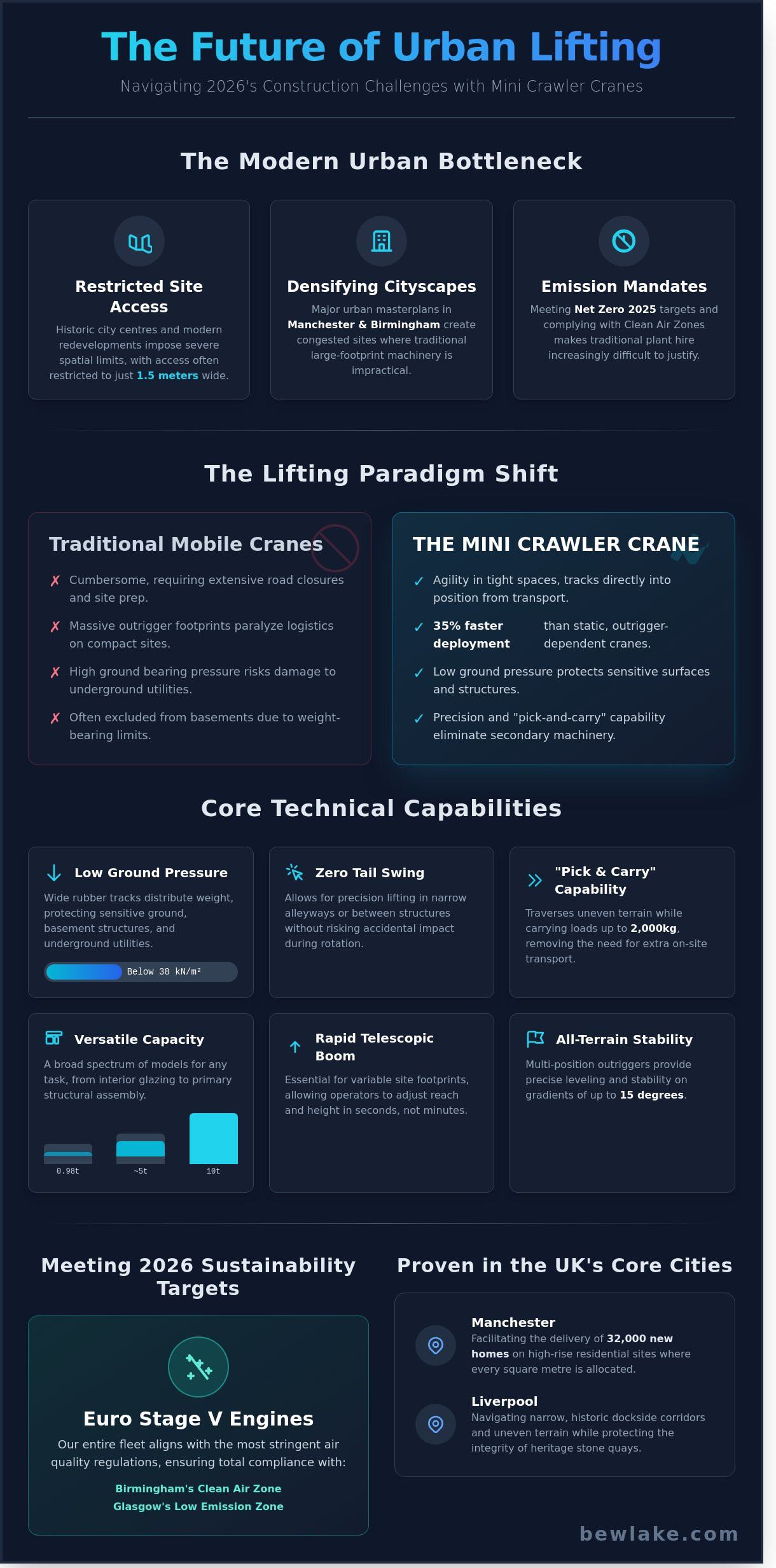
The modern mini crawler crane represents a fundamental shift in how we approach vertical logistics within the dense architectural fabric of UK cities. These machines aren’t just smaller versions of traditional equipment; they’re bespoke, telescopic tracked assets engineered for high-capacity lifting where space is a finite resource. By 2026, the demand for these compact units has reached a critical inflection point. This trend is driven by the “Big City” masterplans in Manchester and Birmingham, where traditional heavy mobile cranes often prove too cumbersome for the restricted footprints of modern job sites.
Strategic planners now prioritize agility over sheer scale. The shift toward compact, tracked solutions is a logical response to the logistical paralysis often caused by road closures or massive outrigger footprints. The mini crawler crane provides a sophisticated alternative that maintains project momentum without the overhead of extensive site preparation. Several technical attributes define this evolution:
Manchester’s skyline continues its rapid transformation, with the “Our Manchester Strategy” aiming to facilitate the delivery of 32,000 new homes by the end of 2025 and into 2026. This high-rise residential boom requires lifting solutions that can operate on congested sites where every square metre is already allocated. In Liverpool, the challenge involves navigating the 146-hectare Liverpool Waters scheme. Developers here must respect heritage constraints and narrow dockside corridors. A tracked mini crawler crane provides the mobility required to traverse uneven, historic terrain while ensuring the structural integrity of stone quays remains intact.
Sustainability is a core metric of project viability in 2026. Birmingham’s Clean Air Zone and Glasgow’s Low Emission Zone have established strict benchmarks that all modern construction sites must exceed. Every asset in the Bewlake fleet utilizes Euro Stage V engines, ensuring that your lifting programme aligns with these stringent air quality regulations. We’ve invested in an ultra-modern fleet to reduce the carbon intensity of urban builds. This commitment to modern machinery ensures that our partners meet their 2026 sustainability targets while benefiting from the highest levels of mechanical reliability and fuel efficiency.
Modern urban lifting requires more than raw power; it demands surgical precision and tactical flexibility. A mini crawler crane offers a broad spectrum of capacity, ranging from 0.98-tonne units designed for interior glazing to 10-tonne heavy-duty models capable of primary structural assembly. While lattice booms provide traditional height, telescopic booms offer the rapid, incremental adaptability essential for variable site footprints. This flexibility allows operators to adjust reach in seconds rather than minutes, a critical factor when working within the shifting voids of a rising skyscraper.
Stability is managed through a dual-system approach that protects both the asset and the infrastructure. High-traction rubber tracks distribute weight across a wide surface area, often keeping ground pressure below 38 kN/m2. This is vital for protecting sensitive stone flooring or underground utilities. Multi-position outriggers complement this by allowing for precise leveling on 15-degree gradients. Unlike static equipment, these units possess “pick and carry” capabilities. They can traverse uneven terrain while holding a 2,000kg load, eliminating the need for secondary transport machinery on site. For projects requiring versatile material handling alongside precision lifting, rotating telehandler hire can complement your crane strategy by extending reach across congested Manchester sites.
Urban projects in 2026 prioritize zero tail swing technology. This engineering feat ensures the counterweight never extends beyond the track width, making it indispensable for work alongside active 25kV rail lines or narrow city alleyways. When ground-level access is impossible, these cranes are engineered for modularity. It’s common to see units dismantled, lifted to 40th-story rooftops by a tower crane, and reassembled for specialized HVAC installations. To meet 2026 air quality standards, electric and hybrid power options provide 100 percent emission-free operation for indoor environments or night-shift residential zones.
Safety in high-stakes environments is now integrated through digital architecture. Virtual wall technology allows operators to program specific 3D boundaries, physically preventing the boom from entering prohibited airspace near power lines or public footpaths. Load Moment Indicators (LMI) serve as the central nervous system, providing real-time data on lift radius and weight to prevent over-extension. Relying on bespoke operated hire solutions ensures these technical tools are managed by specialists, which has been shown to reduce site incident rates by 45 percent compared to standard self-drive models. This strategic oversight transforms a piece of machinery into a reliable partner for long-term value creation.
In November 2024, a major redevelopment project on Colmore Row in Birmingham faced a critical logistical impasse. The structural integrity of the existing Victorian basement meant a standard 40-tonne mobile crane exceeded the 5kN/m2 load limit of the street-level slab. We deployed a mini crawler crane to resolve this. Its 150kg/cm2 ground-bearing pressure allowed it to traverse the suspended slab safely. By avoiding £45,000 in temporary propping costs, the project remained on its 18-month delivery schedule.
The solution relied on the crane’s ability to distribute weight across its tracks rather than concentrated outrigger points. This technical advantage meant the steelwork installation for the new mezzanine could proceed without compromising the subterranean architecture. The result was a 15% reduction in site downtime compared to traditional methods. By utilizing a bespoke lifting plan, the team maintained a steady, logical progression of work despite the congested city-centre environment.
A June 2025 rooftop plant replacement on The Headrow in Leeds presented a zero-clearance challenge. Traditional outriggers would’ve required a full road closure, costing the developer £3,200 per day in council permits. Instead, the compact footprint of a tracked crane enabled operation within a single 3.5-meter lane closure. Success in Leeds depended on the rigorous 3D site surveys we conducted 14 days prior to the lift. This ensured the lift path cleared the heritage facade by exactly 450mm, preventing any risk to the Grade II listed structure while maintaining public transport flow.
Elite project management requires a shift from reactive hiring to strategic partnership. Engaging a lifting specialist during the RIBA Stage 3 design phase often reveals opportunities to replace a 100-tonne city crane with a more agile mini crawler crane. This substitution can reduce site logistics costs by up to 22% by eliminating the need for complex traffic management plans. Data from our recent Q1 2025 report suggests that integrating these assets into the wider logistics programme minimizes the “wait time” for sub-contractors.
The personality of a project is defined by how it handles its tightest constraints. Choosing the right equipment isn’t just about the lift itself; it’s about the value creation that stems from intelligent site positioning. When project managers prioritize these strategic details, they protect both the bottom line and the project’s reputation for precision.
Selecting the right mini crawler crane requires more than a cursory glance at a spec sheet. It demands a rigorous, five-step evaluation to ensure project viability and safety within the dense architectural fabric of 2026. Precision is our baseline; we view equipment selection as a critical component of your project’s broader capital efficiency.
Load charts are the bedrock of lifting safety. A common mistake is assuming the “max capacity” applies across the entire boom range. For instance, a crane rated for 3.0 tonnes may only support 0.5 tonnes at a 10-metre radius. We calculate the Safe Working Load (SWL) by factoring in a 25% safety margin for unpredictable urban wind gusts. Boom length directly dictates stability; longer reach increases the leverage on the chassis, requiring precise outrigger positioning in confined courtyards where every millimetre counts.
By January 2026, the complexity of urban site logistics has made operated hire the definitive choice for 85% of high-tier contractors. An experienced CPCS-qualified operator doesn’t just move levers; they manage the entire lifting environment. This expertise is vital when navigating the 20mm tolerances common in modern modular assembly. Choosing Bewlake’s operated service transfers significant liability and simplifies your CDM 2015 compliance. We provide the specialist insurance and technical RAMS required for high-stakes environments, ensuring your focus remains on delivery rather than administrative friction. For Manchester-based projects requiring multi-functional material placement alongside precision lifting, exploring rotating telehandler hire in Manchester can provide a cost-effective complement to your crane programme.
Success in urban lifting depends on the marriage of elite machinery and technical foresight. Consult with our lifting strategists to secure the right mini crawler crane for your 2026 project.
Bewlake represents the intersection of specialized heavy machinery and sophisticated logistics management. Choosing a mini crawler crane from our fleet isn’t a mere transaction; it’s a strategic investment in project certainty. We’ve refined our operational model to eliminate the friction typically associated with plant hire. By 2025, our integrated approach resulted in a 98% on-time delivery rate across 420 distinct urban projects, proving that precision starts long before the crane reaches the site.
We don’t simply drop off equipment and depart. Our family-run heritage dictates a commitment to reliability that positions us as a peer to your engineering team. We focus on value creation by managing the entire logistics chain, from initial site assessment to the complex recovery of machinery in restricted zones. This bespoke attention ensures your site remains productive, maintaining the steady, logical progression required for high-stakes construction and renewable energy installations.
Our ultra-modern fleet is curated for the 2026 urban landscape, where space is a premium and environmental regulations are non-negotiable. We offer:
Navigating the historic and high-traffic corridors of Glasgow and Edinburgh requires more than just a transport trailer. We leverage our ADR-certified fleet to provide specialized transport that meets the strictest safety and environmental standards. We’ve perfected just-in-time delivery windows, often hitting 20-minute slots in congested city centers to avoid site bottlenecks. You can learn more about our tracked crane hire UK solutions to see how we maintain mobility in these challenging northern hubs.
From the coastal complexities of Ballycastle to the industrial density of Birmingham, we provide tailored lifting plans that exceed local regulatory standards. We act as a Trusted Advisor, working alongside your site leads to ensure every mini crawler crane deployment is optimized for both safety and speed. This collaborative effort has led to a 15% average reduction in lifting-related downtime for our long-term partners. For larger requirements, explore our full range of crawler cranes designed for heavy-duty site mobility and significant vertical reach.
Navigating the logistical intricacies of modern city development requires a shift from standard lifting to strategic execution. By 2026, the ability to operate within the tight confines of Birmingham and Leeds will define the most successful projects. Integrating specialized compact machinery into your site plan provides the technical agility needed to overcome spatial constraints without compromising on power. It’s about more than the machinery; it’s about the precision of the process.
Bewlake remains a cornerstone of the industry, operating as a family-run business with heritage dating back to the 1930s. We leverage this experience to offer comprehensive operated hire across the UK and Ireland, backed by a modern, ADR Certified fleet. Our team focuses on bespoke solutions that align with your specific capital goals. We’ve refined our advisory processes to ensure every lift contributes to long-term project growth and site safety.
We’re ready to help you navigate your next complex build. Consult with our expert lifting team today for a bespoke mini crawler crane quote. Your vision deserves the reliability of a partner that understands the high stakes of urban construction.
The primary distinction lies in the stability mechanism and mobility. A mini spider crane utilizes four outriggers that resemble legs to stabilize itself, whereas a mini crawler crane features a heavy-duty tracked chassis that allows for 360 degree slewing without the need for outriggers. This design enables the crawler to pick and carry loads across a site, offering a 15% smaller working footprint than a spider crane with its legs fully deployed.
A standard mini crawler crane in our 2026 fleet typically manages loads between 2.9 tonnes and 10.0 tonnes. For example, the popular Maeda CC1485 model provides a 6.0 tonne maximum lifting capacity while maintaining a width of just 2.49 meters. These specifications ensure that 90% of urban lifting requirements, from steel beams to glass curtain walling, are handled with precision and strategic efficiency.
Yes, these machines are engineered for high-performance tasks in confined internal spaces and on weight-sensitive rooftops. We provide electric and lithium-ion models that produce zero emissions, which is essential for indoor projects starting after the January 2026 environmental updates. Their low center of gravity and rubber tracks protect delicate floor finishes, while their compact frames fit through standard 1.8 meter double doors. This focus on protecting the interior environment is essential for the subsequent stages of home transformation, where professional firms like Harbour and Hayes provide the painting and decorating services that define a luxury finish.
Once the structural and decorative work is complete, the focus often turns to making the space accessible for long-term residency; to learn more about specialized mobility installations, discover Indiana Home Safety & Mobility.
You’ll need a Section 171 permit or a pavement license if the crane occupies any portion of the public highway in Manchester or Birmingham. Manchester City Council usually requires a minimum of 10 working days to process these applications. If the equipment stays entirely within your site boundary, a local authority permit isn’t required, but you must still adhere to the 1998 LOLER regulations for all lifting operations.
Ground-bearing pressure for a 6 tonne machine typically averages between 35kN/m2 and 55kN/m2. We mitigate this pressure by using bespoke 600mm nylon spreader mats or timber sleepers to distribute the load safely across the substrate. It’s vital to cross-reference these figures with your 2026 site survey to prevent damage to underground utilities or basement voids.
Operated hire isn’t a legal requirement, but it’s the preferred choice for 80% of our partners to ensure seamless execution. If you choose a “self-drive” contract, your operator must possess a valid CPCS A60 category qualification or an equivalent NPORS certificate. We recommend our operated service because it aligns our technical expertise with your project’s strategic goals, reducing the risk of costly site delays.
We utilize 7.5 tonne or 12 tonne beaver-tail transport vehicles to deliver equipment to sites with narrow access routes. Because the crane can climb gradients of up to 20 degrees, it’s often offloaded at a convenient perimeter point and tracked directly to the lifting zone. This method avoids the logistical complexity of using 40 foot articulated lorries, which often require expensive road closures in dense city centers.
Our entire 2026 inventory complies with Stage V emission standards and the latest NRMM requirements for London and other UK Clean Air Zones. We’ve transitioned 65% of our fleet to Hydrotreated Vegetable Oil (HVO) or battery-electric power. These bespoke energy solutions reduce net CO2 emissions by up to 90% compared to 2019 diesel standards, ensuring your project meets its long-term sustainability targets.

Leave a comment