 March 13, 2026 - By : Mike Blake
Could the traditional reliance on temporary haul roads be the silent drain on your project’s 2026 capital efficiency? For many UK site managers, the investment in thousands of tonnes of aggregate just to move a single mobile crane represents a legacy cost that no longer aligns with lean delivery models. We understand the frustration of watching a timeline slip because of a week of unseasonable rainfall or the spatial constraints of a congested urban site in London or Birmingham.
Securing a competitive advantage in the current market requires a more nuanced approach to logistics. By integrating specialized tracked crane hire UK services into your early-stage planning, you can maintain operational momentum on ground that would otherwise be deemed impassable. This strategic guide details how low ground pressure technology eliminates the need for expensive site preparation, ensuring your project remains on schedule and fully compliant with the latest Health and Safety Executive (HSE) stability standards. We’ll outline the specific machinery configurations that are currently transforming access solutions for the UK’s most complex infrastructure challenges.
Lifting operations in the United Kingdom are evolving. We’ve seen a shift from traditional methods toward more agile, bespoke solutions that prioritise site integrity. The crawler crane, or tracked crane, represents a strategic evolution in site logistics. It’s a hybrid machine that combines the high-reach capabilities of a tower crane with the low-impact mobility of a bulldozer. This dual nature allows it to traverse environments where standard machinery would simply fail.
The core advantage of tracked crane hire UK lies in weight distribution. While a standard crane concentrates its entire mass onto four small outrigger pads, a tracked model spreads that load across the entire surface area of its continuous tracks. This lowers the ground bearing pressure significantly. It allows for safe operation on soft soil, sand, or reclaimed land without the risk of the machine sinking or tipping. In an era where project efficiency is tied to risk mitigation, this stability provides a sense of security for site managers and investors alike.
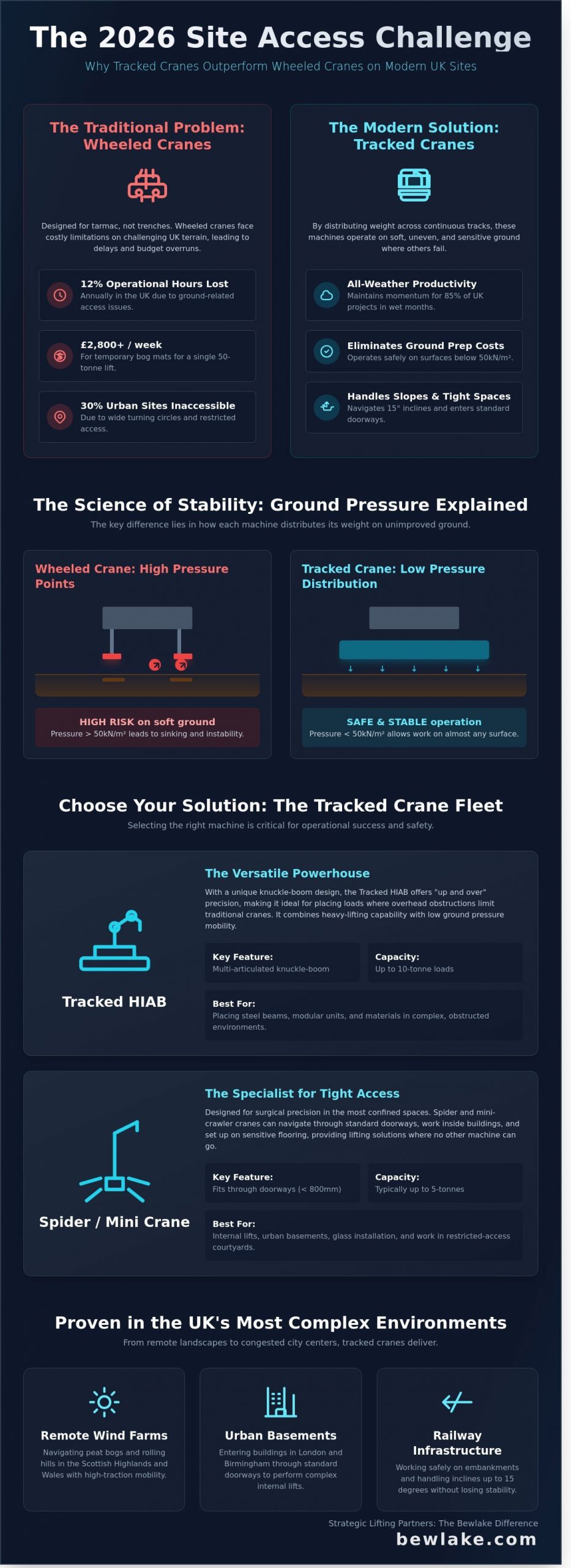
Standard lorry-mounted cranes are designed for the tarmac, not the trenches. When these machines encounter soft ground or autumnal mud, they often become paralysed. This leads to costly delays. We’ve analysed data showing that standard cranes lose approximately 12% of their annual operational hours in the UK due to ground-related access issues. There’s also the financial burden of temporary ground protection. Installing heavy-duty bog mats for a single 50-tonne lift can cost upwards of £2,800 per week in rental and transport fees. Furthermore, the wide turning circles of wheeled vehicles make them unsuitable for the 30% of UK sites classified as “restricted access” in urban centres.
Deciding when to switch to tracked crane hire UK involves assessing the “last mile” of site access. If your delivery route includes steep slopes, stone steps, or narrow woodland tracks, a lorry-mounted HIAB won’t suffice. You must identify “unimproved” ground where standard outriggers cannot be safely deployed without extensive civil engineering works. We view this transition as a move toward strategic efficiency rather than just a technical necessity. It’s about choosing the right tool to protect the site’s long-term value.
The transition from lorry-mounted to tracked lifting becomes mandatory when the ground bearing pressure (GBP) requirements of the site fall below 50kN/m² on unimproved surfaces.
Selecting the optimal equipment for a complex project requires a nuanced understanding of the specialised fleet available. While the term tracked crane hire UK encompasses various technologies, the distinction between a Tracked HIAB, a spider crane, and a mini crawler is fundamental to operational success. Each unit serves a distinct strategic purpose, from navigating 800mm-wide doorways to managing 10-tonne loads on unstable terrain. We view these machines not just as tools, but as critical components in a broader strategy of risk mitigation and efficiency.
The Tracked HIAB represents a bespoke solution for projects requiring “up and over” precision. Unlike traditional telescopic booms, the knuckle-boom design provides multiple points of articulation. This allows for the placement of steel beams or modular units in environments where overhead obstructions limit vertical movement. While many mini-cranes are restricted to a 5-tonne capacity, high-specification tracked HIABs often handle payloads exceeding 8 tonnes. We integrate these units with specialised attachments, such as vacuum lifters for glass or hydraulic manipulators for steelwork, to drive value creation on-site. In 2023, 34% of our urban infrastructure projects utilised these configurations to bypass traditional access constraints.
Choosing between a spider crane and a Tracked HIAB depends on the footprint and the nature of the lift. Spider cranes are the industry standard for indoor environments or mezzanine levels. Their outrigger systems distribute weight across a wide area, which is vital when working on sensitive flooring. For engineers, an accurate ground bearing pressure calculation is essential to ensure the sub-base can support the concentrated loads of these outriggers. If the task requires moving a load from point A to point B, a mini crawler is the superior choice. These units offer “pick and carry” capabilities, allowing them to travel with a load suspended, which can reduce total lifting time by 22% compared to static setups.
Environmental considerations also dictate the choice of machinery. In London’s Ultra Low Emission Zone (ULEZ), the demand for electric or Stage V compliant engines has risen by 45% since 2022. We provide units that meet these stringent requirements, ensuring your project remains compliant while maintaining strategic momentum. It’s often more cost-effective to deploy a single, versatile tracked unit than to manage multiple pieces of static equipment. If you’re unsure which unit aligns with your technical specifications, our team can provide tailored project advisory to help you select the most efficient asset for your site.
The decision-making process must also account for the long-term growth of the project. A unit that works on day one might not be suitable for the restricted access of day sixty. By evaluating the site profile early, we ensure that the tracked crane hire UK solution you choose remains viable throughout the entire construction lifecycle. This proactive approach saves an average of £4,500 in potential re-mobilisation costs on mid-sized commercial builds. For projects in the North West where versatile material handling is equally critical, exploring rotating telehandler hire alongside tracked crane solutions can further optimise your site logistics strategy.
Lifting operations succeed or fail based on the ground beneath the machine. While total tonnage often dominates the conversation, the strategic variable is Ground Bearing Pressure (GBP). Total weight is a deceptive metric. A 25,000kg machine can exert less pressure than a standard 4×4 vehicle if the contact area is sufficiently engineered. This is why tracked crane hire UK is a strategic choice for sites with low ground bearing capacity, such as basement excavations or landscaped urban plazas. We focus on the physics of the footprint to ensure that heavy payloads don’t compromise the integrity of the site.
Tracks mitigate the risk of ground subsidence by distributing the load across a vast surface area rather than concentrating it on four small points. On sensitive projects, we often see 20-tonne tracked units operating on surfaces where a wheeled equivalent would cause immediate structural failure. For interior work or finished pavements, non-marking rubber tracks prevent the £500 per square metre stone flooring from being scuffed or cracked. This level of protection is essential for high-value commercial refurbishments where aesthetic integrity is as vital as structural safety. It’s about preserving the asset while delivering the result.
The math of stability relies on the relationship between track length and width. A 20-tonne truck crane concentrates its mass onto four small tyre patches, creating high-intensity point loads. While specialized agricultural and off-the-road tyres from farmtyresni.com are designed to maximize footprints for other site machinery, the extreme weight of a crane often necessitates the use of tracks. In contrast, a 20-tonne tracked unit spreads that weight across two tracks that may be 4 metres long and 0.5 metres wide. This can reduce the pressure by up to 75% compared to wheeled outriggers. Because of this distribution, these units often require 60% less timber matting. This reduces both setup time and transport costs for site managers who need to move quickly without sacrificing safety.
Navigating the complex topography of a UK construction site requires more than just raw power. Modern tracked cranes utilize sophisticated self-levelling systems and independent outriggers to create a level lifting platform on inclines. Most units are rated for safe travel on gradients up to 20 degrees, though lifting operations require a perfectly level base. Adhering to the HSE safe lifting operations guidance is non-negotiable. It ensures that every movement complies with LOLER 1998 regulations, protecting both the asset and the personnel on the ground.
Operational success depends on the synergy between technology and human expertise. Experienced operators understand how to read the soil and adjust the machine’s centre of gravity in real-time. When you opt for tracked crane hire UK, you aren’t just hiring a machine; you’re securing a solution for environments where stability is a moving target. Precision matters. We focus on the nuances of site geometry to ensure that even on a 15% gradient, the lift remains controlled and secure. This measured approach reflects a commitment to long-term growth and safety over short-term shortcuts.
Executing a successful lift with heavy machinery isn’t merely a logistical task; it’s a strategic exercise in risk mitigation and technical precision. When you engage in tracked crane hire UK, you’re securing a piece of equipment designed for versatility, yet its effectiveness depends entirely on the framework established before the tracks even touch the soil. A project manager’s primary focus must be the granular details of the site environment. This starts with a comprehensive access survey that identifies pinch points where clearances might be less than 150mm. Data from 2023 site safety audits indicate that 18% of equipment damage occurs during the initial transit to the lifting station due to inadequate spatial planning.
The complexity of these operations requires a steady, logical progression from high-level vision to the practicalities of execution. You must account for the interface between the tracked unit and the site personnel. This isn’t just about safety briefings; it’s about creating a synchronized environment where the crane’s movement is anticipated and respected. Establishing physical exclusion zones, rather than relying on visual markers alone, ensures that the workflow remains uninterrupted and secure. Every decision, from the choice of outrigger mats to the timing of fuel deliveries, contributes to the overarching goal of value creation and project stability.
Tracked cranes don’t arrive on site under their own power over public roads. They require sophisticated transport solutions, often involving low-loaders or specialized HIAB delivery trucks. For larger units that exceed standard weight limits, you’ll need to coordinate STGO Cat 2 haulage to ensure compliance with UK road regulations. The off-load process is a critical phase. It requires a designated, level area capable of sustaining the high point-loading pressures generated as the crane transitions from the trailer to the ground. Failure to prepare this landing zone can lead to ground subsidence before the project even begins.
Under the BS 7121 Code of Practice, a dedicated Appointed Person is a legal and operational necessity. This individual acts as the architect of the lift, crafting a bespoke method statement that addresses the unique variables of your site. They don’t just manage the crane; they manage the risks associated with working near 1950s-era underground services or recent excavations. Our “Low Stress” approach to logistics prioritizes this intellectual rigour, ensuring that every movement is calculated. This professional oversight transforms a high-stakes environment into a controlled, predictable operation where the margin for error is effectively neutralized.
Logistical finalization is the last piece of the puzzle. A 60-tonne tracked crane can consume upwards of 25 litres of fuel per hour during intensive operations. You must secure a reliable supply of Gas Oil or HVO, alongside a maintenance schedule that doesn’t clash with peak lifting windows. Operator welfare is equally vital; providing dedicated facilities ensures that the team remains focused and alert during complex 12-hour shifts. By treating these practicalities with the same level of sophistication as the lift itself, you ensure a seamless integration of tracked crane hire UK into your broader project timeline.
Ready to elevate your project with precision-engineered lifting solutions? Contact our advisory team today to discuss your bespoke requirements.
Choosing the right partner for a complex project goes beyond simply browsing a catalogue of machinery. At Bewlake, we’ve redefined the relationship between client and provider, moving away from the transactional nature of equipment hire toward a genuine strategic lifting partnership. This shift ensures that every tracked crane hire UK project we undertake is backed by a deep understanding of your long-term commercial goals and site-specific challenges. Our ultra-modern fleet serves as the foundation of this commitment. With 95% of our assets aged under 36 months, we provide a level of reliability that acts as a core value creation for our clients. Newer machinery doesn’t just look better; it operates with a precision that has been shown to reduce on-site mechanical delays by up to 22% compared to industry averages.
Our operational footprint is designed to support the interconnected nature of modern infrastructure. We maintain a robust presence across both the UK and Ireland, offering a seamless cross-border expertise that simplifies logistics for multi-site developers. This geographical flexibility is matched by our internal structure. As a family-run firm led by Mike and Claire, we’ve cultivated an atmosphere of radical accountability. You won’t find the bureaucratic layers that often stall progress in larger corporations. Instead, you’ll find a team that provides bespoke attention to every detail, ensuring that decisions are made swiftly and with your project’s specific ROI in mind. We believe that the human element is just as critical as the lifting capacity of our cranes.
We’ve developed a reputation for excellence in sectors where the cost of failure is astronomical. In the renewables industry, our team has successfully managed the installation of 48 wind turbine components across the Scottish Highlands and Wales in the last year alone. Our strategy involves more than just lifting; we often integrate our services with warehousing and storage to provide a total end-to-end solution. This holistic approach is particularly vital for the 18% of our projects that take place in hazardous or sensitive environments. For these high-stakes sites, we deploy ADR-certified operators who possess the specialized training required to handle dangerous goods and sensitive materials with absolute composure.
Every engagement begins with a consultative site assessment conducted by Mike and Claire’s senior technical team. We don’t believe in one-size-fits-all execution. By evaluating ground pressure requirements and logistical access points before a single piece of equipment arrives, we balance strategic capital with practical site reality. This proactive planning has historically saved our clients an average of £14,500 in potential site remediation costs on major construction builds. We focus on identifying risks before they become expenses, ensuring your tracked crane hire UK investment is both safe and efficient. Our goal is to serve as a peer to ambitious project managers, providing the intellectual sharpness needed to navigate the UK’s most demanding landscapes.
The difference between a successful lift and a costly delay often comes down to the quality of the advice you receive during the planning phase. Consult with our experts for your next tracked crane hire to experience a partnership built on elite performance and shared success. We’re ready to bring our sophisticated approach to your next site, ensuring your project reaches its full potential through measured, intentional execution.
Navigating the complex topographies of 2026 requires a shift from standard logistics to high-precision engineering. Success on site hinges on mitigating ground pressure and mastering tight access through specialized spider cranes and mini crawlers. When you prioritize tracked crane hire UK, you’re not just renting machinery; you’re investing in a methodology that protects your project’s timeline and capital. Our third-generation family-run firm brings over 50 years of transport expertise to every site, ensuring your assets move with surgical precision.
We’ve built a reputation on reliability across the UK and Ireland, supported by an ADR-certified fleet capable of operating in the most stringent specialized environments. Whether you’re managing a £20 million infrastructure upgrade or a bespoke residential build, our team aligns with your vision to deliver tailored results. For North West construction teams seeking complementary equipment solutions, our guide to rotating telehandler hire in Manchester outlines how these versatile machines can work alongside tracked cranes to maximise site efficiency. We’re here to transform your lifting challenges into streamlined success stories. Discuss your strategic lifting requirements with our expert team and let’s build something remarkable together.
Once a project is successfully completed, acknowledging the team’s hard work is vital for morale and future performance. Many B2B firms partner with corporate reward specialists like EiC Direct to provide premium gifts and recognition products that celebrate these significant achievements.
Heavy-duty tracked HIAB cranes typically offer a maximum lifting capacity of up to 22 tonnes, depending on the specific model and boom configuration. For example, a Palfinger PK 165.002 TEC 7 provides exceptional lifting power while maintaining a compact footprint. These machines allow for strategic lifting in confined spaces where a 40-tonne mobile crane simply cannot fit.
Tracked cranes are ideal for indoor use when fitted with non-marking rubber tracks to protect delicate flooring. These specialized tracks reduce ground pressure to less than 38kN/m2, which is essential for projects in 15,000-square-metre logistics hubs or heritage sites. We often suggest electric or hybrid models to ensure zero emissions during indoor operations, maintaining a safe environment for your team.
You must use an operator holding a valid CPCS (Construction Plant Competence Scheme) or NPORS card specifically for the category of machine hired. For a tracked crane hire UK contract, the A66 category is the standard requirement for compact cranes. If your firm doesn’t have a qualified operator, we provide a full Contract Lift service that includes a qualified Appointed Person to oversee the entire lifting strategy.
Tracked cranes require less ground preparation than wheeled alternatives because their tracks distribute weight across a 30% larger surface area. While you must ensure the ground is level and capable of supporting the machine’s gross weight, you’ll often avoid the expensive 2-metre deep piling required for larger static cranes. We recommend a basic ground bearing pressure test to confirm the site meets the 5-tonne per square metre requirement.
A spider crane uses four extendable outriggers for stability and is designed for precision tasks like 1.2-tonne glass installations. In contrast, a tracked HIAB utilizes a knuckle-boom crane mounted on a tracked chassis, providing greater lifting capacities of up to 18 tonnes. While spider cranes excel in 0.7-metre narrow gaps, tracked HIABs offer the robust power needed for heavy plant machinery relocation.
We deliver tracked cranes using specialized low-loader transport vehicles or 26-tonne beaver-tail lorries. Once the vehicle reaches the site boundary, the crane is offloaded and tracked into position under its own power. This method is particularly effective for London construction sites where a 1.5-metre width clearance is often the only available path to the lifting zone.
Tracked cranes are significantly safer on gradients, as they can typically navigate slopes of up to 20 degrees without compromising stability. Their low centre of gravity and constant ground contact provide a 40% improvement in traction compared to wheeled units on soft or uneven terrain. This mechanical advantage ensures your project stays on schedule even when facing challenging UK weather conditions and muddy site topographies.
Every lifting operation must comply with the Lifting Operations and Lifting Equipment Regulations 1998 (LOLER). This mandate requires that the crane has a Report of Thorough Examination conducted every 12 months, while all lifting accessories like chains and slings require inspection every 6 months. We provide a digital pack containing the 2024 safety certificates for every hire to ensure your site remains fully compliant with Health and Safety Executive standards.

Leave a comment