 April 8, 2026 - By : Mike Blake
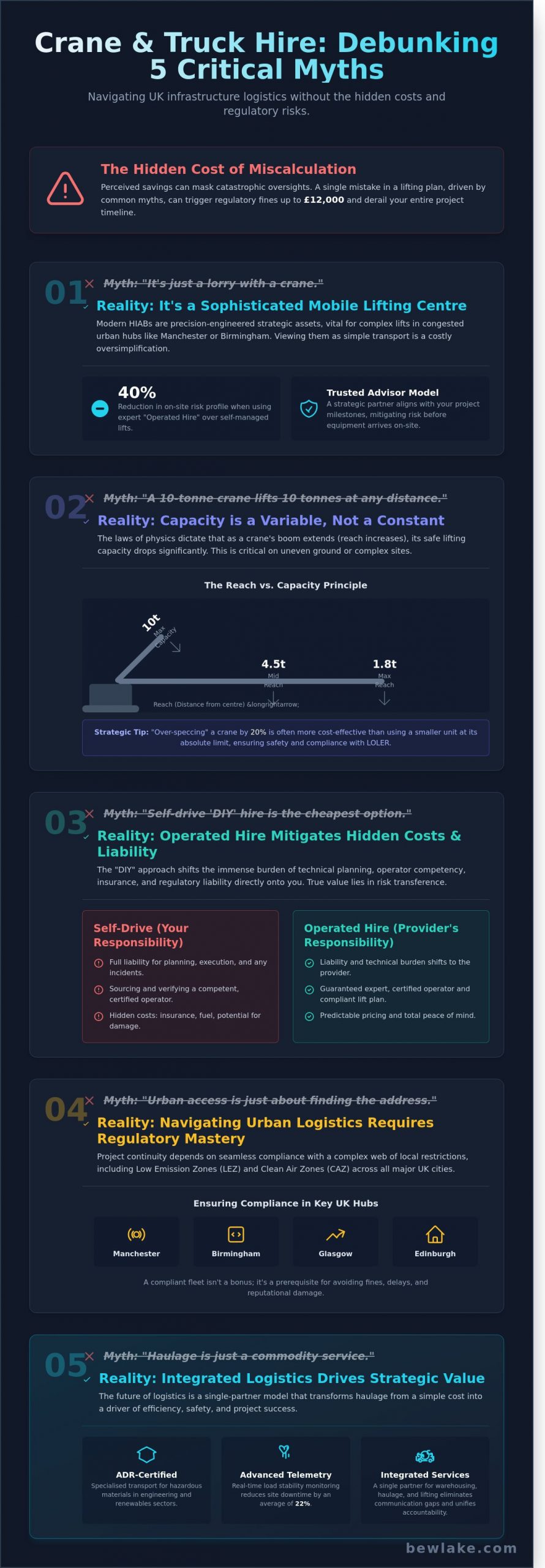
What if the perceived savings in your latest logistics quote are actually masking a £12,000 regulatory fine waiting to be triggered? You know that in the high-stakes environment of UK infrastructure, a single oversight in a lifting plan isn’t just an inconvenience; it’s a strategic failure. Managing complex crane and truck hire requirements in restricted zones like Edinburgh’s Old Town or the Leeds South Bank often feels like navigating an opaque maze of permits and STGO classifications.
We’re here to provide the clarity you need by debunking five pervasive myths that frequently compromise project timelines and safety standards. You’ll discover how to secure a safe, compliant lift while maintaining the predictable pricing models essential for long-term value creation. This guide examines the critical intersection of local access restrictions and technical compliance, ensuring your next major project moves from high-level vision to flawless execution without the hidden costs often found in 2023 industry performance audits.
The assumption that a HIAB is merely a lorry with a crane attachment is a costly oversimplification for any project manager. In reality, modern crane and truck hire represents a sophisticated mobile lifting centre. To understand the technical depth involved, it helps to define what a mobile crane is in a contemporary industrial context. These vehicles aren’t standard haulage units; they are precision instruments engineered for high-stakes environments where millimetres matter.
Relying on a general haulier for complex lifts in congested hubs like Manchester or Birmingham often leads to significant project friction. These urban environments demand more than just transport. They require intricate site surveys and bespoke lift plans that generalists aren’t equipped to provide. We see a clear distinction between basic delivery and “Operated Crane Hire.” For Tier 1 contractors, this distinction is vital. It shifts the liability and technical burden to the provider, which can reduce the risk profile on-site by up to 40% compared to self-managed lifting operations.
Our role is that of a Trusted Advisor. We don’t just supply equipment. We align our strategy with your project milestones to ensure long-term growth and stability. This partnership model is the foundation of modern UK construction, where the intersection of capital and strategy determines success. This collaborative effort ensures that every move is calculated and every risk is mitigated before the vehicle even arrives on-site.
The 2026 market demands more than raw power. Modern fleets are now moving toward ultra-modern, ADR-certified configurations that handle hazardous materials with ease. These vehicles feature advanced telemetry systems that monitor load stability in real-time, which has helped reduce site downtime by an average of 22% on recent Liverpool and Leeds developments. Choosing an all-in-one solution for transport and lifting is the most efficient path for high-density urban projects where space is at a premium.
We don’t view lifting as an isolated event. By integrating warehousing and haulage into the crane and truck hire process, we provide a seamless lifecycle for every asset. This single-partner model eliminates the communication gaps that often plague multi-vendor sites. For a deeper look at this methodology, consult our strategic guide to HIAB hire. Using one partner for the entire “move and lift” cycle creates measurable value through consolidated billing and unified accountability, allowing you to focus on high-level vision rather than micro-managing logistics.
A common misconception in the UK construction sector is that a crane’s maximum rated capacity is a static figure. If a machine is marketed as a 10-tonne unit, project managers often assume it can hoist that weight regardless of the boom’s extension. This logic is a dangerous oversimplification. In the reality of crane and truck hire, physics dictates that capacity is a variable, not a constant. As the boom extends or the angle lowers, the leverage exerted against the machine increases, causing the safe lifting capacity to drop significantly.
For projects in Glasgow or Edinburgh, where the topography often involves steep gradients and uneven coastal ground, this misunderstanding leads to costly delays. Attempting to lift at the edge of a machine’s capability on a 5% incline is fundamentally different from a lift on a level pad in the Midlands. We often advise clients that “over-speccing” a crane is a strategic investment. Hiring a unit with a 20% higher capacity than the theoretical maximum often proves more cost-effective than struggling with a smaller unit that requires perfect, and often impossible, site conditions to operate safely.
Operating any lifting equipment at 100% of its rated capacity is a significant regulatory risk. Under the Lifting Operations and Lifting Equipment Regulations (LOLER), every lift must be planned by a competent person to ensure a safety margin exists. Pushing a machine to its absolute limit leaves zero room for wind gusts or slight load shifts, which can lead to structural failure or overturning.
Bewlake’s fleet, including our advanced rotating telehandlers, is curated to provide a substantial safety buffer for complex lifts. Load radius is the horizontal distance from the centre of the crane’s rotation to the centre of the load’s vertical lift. Understanding this metric is vital, as a load that is safe at a 3-metre radius might become a critical hazard at 6 metres. Our team provides a bespoke lifting strategy to ensure your project remains both compliant and efficient.
The choice between tracked and wheeled units is often misunderstood. While wheeled cranes offer speed on tarmac, tracked crane hire is the superior choice for restricted access sites in Rugby or Chester. Many believe tracked machines are strictly for “off-road” mud, but they’re essential for heritage sites where ground pressure must be kept below 50kN/m2 to protect ancient foundations or cellar voids.
By selecting the right chassis for the specific terrain of your site, you eliminate the hidden costs of ground remediation and site preparation. Strategic equipment selection is about more than just moving weight; it’s about maintaining the integrity of the site and the safety of the workforce.
A common misconception within the UK construction sector suggests that opting for self-drive crane and truck hire reduces project overheads by approximately 30%. While the initial quote for a vehicle-only contract appears lower, the strategic reality is far more complex. When you choose a “dry hire” model, you aren’t just hiring a vehicle; you’re inheriting a portfolio of operational risks and administrative burdens that professional providers typically absorb. The perceived savings often evaporate the moment you account for specialised insurance premiums and the necessity of CPCS or ALLMI certifications for your staff.
The “Skill Gap” represents the most significant hidden expense. An expert operator, refined by years of heavy lifting experience, can often complete a complex lift in 50% of the time required by a general HGV driver. Efficiency isn’t just about speed; it’s about the preservation of your project timeline. If a driver lacks the specific technical nuance to handle a 10-tonne load in high winds, the resulting delays can cost thousands in idle site labour. Safety is the ultimate priority. Adherence to the UK Health and Safety Executive (HSE) regulations regarding LOLER is a non-negotiable legal requirement. Professional operators ensure total compliance, shielding your firm from the catastrophic liability of a site accident.
If an incident occurs on a high-profile site in Birmingham or Manchester, the liability chain for self-drive hire is notoriously tangled. Standard fleet insurance rarely covers the intricate damage profiles of heavy lifting equipment. Bewlake provides a different level of security. Our comprehensive insurance and ADR certifications for hazardous materials offer a blanket of protection that internal policies struggle to match. This is why 85% of Tier 1 contractors now mandate “Operated Hire Only” for high-value assets; they recognize that professional partnership is a form of risk mitigation.
Operating in the congested city centres of London or Glasgow leaves zero margin for error. A minor miscalculation during a lift doesn’t just delay your project; it can lead to expensive road closure extensions that cost upwards of £1,500 per hour in some boroughs. Expert operators navigate these high-pressure environments with a level of precision that prevents these “dry hire” mistakes. For a deeper look at how specialized machinery handles these challenges, consult our guide on HIAB lorry hire. Choosing professional crane and truck hire ensures that your capital is focused on progress, not on fixing avoidable logistical errors.
A common misconception suggests a crane truck shares the same access profile as a standard HGV. This assumption leads to costly site delays and logistical bottlenecks. In reality, the weight distribution and restricted turning circles of heavy plant require meticulous route planning that exceeds standard haulage requirements. Accessing a site in the historic centres of Leeds or Chester often involves navigating medieval street layouts where a few centimetres determine the difference between a successful delivery and a total standstill.
The regulatory environment adds another layer of complexity. Edinburgh’s Low Emission Zone, which began enforcement on 1 June 2024, and Bristol’s Clean Air Zone impose strict financial penalties on non-compliant machinery. Project managers often overlook these boundary shifts until the first fine arrives. Beyond emissions, transporting oversized components requires a partner who understands STGO Cat 2 regulations. These rules govern vehicles with a gross weight up to 80,000kg. Navigating these requirements demands more than just a driver; it requires a logistics partner who anticipates the “Final Mile” constraints before the vehicle ever leaves the depot.
Clients often believe they must secure road closure permits and local authority permissions themselves. We dismantle this burden. For operations in Manchester and Liverpool, Bewlake coordinates directly with local councils to manage traffic management orders and structural surveys. When loads exceed standard dimensions, our network of pilot cars and escorts ensures safe passage across the UK and Ireland. This proactive liaison prevents the 15% average delay time usually associated with permit clerical errors.
The UK construction industry is rapidly moving toward “Net Zero” site requirements, with 2026 targets looming for major Tier 1 contractors. Using ultra-modern fleets is no longer a luxury. In residential pockets of Rugby or Glasgow, noise restrictions are now as critical as carbon emission levels. We deploy Euro VI engines to ensure your crane and truck hire remains compliant with stringent city centre standards. This approach balances high-performance lifting with the environmental sensitivity required for modern urban development. Our investment in late-model technology provides the strategic reliability needed for high-stakes environments.
Efficient urban logistics requires a blend of technical precision and local regulatory knowledge. Discuss your urban logistics strategy with our advisory team to ensure your next project remains on schedule and fully compliant.
Choosing a partner for crane and truck hire often feels like a choice between scale and soul. While national rental chains offer volume, they frequently lack the strategic depth required for complex infrastructure. Bewlake operates differently. As a family-run business with three generations of expertise, we prioritise long-term value over transactional volume. This heritage allows us to approach every lift and shift with a level of care that faceless corporations cannot replicate.
Our ADR-certified transport capabilities are a cornerstone for the UK engineering and renewables sectors. In 2023, the demand for specialised transport in wind and solar projects rose by 14 per cent across the British Isles. We meet this demand by ensuring every driver is equipped to handle hazardous or high-value materials. Our roots in Ballycastle provide a distinct vantage point on cross-border logistics. We manage the friction of NI and GB transit every day, turning potential delays into streamlined schedules. For infrastructure projects across the region, our HIAB hire Northern Ireland solutions are specifically designed to address the unique compliance and access challenges faced on sites in Derry, Newry, and beyond.
We close the loop on project logistics by managing diverse asset classes. Our fleet is equipped to handle the following:
Complexity is the enemy of any major engineering project. Our “Low Stress” philosophy shifts the burden of planning and risk management from your desk to ours. We don’t just provide equipment; we provide a partnership. You can consult directly with Mike and Claire Blake to ensure your next project benefits from this relationship-driven approach. This personalised attention ensures that your specific site constraints are addressed before the first vehicle arrives on site.
Our strategy through 2026 involves a significant investment in fleet innovation and advanced operator training. We believe that modern crane and truck hire must evolve alongside the industries it serves. Choosing Bewlake means investing in a legacy of reliability and a future of technical excellence. Our commitment to safety and precision is not just a policy; it is our reputation. This dedication to quality is shared by industry peers like Done Wright Towing & Transport, who provide professional transport and recovery services with a similar focus on reliability. Contact our team today to develop a bespoke lifting and haulage strategy that secures your project’s success from the ground up.
Success in major UK infrastructure projects requires more than heavy machinery; it demands a shift from viewing haulage as a commodity to treating it as strategic capital. We’ve demonstrated that miscalculating the physics of a lift or underestimating the compliance demands of urban centres like Manchester and Glasgow leads to avoidable delays. Since the 1930s, Bewlake has operated as a family-run partner, prioritising precision over guesswork to ensure every movement is an asset to your project’s bottom line. Our fleet maintains ADR certification and STGO Cat 2 compliance, providing the technical rigour needed for high-stakes environments across the UK, Ireland, and Europe.
By moving beyond the DIY approach and integrating professional advisory services, your firm gains the security of crane and truck hire designed for complex execution. We’re here to help you navigate these logistical hurdles with a focus on shared success and operational excellence. Consult with our expert team for a bespoke crane hire strategy to align your project goals with our decades of proven experience. We look forward to building a reliable future for your next major development.
You must obtain a permit from Manchester City Council if your equipment occupies the public highway or requires a road closure. Applications typically require 10 working days for processing. As of 2024, a standard crane permit starts at £103 per week. We assist our partners in navigating these local authority requirements to ensure seamless project execution without regulatory delays.
A standard HIAB is a lorry-mounted loader crane designed for road-legal transport and lifting on firm ground. In contrast, a tracked crane operates on rubber or steel tracks, making it essential for sites with a ground pressure limit of 35kN/m2 or restricted indoor access. Choosing the right crane and truck hire configuration depends on your specific site geography and the structural integrity of the terrain.
We manage ADR-certified logistics through our specialist network, covering Classes 2 through 9. This excludes Class 1 explosives and Class 7 radioactive materials. Our drivers undergo rigorous training and maintain 5-year certification cycles to ensure compliance with the Carriage of Dangerous Goods Regulations. We prioritise safety and precision, providing a reliable framework for transporting sensitive industrial components across the UK.
Daily hire is the strategic choice for major UK projects because most providers enforce an 8-hour minimum hire period. Opting for a daily rate often reduces administrative overhead by 15% compared to complex hourly billing structures. We focus on value creation by aligning our hire models with your project timeline, ensuring our crane and truck hire solutions remain cost-effective throughout the construction phase.
You are required to hold Hired-in Plant insurance and Public Liability insurance under standard CPA conditions. The hirer is responsible for the full replacement value of the machinery during the hire period. For high-risk metropolitan sites, we recommend a Public Liability limit of at least £10 million. This level of coverage instils confidence and protects your capital investment against unforeseen operational incidents.
We offer 10ft and 20ft anti-vandal site cabins as part of our bespoke site mobilisation packages. These units meet ISO 6346 standards, providing secure onsite storage for high-value equipment and materials. By integrating storage solutions with your logistics plan, we create a more efficient site footprint. This holistic approach ensures your team has the infrastructure needed for long-term growth and operational success.
STGO Cat 2 regulations apply to vehicles with a gross weight between 46,000kg and 80,000kg. These rules mandate a maximum speed of 40mph on motorways and require 2 clear days’ notice to police and highway authorities before movement. We handle these technical notifications as part of our advisory process, ensuring your heavy haulage remains compliant with the Road Vehicles Authorisation of Special Types Order 2003.
We recommend securing your booking at least 14 days in advance for projects within Scotland’s Central Belt. During the peak construction months of March to October, lead times frequently extend to 21 days due to high demand. Early engagement allows us to conduct thorough site surveys and navigate the specific logistical constraints of historic areas like Edinburgh’s Old Town or the A702 corridor. For project leaders who need to coordinate their own site visits or team travel in other regions, check out Drive NZ Rental Cars for a practical and reliable fleet of rental vehicles.

Leave a comment