 April 25, 2026 - By : Mike Blake
What if the most significant risk to your 2026 project timeline isn’t a global supply chain shift, but the final ten metres of site access? In the constrained urban landscapes of Manchester and Glasgow, the margin for operational error has become non-existent. You likely recognise that a single oversight in heavy load positioning can trigger costly ground damage or a breach of stringent UK abnormal load regulations. Recognising the value of professional Container Lifter Services is the first step toward securing your site’s integrity and ensuring a seamless transition from transit to placement.
We view every logistical challenge as an opportunity for strategic alignment and value creation. This guide provides a clear roadmap for leveraging specialised lifting technology to achieve zero-damage delivery and absolute compliance with current UK safety standards. We will detail the sophisticated methods used to optimise site workflows, allowing your team to focus on growth while we handle the complexities of precision logistics.
As UK infrastructure demands grow in 2026, logistics has transcended the simple movement of goods. Container Lifter Services now represent a specialised discipline within the broader intermodal freight transport framework, focusing on heavy-duty lifting where precision is the primary objective. We view this as a transition from basic haulage to “point-of-use” positioning. This approach ensures that 20ft and 40ft units aren’t just dropped on a site, but are integrated into a project’s workflow with surgical accuracy.
Maintaining the structural integrity of these units is paramount. Even a slight torsion during a lift can compromise the rigid ISO-standard frame. Our focus on Strategic Lifting addresses the reality of modern UK sites in cities like Manchester and Glasgow, where space is a premium asset. By utilizing advanced hydraulic systems, we help partners maximize limited footprints, often achieving vertical density that was previously considered too risky or complex. This strategic approach turns a logistical necessity into a tool for value creation.
Millimetre-perfect placement is no longer a luxury; it’s a technical requirement for Modular Buildings and complex stacked configurations. If a unit is out of level by even 5mm, door alignment fails and weatherproofing seals are compromised. Container Lifting is the controlled movement of ISO-standard units using specialised hydraulic attachments. This level of control prevents the racking of frames that often occurs with substandard equipment, ensuring the unit remains a bespoke solution for its intended environment.
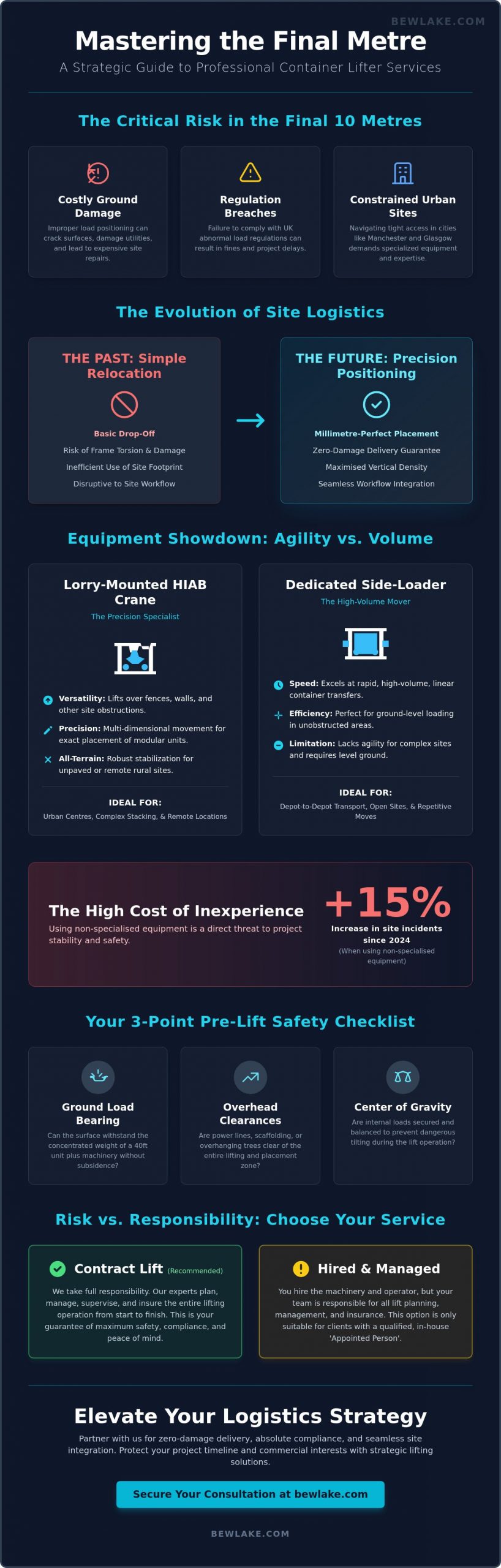
Distinguishing between a standard delivery and a complex site reconfiguration is vital for operational safety. Professional intervention becomes necessary when site conditions involve subsidence risks, blocked access, or the requirement for multi-unit stacking. This expertise is particularly critical for Site Cabins used as welfare units, where secure, level foundations are mandated by HSE standards. We’ve seen a 15% increase in site-related incidents since 2024 when using non-specialised equipment, proving that bespoke Container Lifter Services are a prerequisite for long-term project stability and safety.
Effective lifting requires a blend of high-level strategy and technical execution. We focus on the following factors during every engagement:
Selecting the right equipment for Container Lifter Services determines the efficiency of a project’s entire supply chain. While side-loader trucks excel at high-volume, linear transfers on level ground, they lack the agility required for complex sites. We often see side-loaders struggle with the Challenges facing urban logistics, where space is a premium and positioning must be exact. In contrast, lorry-mounted HIAB cranes provide the multi-dimensional movement necessary to navigate these constraints.
For rural sites across the UK and Ireland, all-terrain lifting capabilities are essential. Unpaved ground or remote locations require vehicles with robust stabilization and high-torque drivetrains. Hydraulic reach allows an operator to lift a 20ft or 40ft unit over physical barriers like 2.5-metre perimeter fences, walls, or parked vehicles. This capability eliminates the need for expensive site clearance or the temporary removal of obstructions, saving both time and capital. The same precision HIAB technology that serves container logistics is equally critical for specialist applications such as hire boats near me operations, where a single centimetre of miscalculation during a lift can cause significant damage to a bespoke vessel.
Safety remains the cornerstone of our operational philosophy. We ensure that every lift involving hazardous materials is managed by ADR-certified operators. This certification confirms the driver’s specialized training in handling dangerous goods, providing a layer of security for high-stakes industrial deliveries. It’s a standard that mitigates risk and ensures compliance with stringent UK environmental regulations.
A strategic hiab hire offers a level of flexibility that dedicated side-loaders cannot match. In tight urban residential areas, the ability to rotate and place a container at a 90-degree angle is a significant operational advantage. Understanding the balance between reach and capacity is vital. For example, a crane might lift 12 tonnes at a 4-metre radius, but that capacity reduces significantly as the boom extends to 18 metres. Remote-controlled systems allow our operators to stand at the exact point of placement, ensuring millimetre-perfect alignment while maintaining a safe distance from the load.
Precision isn’t just about the crane; it’s about the interface between the machine and the cargo. We utilize specialized hardware to maintain the structural integrity of every unit.
Our approach integrates these technical specifications into a broader strategy for value creation. If you are looking to optimize your site delivery and logistics, we invite you to explore our bespoke solutions tailored for the evolving UK market.
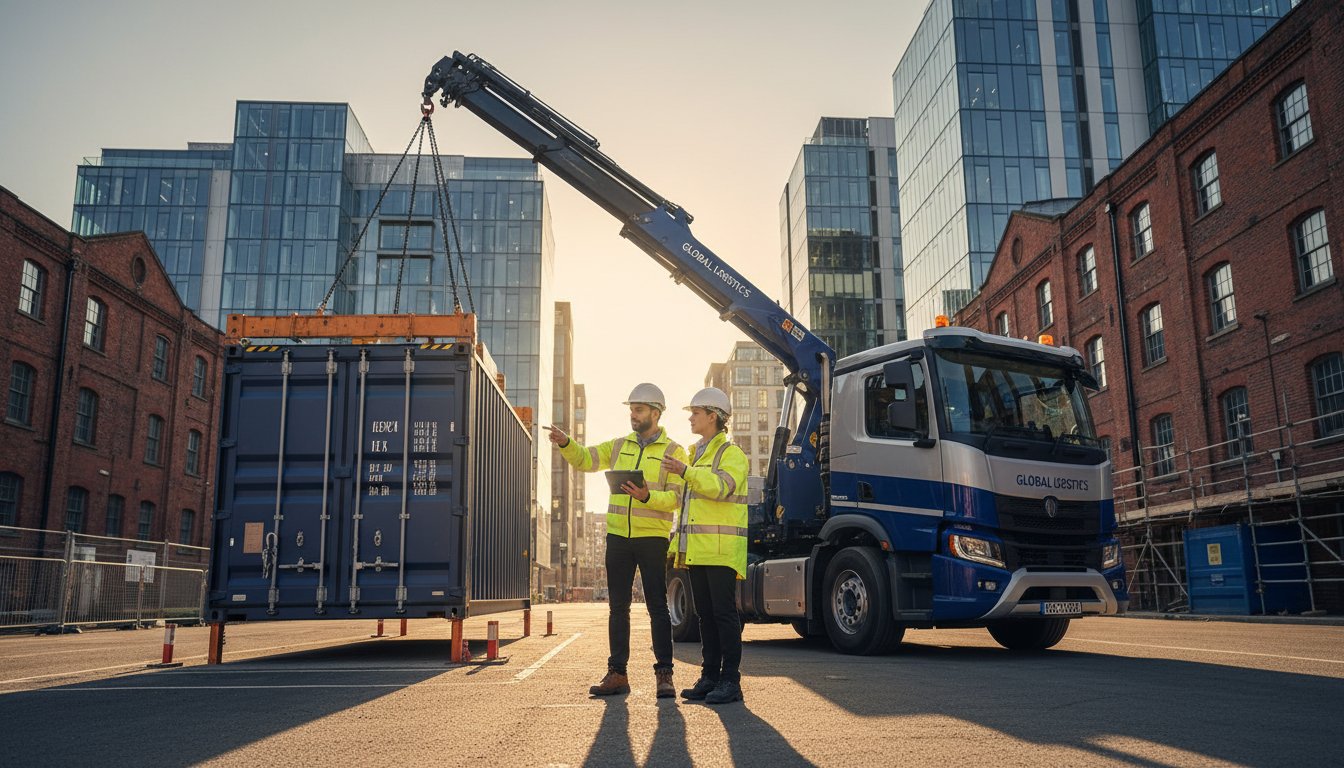
Urban environments like Manchester and Glasgow demand more than just heavy machinery; they require a strategic alignment of spatial awareness and regulatory precision. Historic city centres weren’t designed for the 40ft footprint of modern global trade. Deploying Container Lifter Services in these areas requires a deep understanding of local bylaws and the physical constraints of Victorian architecture. We focus on bespoke solutions that respect the architectural heritage while maintaining the pace of 2026 industrial requirements.
Environmental regulations have fundamentally altered fleet selection. Birmingham’s Clean Air Zone (CAZ) and Glasgow’s Low Emission Zone (LEZ) impose strict standards on heavy goods vehicles. Operating non-compliant machinery in these zones can result in daily charges exceeding £100 per vehicle. We mitigate these overheads by utilizing a modern, Euro VI compliant fleet. This strategic approach ensures project budgets remain predictable and aligned with corporate sustainability goals.
Local knowledge is the difference between a seamless delivery and a costly delay. In Leeds and Liverpool, narrow access routes and low-hanging rail bridges often create “dead zones” for standard transport. Our team conducts pre-site surveys to identify these height restrictions before the vehicle leaves the depot. Furthermore, in towns like Rugby and Chester, we manage the complex coordination required for pavement closures. This includes securing Temporary Traffic Management Orders (TTMOs) from local councils, ensuring that Container Lifter Services are executed without compromising public safety or local traffic flow.
Managing restricted access lifting in the industrial corridors of the North West involves precision engineering. We recently facilitated a project in Manchester Wharf where the proximity to the canal required specialized weight distribution mats. In Edinburgh, delivering site accommodation to high-density construction projects meant operating within millimetres of Grade II listed structures. When ground conditions are compromised, such as in regional parks or undeveloped sites, we deploy tracked crane hire UK solutions. This technology solves soft-ground issues by distributing the load across a wider surface area, protecting the terrain and the cargo.
Safety remains our primary benchmark for success. We adhere strictly to the UK Health and Safety Executive (HSE) guidelines regarding the Lifting Operations and Lifting Equipment Regulations (LOLER). For 40ft container transport, we handle the “Abnormal Loads” notification process through the ESDAL system, providing the required two clear days’ notice to police and highway authorities. Our adherence to the Fleet Operator Recognition Scheme (FORS) Silver standard provides clients in Birmingham and Rugby with the assurance that every lift is governed by elite safety protocols and environmental consideration.
Safety represents the primary driver of value in any heavy lifting operation. It’s not just a matter of compliance; it’s about protecting your capital and ensuring operational continuity across your supply chain. When deploying Container Lifter Services, the margin for error is non-existent. A single oversight in site preparation can lead to structural damage or significant project delays that ripple through your entire schedule.
One of the most critical decisions involves the distinction between a “Contract Lift” and “Hired & Managed” services. Under standard CPA (Construction Plant-hire Association) conditions, a hired-in crane puts the entire burden of planning, supervision, and insurance on you. Conversely, a Contract Lift transfers the risk to the service provider. They take full responsibility for the method statement, risk assessment, and insurance cover. This shift in liability is often the most cost-effective way to manage high-value assets and protect your bottom line.
Ground pressure calculations are another non-negotiable factor. A fully loaded 40ft container can weigh 30 tonnes; add the weight of the crane, and the pressure on the ground is immense. Without a professional survey to determine the surface’s load-bearing capacity (measured in kN/m2), outriggers can sink. This is why we insist on using a qualified Slinger Signaller for every project. This individual acts as the crane operator’s eyes, managing the load’s path and ensuring the exclusion zone remains secure throughout the lift.
Utilising a strategic guide to contract lifting is essential for high-value projects where precision is a requirement rather than an option. This approach clarifies insurance implications, specifically identifying who is liable for the lift, the load, and the site itself. Our approach to Method Statements and Risk Assessments (RAMS) focuses on identifying hazards before the equipment even arrives on site. We don’t just provide Container Lifter Services; we provide a managed environment where risk is systematically eliminated. This level of oversight ensures your project stays on schedule and within budget.
Bewlake operates as a third-generation family-run business with deep, generational roots in the UK transport infrastructure. This heritage provides a level of stability and institutional knowledge that newer entrants cannot replicate. We apply a “Low Stress” philosophy to every engagement, whether we’re handling complex residential relocations or large-scale commercial logistics. This approach focuses on removing the friction points that typically plague heavy lifting projects, ensuring a seamless transition from point A to point B.
Our commitment to excellence is reflected in an ultra-modern fleet. We invest heavily in the latest technology, including ADR-certified vehicles designed for specialized and hazardous requirements. We don’t just provide equipment; we offer a peer-to-peer relationship to ambitious founders and project leads. We understand that your reputation is tied to the successful execution of these moves. By positioning ourselves as a trusted advisor, we ensure our Container Lifter Services align perfectly with your broader corporate objectives and operational timelines.
High-level logistics is fundamentally about capital preservation. When a site sits idle due to poor coordination, the financial drain is immediate. Industry data suggests that unplanned downtime in engineering sectors can cost projects upwards of £2,500 per hour in lost productivity. Our managed transportation model prioritizes efficiency to reduce these risks and prevent asset damage. We treat your equipment as strategic capital—whether it is a heavy industrial unit or a precision-engineered HiFi Rack for sensitive audio components—ensuring every move contributes to value creation rather than overhead.
We specialize in tailoring solutions for high-growth sectors across the UK and Europe, including:
A bespoke project managed by Bewlake offers far more value than a simple ad-hoc hire. It’s a calculated move toward long-term growth and operational security, moving with a steady, logical progression from initial vision to final execution.
For e-commerce and retail businesses, this strategic approach to physical assets is often paired with the end-to-end fulfilment expertise of EZ3PL Ltd, creating a seamless transition from site setup to operational delivery.
The complexity of modern logistics requires more than a standard checklist. Every site has unique challenges, from tight urban access in Manchester to remote locations in the Scottish Highlands. Engaging in an early-stage consultation allows our team to integrate with your site planning process, identifying potential bottlenecks before they impact your timeline. This proactive strategy is why we remain the preferred choice for Container Lifter Services in 2026.
We invite you to request a bespoke quote tailored to your specific site challenges. Our team is ready to provide the sophisticated oversight and calm reliability your project deserves. Partner with Bewlake for your next precision lifting project and experience the difference that strategic partnership makes to your bottom line.
Navigating the complexities of urban logistics in Manchester and Glasgow requires more than just heavy machinery; it demands a partnership rooted in precision and long-term value. We’ve explored how the right Container Lifter Services bridge the gap between technical execution and strategic growth. By leveraging a FORS and ADR certified fleet, businesses can mitigate risk while maintaining the fluid movement of goods across the UK. Our three generations of family-run expertise ensure that bespoke lifting solutions are never a one-size-fits-all approach. Whether you’re managing a high-stakes site in the North West or coordinating complex movements in Scotland, the focus remains on safety, compliance, and operational excellence. It’s about securing your supply chain with a team that views your success as a shared milestone. Let’s define the next phase of your project’s growth together.
Consult with our Specialist Lifting Team
We look forward to bringing a new standard of reliability to your next major lift.
A container lifter typically requires a minimum of 10 metres of lateral clearance to extend its hydraulic outriggers and position the unit safely. We advise clients to maintain a total operating width of 12 metres to account for vehicle manoeuvring and site safety margins. This spatial precision ensures our Container Lifter Services remain efficient while protecting your onsite infrastructure from accidental damage.
You can absolutely lift a shipping container that’s fully loaded, provided the total weight doesn’t exceed the safe working load of 36 tonnes. Our specialised equipment handles heavy lifts where standard haulage might fail. This capability allows for the seamless relocation of inventory without the logistical burden of decanting goods, which preserves your operational momentum and protects your high value assets.
You must obtain a Section 171 licence from the Manchester City Council or Birmingham City Council if the lift occurs on a public highway. These permits usually cost between £150 and £300 depending on the local authority’s 2025 fee structure. We coordinate with local councils to ensure all legal frameworks are satisfied before the vehicle arrives, preventing any costly delays or fines.
A side-loader lifts the container parallel to the trailer, while a HIAB uses a crane arm to place units at various angles or distances. Side-loaders are the preferred choice for heavy, 40ft loaded units due to their superior stability and weight distribution. HIABs offer more flexibility for tight spaces but often have lower weight capacities for maximum reach operations compared to dedicated lifters.
A standard side-loader cannot lift a container over a high fence or wall because it operates through a direct vertical lift beside the chassis. If your site has a boundary wall higher than 1 metre, we typically deploy a high capacity HIAB crane. This strategic choice ensures your unit reaches its destination without compromising the structural integrity of your perimeter security or the container itself.
Heavy container lifts require level, compacted ground such as reinforced concrete or a minimum of 200mm of compacted hardcore. Asphalt surfaces often fail under the 30 tonne point pressure exerted by outriggers during a lift. We recommend conducting a plate bearing test to ensure the surface can withstand the specific pressure loads required for safe execution without causing ground subsidence.
Our operators maintain full ADR certification to handle hazardous materials in accordance with the Carriage of Dangerous Goods Regulations 2009. This specialised training allows us to manage complex logistics involving chemicals or flammable goods with absolute precision. We prioritise safety protocols that align with the latest 2023 UK health and safety standards to ensure your high stakes cargo is handled correctly.
Prepare your site by ensuring a 30 metre clear approach for the vehicle and removing all overhead obstructions like power lines. The designated drop zone must be level within a 2 percent grade to prevent structural racking of the container. Our Container Lifter Services depend on these site preparations to guarantee a swift, secure delivery that meets your project’s specific timeline and safety requirements.

Leave a comment