 May 4, 2026 - By : Mike Blake
With 35 worker fatalities recorded in the UK construction sector during 2024/25, the margin for error in high-stakes lifting operations has never been thinner. At Bewlake Lift & Haul Ltd, we recognize that the weight of regulatory compliance, particularly with the HSE reviewing LOLER standards in 2026, often feels like a significant barrier to project momentum. Whether you’re managing complex loads in the tight urban environments of Leeds or coordinating specialized haulage in Liverpool, the potential for costly site delays is a constant risk to your strategic capital. Mastering lift planning and risk assessment isn’t just a matter of site safety; it’s a fundamental requirement for maintaining the flow of elite business operations.
This guide provides a sophisticated checklist designed to move you beyond regulatory anxiety toward a position of strategic confidence. You’ll gain a foolproof mitigation strategy that aligns with the new BS 7121-2-4:2025 standards and prepares your firm for the October 2026 Building Safety Levy. We’ll outline how to achieve seamless execution and full legal compliance, ensuring your projects remain on schedule and within budget despite an increasingly complex legislative environment. This is your blueprint for protecting both your workforce and your long-term growth.
The legal framework for any lifting operation in the UK is anchored by the Lifting Operations and Lifting Equipment Regulations 1998 (LOLER). These regulations demand that every operation is meticulously planned by a competent person, appropriately supervised, and executed with precision. At Bewlake Lift & Haul Ltd, we don’t view these requirements as mere administrative hurdles. Instead, they represent the essential architecture of project safety and capital protection. Central to this structure is the Appointed Person (AP), an individual who orchestrates the safe system of work. The AP ensures that the lift planning and risk assessment process accounts for every variable, from ground bearing capacity to the stability of the load itself.
To better understand the core hazards and controls involved in these operations, watch this helpful video:
In high-traffic hubs like Manchester or Birmingham, environmental analysis must go deeper than surface-level checks. Urban density introduces wind tunnels, restricted access, and proximity to public infrastructure that elevate the stakes. We categorize operations into three distinct tiers to manage these complexities. Basic lifts involve routine maneuvers in clear environments. Standard lifts require more technical oversight for specific loads. Complex lifts, however, involve tandem maneuvers or extremely tight urban footprints where a bespoke strategy is the only way to ensure project momentum.
There’s a vital synergy between LOLER regulations and the BS 7121 code of practice, particularly with the 2025 updates regarding loader cranes. While LOLER sets the legal standard, BS 7121 provides the practical blueprint for compliance. For many project leads, opting for contract lifting through Bewlake Lift & Haul Ltd is a strategic decision that transfers primary legal liability from the client to the specialist provider. This creates a robust layer of protection for your firm’s reputation and financial interests.
A successful operation relies on a disciplined hierarchy: the AP provides the strategic vision, the Crane Supervisor manages the site execution, and the Slinger Signaller secures the load. Bewlake Lift & Haul Ltd defines competence as a sophisticated blend of ADR certification and years of nuanced on-site experience. It’s this human element that ensures a lift planning and risk assessment document translates into a seamless, safe reality on the ground.
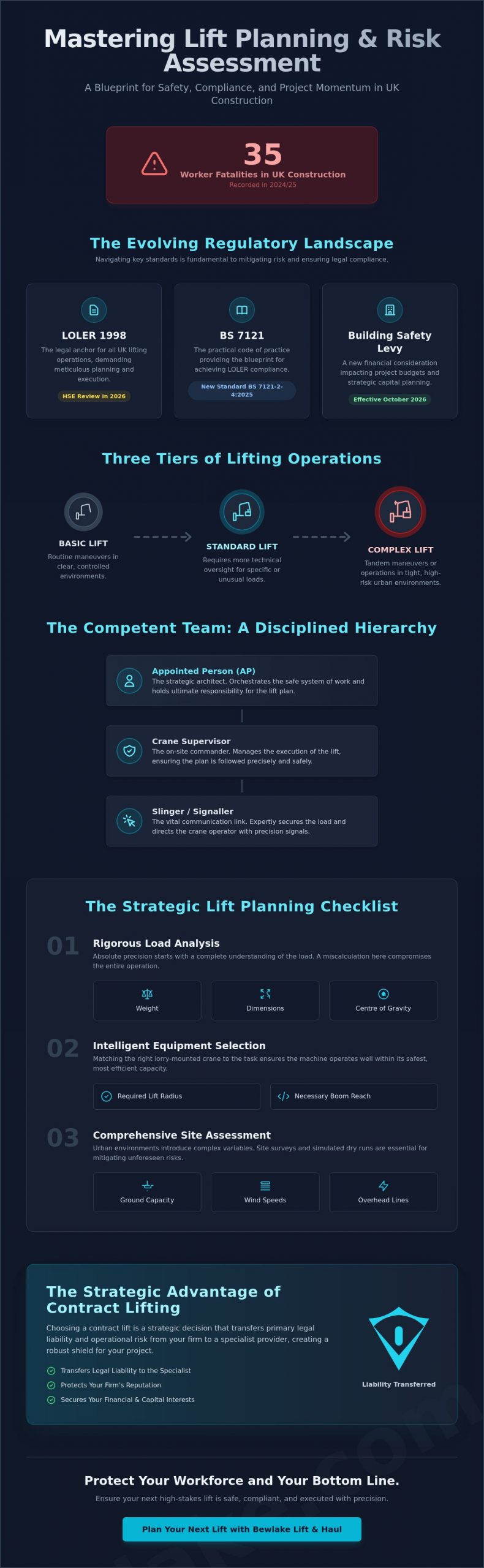
Transitioning from regulatory theory to practical execution requires a disciplined, step-by-step approach. A strategic lift planning and risk assessment begins with a rigorous load analysis. We don’t just record the weight; we calculate the exact dimensions and the precise centre of gravity. If the centre of gravity is offset by even a few centimeters, it compromises the stability of the entire operation. Once the load is fully understood, Bewlake Lift & Haul Ltd matches it to the appropriate equipment. Selecting a lorry-mounted crane involves balancing the required radius against the boom’s reach to ensure the machine operates within its most efficient capacity.
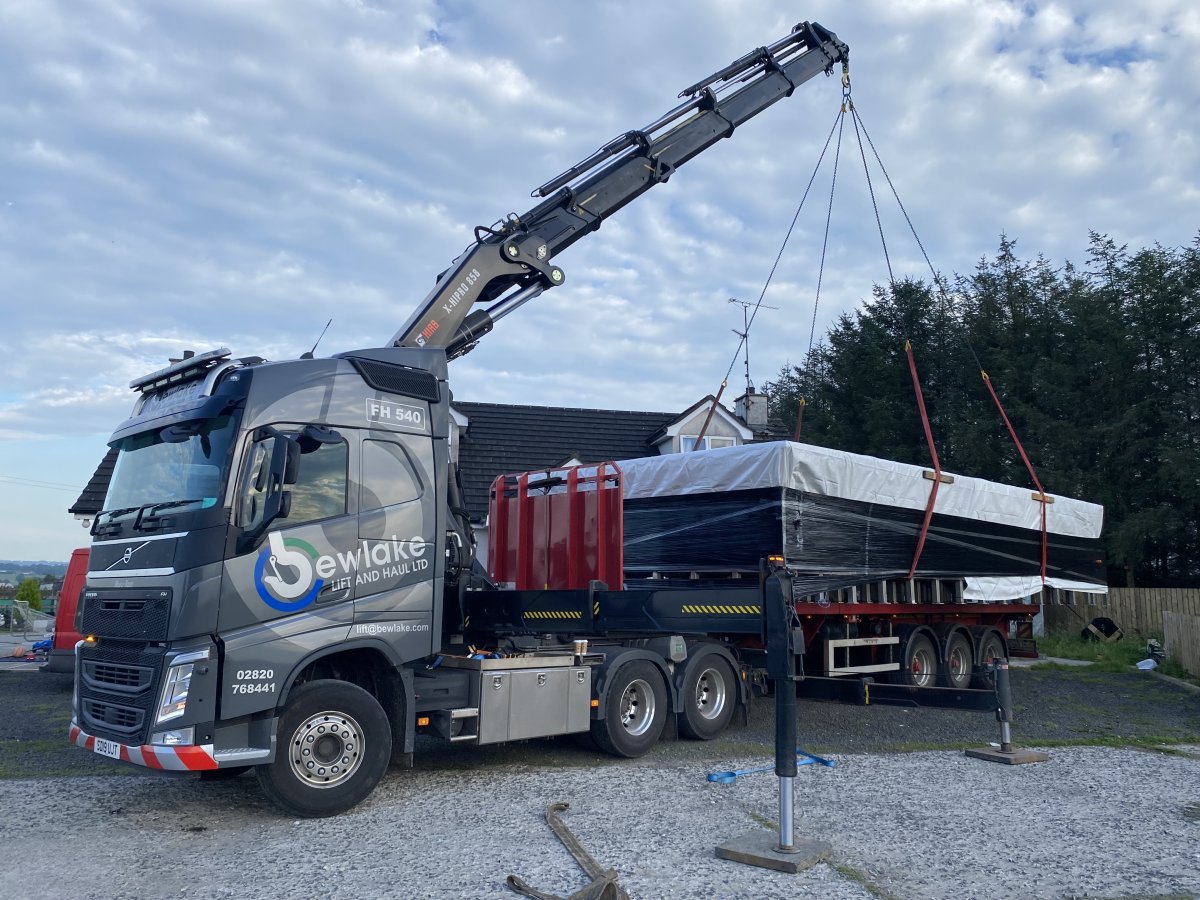
Site-specific variables in urban centres like Glasgow or Edinburgh often present unique challenges that demand a deeper level of scrutiny. Evaluating ground bearing capacity is paramount in these environments. We must confirm the substrate can support the concentrated pressure of a heavy HIAB unit without risk of subsidence—a process often requiring the technical expertise of an accredited partner like The Testing Lab PLC. Simultaneously, environmental factors like wind speeds and overhead obstructions, including power lines or architectural overhangs, require constant monitoring. A sudden gust in a tight city centre can turn a standard lift into a complex hazard instantly.
Unlike static tower cranes, HIAB units require a careful evaluation of outrigger loadings and the physical footprint of all-terrain configurations. Bewlake Lift & Haul Ltd believes in a holistic approach where HIAB hire is integrated with specialised haulage. This creates a seamless “collect and lift” workflow that reduces site downtime and protects your strategic capital. If you’re looking to streamline your next project, our team is ready to consult on your bespoke lifting requirements.
The Risk Assessment and Method Statement (RAMS) serves as the definitive roadmap for the lifting team, anchoring the lift planning and risk assessment process in reality. It details a meticulous sequence of operations, from the initial arrival on-site to the final landing of the load. A robust RAMS is the primary tool for mitigating site-specific risks, ensuring every participant understands their role and the safety boundaries of the task.
To help streamline the management of these critical documents and overall site operations, you can check out New Build Log, a construction project management application built for modern site managers.
Managing the intersection between heavy machinery and the public requires more than just a standard permit. In high-traffic environments, a comprehensive lift planning and risk assessment must account for pedestrian flow and active traffic management. We believe that precision is born from preparation. For projects in historic or constrained locations like Chester or Rugby, conducting a physical site survey and a “dry run” is non-negotiable. These simulations allow us to identify hidden bottlenecks and access restrictions before they impact your project’s bottom line or site safety.
During the execution phase, the margin for error is eliminated through rigid communication protocols. We utilize a combination of standardized hand signals and dedicated radio channels to ensure the slinger signaller and crane operator remain in constant, clear contact. This level of coordination is what transforms a complex commercial relocation into a seamless, low-stress operation. By prioritizing these elite communication standards, we protect both the integrity of the load and the safety of the surrounding environment.
Leeds presents a classic “last mile” challenge where traditional lorry-mounted cranes often find their limits. When urban density restricts the footprint of standard vehicles, we deploy tracked crane hire UK solutions. These compact, all-terrain units navigate narrow access points that would otherwise stall a project. This ensures your strategic capital remains productive even in the most demanding environments where space is at a premium.
True efficiency is found at the intersection of logistics and lifting. Integrating specialised haulage Ireland and UK-wide transport into a single, unified lift planning and risk assessment strategy eliminates the friction of multi-vendor coordination. We position ourselves as your strategic partner, offering a bespoke, fully managed service that oversees every detail from the point of origin to the final landing. This holistic approach ensures that your long-term growth isn’t hindered by the logistical complexities of cross-border or high-value transit.
Mastering the intricacies of modern lifting requires a shift from viewing safety as a regulatory hurdle to seeing it as a blueprint for long-term success. We’ve explored how a robust lift planning and risk assessment framework protects your strategic capital by anticipating urban bottlenecks and navigating the evolving 2026 regulatory landscape. From the initial load analysis to the final precise landing in hubs like London or Birmingham, every detail matters. Precision isn’t just an objective; it’s our standard of operation. By integrating specialized haulage with expert planning, you eliminate the friction that often stalls ambitious projects.
We invite you to leverage our ADR certified fleet and third-generation family expertise to streamline your most demanding logistics. With full coverage across the UK and Ireland, from Glasgow to the south coast, we provide the calm reliability and bespoke attention your business deserves. Partner with Bewlake for your next strategic lift—Request a bespoke quote today. We’re ready to ensure your vision is executed with absolute clarity and full legal compliance. Let’s build your next success with the confidence that only a trusted advisor can provide.
A risk assessment focuses on identifying potential hazards and implementing control measures to mitigate them. In contrast, a lift plan serves as the technical methodology for the execution itself. While the assessment addresses site safety and environmental variables, the plan details equipment capacity, rigging configurations, and load dynamics. Both elements are essential pillars of a professional lift planning and risk assessment strategy that protects your project’s capital.
Under a standard CPA Crane Hire agreement, the legal responsibility for planning and supervising the lift rests entirely with the customer. The hirer must provide a competent Appointed Person to manage the operation’s safety and compliance. If your organization prefers to transfer this liability, a “contract lift” is the strategic alternative. In this model, the provider assumes full responsibility for the technical planning and execution under LOLER 1998 standards.
We recommend a formal review of your lifting documentation every six months or whenever a significant change occurs on-site. In high-density hubs like Birmingham or Manchester, the introduction of new structures or changes in ground bearing capacity can invalidate previous assumptions. Regular reviews ensure your lift planning and risk assessment remains current with the BS 7121-1:2016 code of practice and the latest 2026 HSE regulatory updates.
Yes, Regulation 8 of LOLER mandates that every lifting operation must be properly planned, regardless of its perceived simplicity. Even a routine HIAB delivery requires a written plan that identifies the load’s weight and the crane’s safe working limits. While the level of detail may be less extensive than a “complex” tandem lift, the legal requirement for a documented safe system of work is non-negotiable for all UK projects.

Leave a comment