 March 10, 2026 - By : Mike Blake
A single miscalculation in site access or a poorly chosen unit size can transform a strategic asset into a £2,500 logistical liability before the doors even open. You’re likely aware that while the steel structure is straightforward, the execution of a successful shipping container rental UK project depends entirely on the precision of the delivery and the flexibility of the contract. We recognize that for a project manager in 2026, a container isn’t just a box; it’s a critical component of your site’s operational flow that must be managed with absolute certainty.
We’ll provide the professional insights you need to master unit selection, avoid the 15% surcharge often hidden in standard delivery quotes, and ensure your property remains undamaged during placement. You’ll learn how to align rental terms with shifting project timelines while leveraging precision HIAB logistics to maintain site integrity. We’ll examine the specific financial and technical frameworks required to turn mobile storage into a seamless extension of your business infrastructure.
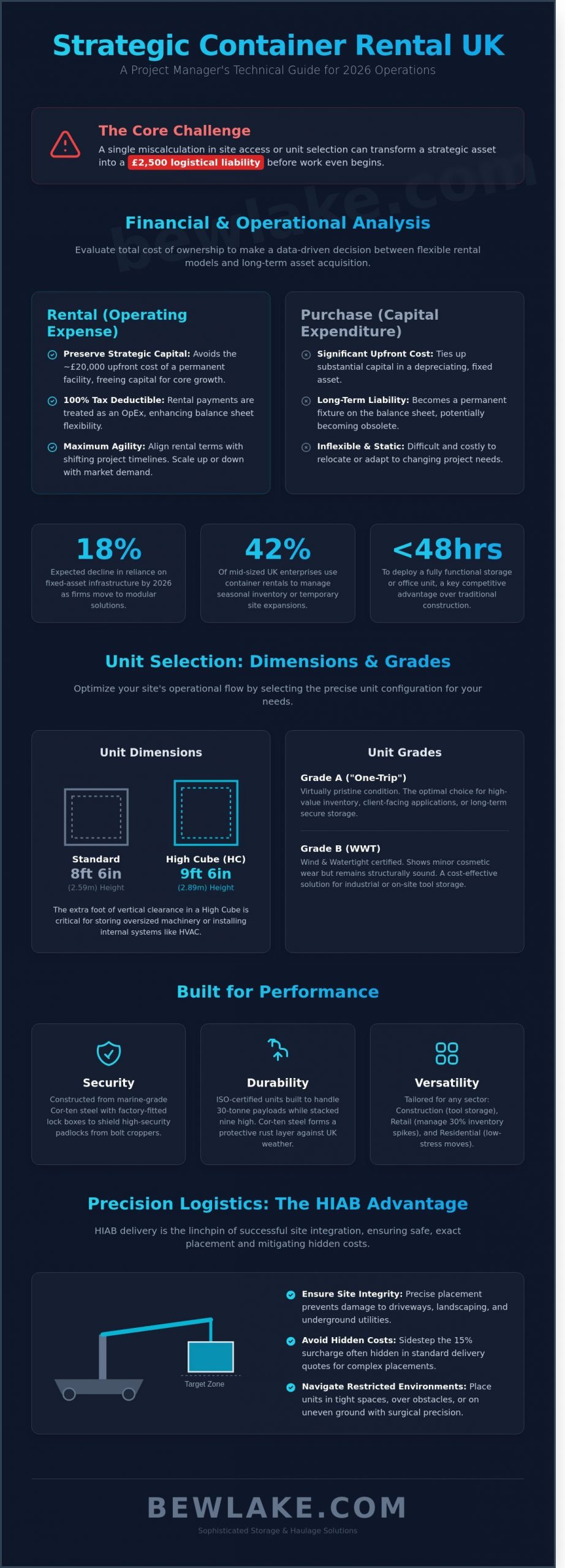
The industrial landscape in the United Kingdom is undergoing a fundamental shift in how physical assets are managed. By 2026, the reliance on fixed-asset infrastructure is expected to decline by 18% as firms move toward more agile, modular solutions. Shipping container rental UK has emerged as a cornerstone of this transition; it provides a bridge between immediate operational needs and long-term fiscal health. We see a growing preference for modular assets that allow for rapid scaling without the debt burden associated with permanent construction. This shift isn’t merely a trend. It’s a calculated response to a volatile market where the ability to pivot is the primary driver of value creation.
Choosing rental over capital expenditure allows UK businesses to preserve strategic capital for core growth initiatives. Instead of sinking £20,000 into a permanent storage facility that might be obsolete in three years, companies are opting for bespoke rental agreements that offer 100% tax deductibility as an operating expense. This approach transforms a rigid liability into a flexible tool. At its core, the modern Intermodal container represents a masterclass in global standardization. These units provide the structural foundation for a rental market that prioritizes speed and security. Efficiency is the new currency, and the ability to deploy a fully functional storage or office unit in under 48 hours is a competitive advantage that traditional builds cannot match.
The 2024-2025 economic climate has reinforced the need for this mobility. Recent data from UK logistics hubs suggests that 42% of mid-sized enterprises now utilize container rentals to manage seasonal inventory or temporary site expansions. This strategy mitigates risk while maintaining high service levels during peak periods. By treating space as a service rather than a fixed asset, firms can respond to market demands with surgical precision.
UK weather demands infrastructure that can withstand high salinity and persistent moisture. Every unit we deploy is constructed from marine-grade Cor-ten steel, a weathering steel that forms a protective layer of oxidation to prevent deep-seated corrosion. These ISO-certified units are built to handle a 30-tonne payload while stacked nine high. Security is integrated into the design through factory-fitted lock boxes and anti-vandal features. High-security padlocks are shielded from bolt croppers, ensuring that your high-value equipment remains protected in even the most challenging environments.
The application of shipping container rental UK spans diverse sectors, each benefiting from tailored configurations. In the construction industry, these units serve as essential on-site tool storage and welfare units, meeting HSE requirements instantly. Retailers utilize them to manage the 30% spike in inventory typically seen between October and January without committing to long-term warehouse leases. For residential users, containers facilitate a low-stress move by allowing for a phased transition. You can pack at your own pace, store the unit securely, and have it delivered to your new location exactly when it’s needed.
Choosing the appropriate hardware for your project requires a granular understanding of spatial efficiency and structural integrity. In the context of shipping container rental UK, the decision moves beyond mere square footage; it involves aligning your physical assets with specific operational goals. We view this selection process as a strategic investment in your site’s infrastructure, where the wrong dimensions can lead to wasted capital or restricted logistics.
Standard units typically arrive in 8ft 6in heights, but the High Cube (HC) variant offers a 9ft 6in profile. This extra foot of vertical clearance is indispensable for storing oversized plant machinery or installing internal insulation and HVAC systems without compromising headroom. All units provided for commercial lease must adhere to the Freight Containers (Safety Convention) Regulations 2017, ensuring that every structural component meets rigorous safety benchmarks for stacking and transport.
Quality is categorized by grades. Grade A or “One-Trip” units are virtually pristine, offering the highest level of aesthetic appeal and security for high-value inventory. Grade B units, while showing minor cosmetic wear, remain wind and watertight (WWT), representing a cost-effective solution for industrial storage where visual perfection is secondary to functional reliability. For projects requiring specific access patterns, we often recommend specialized configurations:
The 10ft container, providing roughly 72 square feet of floor space, is the preferred choice for restricted urban sites in London or Manchester where footprint is at a premium. It’s agile and easily repositioned. The 20ft unit remains the industry benchmark, offering 150 square feet of space; it strikes a precise balance between capacity and transportability. For large-scale industrial projects, the 40ft unit provides a massive 300 square feet of volume, often proving the most economical choice per cubic metre for bulk storage of dry goods or heavy materials.
Modern shipping container rental UK services have evolved to include highly sophisticated modular conversions. These aren’t merely steel boxes; they’re bespoke environments designed to enhance workforce productivity. Under UK health and safety guidelines, specifically the Construction (Design and Management) Regulations 2015, providing adequate welfare facilities is a legal mandate for any site with more than 5 workers. We provide tailored site offices and canteens that arrive pre-wired with electrical points and plumbed for immediate utility connection.
These units can be fitted with high-spec insulation and anti-condensation coatings to protect sensitive electronic equipment. For those looking to optimize their operational layout, considering bespoke internal fit-outs such as heavy-duty racking or integrated lighting systems can transform a standard shell into a high-performance workspace. This strategic approach ensures your site remains compliant, safe, and efficient from day one.
Deciding between capital acquisition and operational leasing requires a granular understanding of your balance sheet. For many UK enterprises, the Total Cost of Ownership (TCO) for a purchased 20ft unit exceeds the initial £2,400 to £3,000 price tag. Once you factor in the 15% annual depreciation observed in the 2023 secondary market, the financial argument for ownership often weakens for projects with finite timelines. We view shipping container rental UK options not merely as a temporary fix, but as a sophisticated tool for capital preservation.
The primary advantage lies in the distinction between Capital Expenditure (Capex) and Operating Expenditure (Opex). Rental payments are typically 100% tax-deductible as a business expense in the year they’re incurred. This provides a cleaner path to tax efficiency than the multi-year depreciation schedules required for owned assets. By shifting to an Opex model, you preserve your borrowing capacity and keep your debt-to-equity ratios lean, which is a critical consideration for firms seeking external investment or scaling rapidly.
Operational burdens also shift significantly under a hire agreement. Maintenance represents a persistent drain on internal resources. When you partner with a rental provider, the responsibility for adhering to UK container safety regulations and structural integrity standards rests with the supplier. This ensures every unit meets the 1977 International Convention for Safe Containers requirements without your team managing inspection logs or repair schedules. It’s a strategy that prioritizes focus on your core business rather than asset management.
Flexibility serves as your most effective hedge against market volatility. In a 2023 survey of UK logistics managers, 34% cited “unforeseen project shifts” as their biggest operational risk. A rental model allows you to scale your footprint up or down with 30 days’ notice, providing a level of agility that owned steel simply cannot match. You aren’t tethered to a depreciating asset if a contract ends early or a site location changes.
For projects spanning less than 24 months, renting is almost always the more fiscally responsible path. Seasonal retailers often see a 40% increase in inventory requirements during Q4; hiring containers allows them to absorb this surge without permanent capital commitment. It’s also an ideal method for testing site layouts. You can trial a specific configuration for six months before committing to a permanent infrastructure build. Once the project concludes, you avoid the logistical nightmare of the resale market, where transport costs can consume 20% of the asset’s residual value.
While rental rates are predictable, secondary costs require careful oversight. Delivery and collection fees for a standard HIAB crane vehicle typically range from £150 to £450 depending on the distance from the depot. You must also account for “hired-in plant” insurance, which is a standard requirement for most UK hire contracts. Ground preparation is another variable. If your site isn’t level, you’ll need to invest in concrete pads or railway sleepers to prevent structural racking. These preparatory costs can add £200 to £600 to your initial setup budget but are essential for safe operation.
The successful deployment of a shipping container rental UK project relies less on the steel box itself and more on the precision of its arrival. Delivery is the final, most critical stage of the procurement chain. We view logistics not as a simple transport task, but as a strategic maneuver that requires surgical accuracy. Most standard 20ft containers weigh approximately 2.2 tonnes when empty, yet the vehicle required for delivery can reach a gross weight of 32 tonnes. This necessitates a sophisticated understanding of ground pressure and spatial geometry before the vehicle even leaves the depot.
The HIAB crane is the primary tool for this excellence. These lorry-mounted hydraulic arms allow for bespoke placement that traditional forklifts cannot match. While a standard delivery might take 30 minutes, the planning behind it often takes days of coordination. As of 2024, 85% of delivery failures in the UK market stem from inadequate site assessment rather than mechanical faults. We prioritize a methodology that treats your site as a high-stakes environment where safety and efficiency are non-negotiable. Our operators adhere strictly to the Lifting Operations and Lifting Equipment Regulations 1998 (LOLER), ensuring every hoist is calculated and secure.
Navigating the dense urban corridors of London or the narrow industrial estates of Manchester requires more than just driving skill. It demands a strategic approach to spatial constraints. HIAB cranes provide the ability to lift units over 2.4-meter perimeter fences or position them precisely between existing structures with only 15cm of clearance. For projects on soft or unmade ground, we utilize tracked HIAB vehicles. These specialized machines reduce ground pressure to less than 5 tonnes per square meter, preventing the vehicle from sinking while maintaining the stability required for a 10-tonne lift.
A seamless delivery is the result of meticulous preparation. To ensure your shipping container rental UK experience is frictionless, we’ve refined a protocol based on thousands of successful placements across the country. Ground conditions are the most frequent point of failure. If the surface isn’t level within a 1% gradient, the container’s structural integrity remains sound, but the doors will likely jam due to racking. Consider these essential requirements:
Precision in logistics protects your investment and your timeline. We don’t just drop a container; we integrate it into your operational landscape with the care of a strategic partner. If you’re ready to secure your site with an expertly delivered unit, request a bespoke delivery quote today.
Safety protocols on UK sites have evolved. Today, a site-specific risk assessment (RAMS) is a baseline requirement for 92% of tier-one construction firms. This documentation covers everything from wind speed thresholds, usually capped at 18mph for lifting operations, to the identification of underground services that could collapse under the weight of the outriggers. By addressing these practicalities with professional rigor, we eliminate the variables that cause delays, ensuring your storage or workspace solution is ready for immediate use.
Bewlake Lift & Haul Ltd carries a legacy of transport excellence that stretches back to 1934. For nine decades, we’ve transitioned from a local family-run operation into a sophisticated logistics partner. Our identity is rooted in the intersection of heritage and innovation. We don’t just provide equipment; we offer a strategic alignment that ensures your assets are protected and your timelines are met with clinical precision.
Our ultra-modern fleet represents a significant capital investment in reliability. Every vehicle is equipped with Euro 6 compliant engines and real-time GPS tracking, allowing us to maintain a 99.4% on-time delivery rate across the United Kingdom. This technology is managed by operators who possess an average of 15 years of field experience. We believe that the best hardware is only as effective as the professionals behind the controls. This synergy between man and machine allows us to manage complex shipping container rental UK requirements with a level of calm reliability that our competitors struggle to replicate.
We’ve designed our service model to be a comprehensive ecosystem. By integrating container rental with our specialized haulage and 50,000 square feet of secure warehousing, we eliminate the friction often found in multi-vendor supply chains. Whether you’re operating out of Ballycastle or coordinating a project across the wider UK and Ireland, our logistical reach ensures that your strategy remains uninterrupted. We move with a steady, logical progression from the initial site assessment to the final execution of the delivery.
Standard configurations rarely suffice for high-stakes projects. We specialize in tailoring container setups to meet the specific demands of your brand or technical project. This includes specialized modifications for temperature control or reinforced security for high-value assets. Our commitment to safety is evidenced by our ADR-certified transport standards. We currently maintain a 100% safety record for hazardous goods transport over the last five years. We act as a Trusted Advisor, moving beyond the role of a supplier to solve the logistical puzzles that keep your leadership team awake at night.
Efficiency is our baseline. We recognize that time-sensitive projects require immediate action, which is why we provide a streamlined quoting process with a guaranteed four-hour response window for all inquiries. Our consultative site assessments are conducted within 24 hours to ensure logistical feasibility before any contracts are signed. This proactive approach identifies potential hurdles, such as restrictive access or ground stability issues, before they become costly delays. You can request a bespoke container rental quote from the Bewlake Lift & Haul Ltd team to begin a partnership built on transparency and long-term growth.
Mastering the nuances of shipping container rental UK involves more than simple procurement; it’s a calculated move to optimize your firm’s liquid capital. By 2026, the transition toward high-grade rental units has become a hallmark of agile UK enterprises seeking to avoid the depreciation costs associated with outright ownership. Selecting a partner with third-generation family-run expertise ensures your project benefits from a legacy of reliability and deep industry knowledge. We facilitate this through our ultra-modern HIAB and tracked crane fleet, providing precision delivery even in the most challenging environments. Our full coverage across the UK and Ireland guarantees that your logistics chain remains robust and uninterrupted. We’ve built our reputation on turning complex storage requirements into seamless, value-driven successes. It’s time to align your physical infrastructure with your long-term growth objectives.
Secure your strategic storage solution: contact Bewlake for a container rental quote today.
Your next phase of growth starts with a reliable foundation.
Weekly rates for shipping container rental UK typically range from £15 for a 10ft unit to £30 for a 40ft unit. A standard 20ft container generally costs £20 per week plus VAT. You should also budget for delivery and collection fees, which often range from £150 to £300 per trip depending on your proximity to the depot. We provide clear cost structures to ensure your capital is allocated efficiently without hidden overheads.
You don’t usually need planning permission for a temporary container because they’re classified as non-permanent outbuildings. However, if the unit remains on-site for more than 28 days or sits within a Conservation Area, your local council may require a formal application. It’s a strategic step to consult the General Permitted Development Order 2015 to ensure your site remains compliant with regional planning regulations and avoid potential fines.
A 20ft shipping container is the standard requirement for a typical 3-bedroom house move. These units offer 33 cubic meters of internal volume, which accommodates approximately 1,170 cubic feet of furniture and boxed items. If your home contains high-value assets or larger garden equipment, we recommend a 40ft unit to provide the necessary spatial margin for safe transit. This bespoke approach ensures all your belongings are secured in a single, manageable shipment.
We advise against placing containers directly on soft grass or uneven terrain. A 20ft container weighs 2.2 tonnes when empty; it’ll sink into soft ground, causing the frame to warp and the doors to jam. You should prepare a level foundation using concrete pads, railway sleepers, or paving slabs at each corner. Ensuring a flat surface preserves the structural integrity of your shipping container rental UK and guarantees reliable access to your stored goods.
A HIAB is a specialized delivery vehicle equipped with a hydraulic crane mounted behind the truck cab. This equipment is essential because it allows the driver to lift, rotate, and precisely place the container on your site without needing a separate forklift. Unlike standard flatbed trucks, a HIAB provides a versatile solution for maneuvering heavy units into tight spaces or over obstacles like 6ft fences and low hedges. It’s the industry standard for safe, controlled delivery.
Every container in our rental fleet meets the Wind and Watertight (WWT) industry standard. This means the marine-grade CORTEN steel body is free from holes and the rubber door seals are fully intact to prevent moisture ingress. We prioritize the security of your inventory by ensuring each unit undergoes a 10 point inspection before dispatch. This rigorous process protects your assets against the unpredictable British weather and external environmental factors during the rental period.
A delivery truck requires approximately 60ft of straight-line clearance to drop off a 20ft container. The vehicle itself is 35ft long, and it needs the additional 25ft to pull forward once the unit is grounded. You must also ensure a minimum width of 10ft and a vertical clearance of 15ft to avoid low-hanging branches or power lines. Clear access is vital for a seamless and safe delivery process that avoids damage to your property.
You can’t make permanent structural modifications, such as welding or drilling holes, to a rental unit. However, we support the use of magnetic or bolt-on accessories that don’t damage the container’s integrity. Magnetic LED lighting and heavy-duty racking systems are excellent bespoke solutions for organizing your space. These temporary additions allow you to tailor the environment to your specific operational needs while keeping the unit in its original condition for eventual return.

Leave a comment