 March 21, 2026 - By : Mike Blake
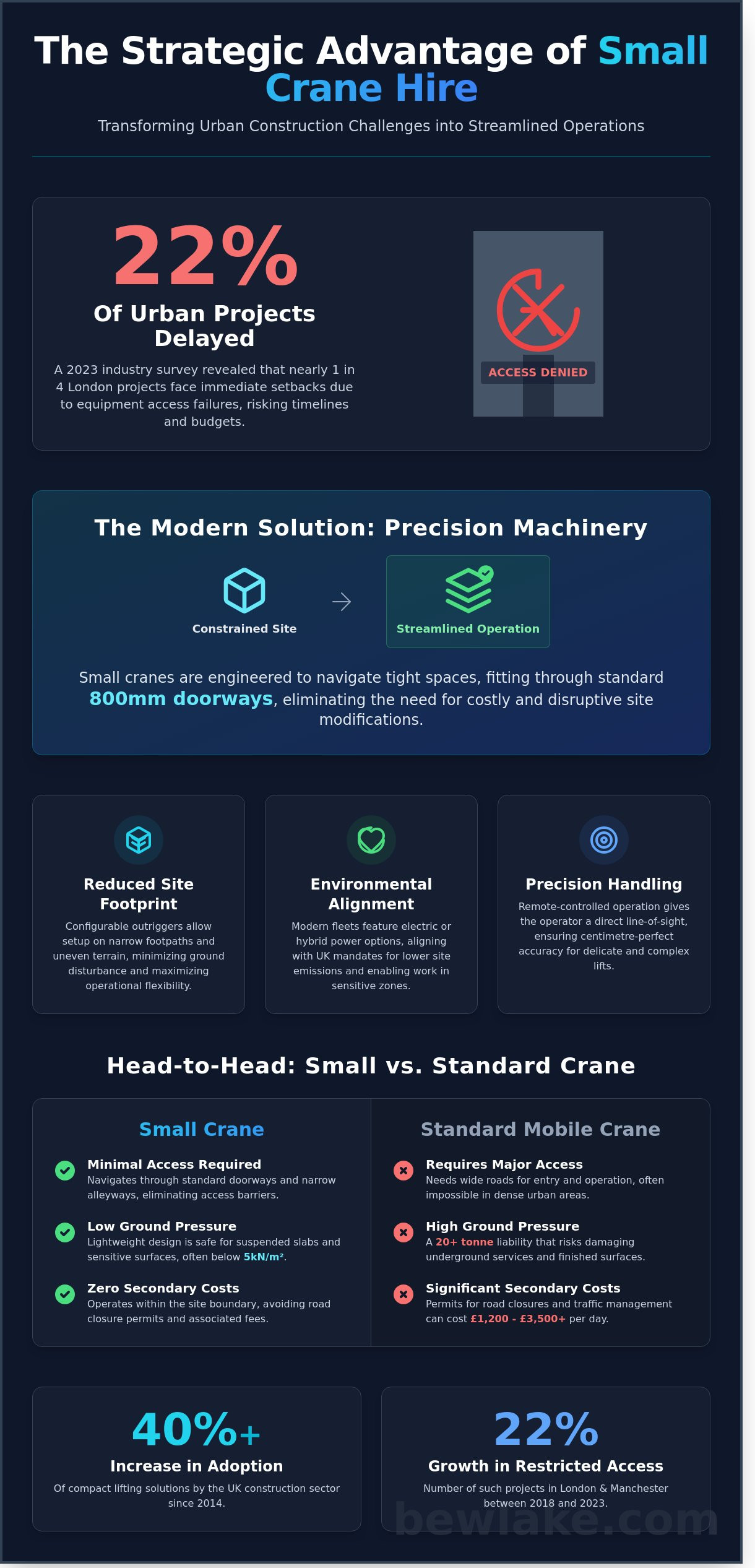
Why do we continue to risk project viability by forcing industrial-scale machinery into constrained urban footprints when the most effective solution fits through a standard 800mm doorway? According to a 2023 industry survey, nearly 22% of urban development projects in London faced immediate delays because of equipment access failures. You likely recognise that modern construction requires a more nuanced approach than the “bigger is better” philosophy of the past. It’s a common frustration when a site’s physical boundaries threaten to derail a carefully planned schedule or cause unnecessary ground disturbance.
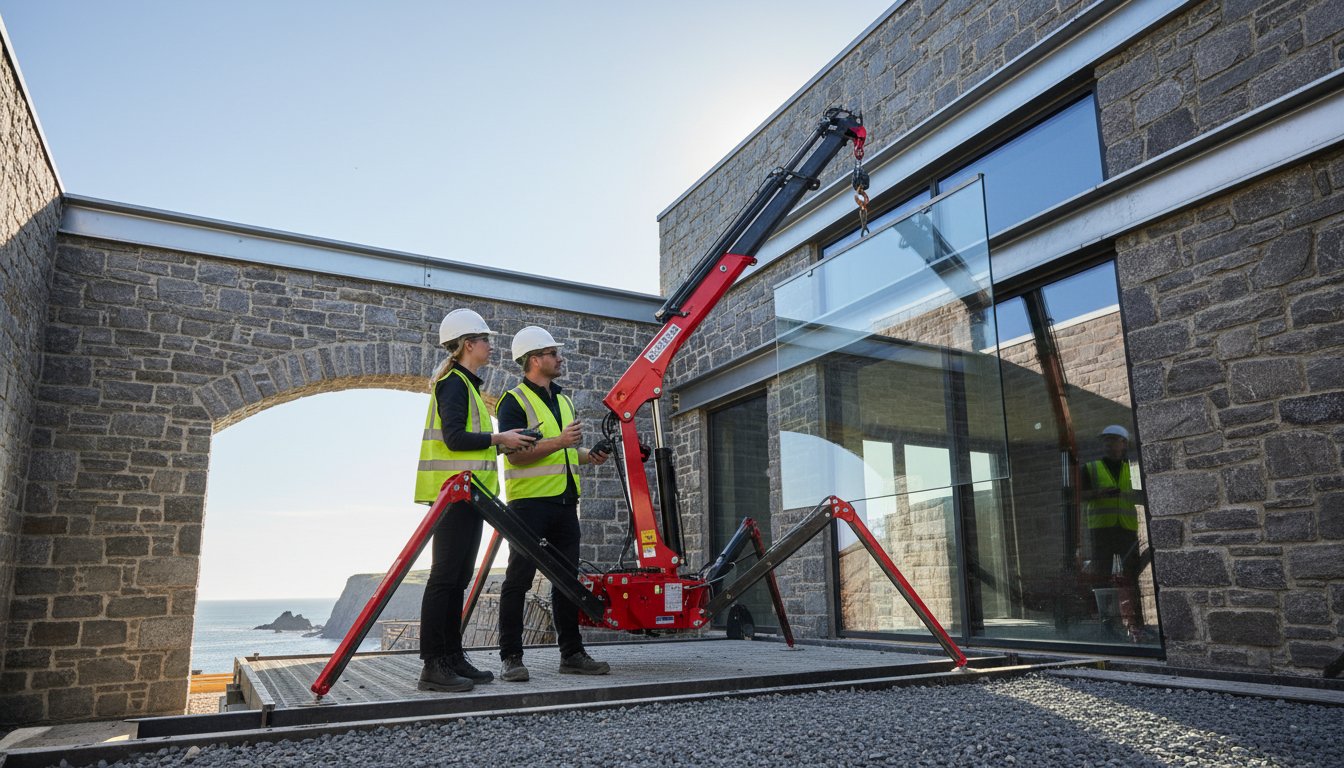
By integrating strategic small crane hire into your early-stage planning, you can address these tight constraints with precision and professional confidence. Our objective is to help you transform logistical bottlenecks into streamlined operations that protect both your timeline and your site’s integrity. This guide provides a clear framework for distinguishing between spider cranes, tracked HIABs, and mini-crawlers. We’ll ensure your next lift complies with UK LOLER regulations while maintaining the bespoke attention your project deserves.
Small crane hire defines the deployment of compact, high-performance lifting machinery specifically engineered for environments where space is at a premium and structural sensitivity is high. These units are not merely scaled-down versions of the traditional Crane (machine); they represent a bespoke category of engineering designed to solve the logistical puzzles of the 21st-century build. Since 2014, the UK construction sector has seen a 40% increase in the adoption of compact lifting solutions as project managers seek to mitigate the risks associated with heavy plant in congested areas.
The evolution of the mini crane has been rapid. Once viewed as a niche tool for specialized glazing, these machines are now essential site assets. This shift is driven by a focus on value creation and the need for surgical precision in delivery. We see this most clearly in the UK’s major cities, where urban densification has reached a point that renders traditional mobile cranes impractical. Between 2018 and 2023, the number of “restricted access” projects in London and Manchester grew by 22%, making small crane hire a strategic necessity rather than an optional extra.
The benefits of this approach extend beyond simple access. Compact machinery offers a three-fold advantage for the modern developer:
Physical barriers are the most obvious hurdle. We often encounter sites where the only entry point is a standard 800mm wide doorway or a narrow Victorian alleyway. Beyond the horizontal, weight constraints are a critical factor. When working on suspended slabs or reinforced rooftops, the 20-tonne weight of a standard crane is a liability. Our advisory process identifies these hidden obstacles early, ensuring that the chosen equipment doesn’t exceed the structural load-bearing capacity of the site, which often sits below 5kN/m2 in older commercial buildings.
The decision to opt for small crane hire often rests on the cost-to-benefit ratio of the entire project lifecycle. While a 50-tonne mobile crane has its place, the secondary costs are often prohibitive. In London, a single-day road closure and the associated traffic management permits can cost between £1,200 and £3,500. By using a compact unit that fits within the site boundary, these external costs are eliminated. Small crane hire is the intersection of high-capacity hydraulics and minimal physical footprint. This strategic choice ensures that capital is deployed efficiently, focusing on the lift itself rather than the bureaucracy of the street. We focus on bespoke results that respect the bottom line while maintaining the highest safety standards on site.
Precision is the cornerstone of modern lifting strategy. Selecting the right machinery is no longer just about gross tonnage; it’s about the surgical application of force within restricted footprints. Recent industry data from 2023 suggests that 62% of urban development projects in the UK now face severe access constraints that preclude the use of traditional mobile cranes. This shift has elevated the importance of small crane hire as a primary consideration for project managers seeking to maintain momentum without compromising safety or site integrity.
Rotating telehandlers represent a significant evolution in this space. They provide a hybrid solution, combining the reach of a telescopic handler with the 360-degree continuous rotation of a crane. For multi-storey material handling, these machines offer a bespoke alternative to static tower cranes, particularly when site duration doesn’t justify the installation costs of permanent structures. When we evaluate the logistics of a complex lift, we look for equipment that offers a high degree of value creation through reduced setup times and minimal site disruption.
Safety remains the non-negotiable foundation of every operation. While UK sites adhere to LOLER and PUWER standards, referencing international benchmarks like OSHA crane regulations provides a broader perspective on the rigorous inspection and operator qualification requirements necessary for high-stakes environments. This global view on safety ensures that our lifting protocols remain at the forefront of the industry.
Tracked HIABs are often described as the Swiss Army Knife of the lifting sector. These machines take the proven capability of a lorry-loader and mount it onto a compact, tracked chassis. This configuration allows for exceptional mobility across rough terrain where a standard wheeled vehicle would fail. Their ability to navigate mud or soft ground while maintaining a compact stowed position makes them indispensable for utility work and remote infrastructure projects.
Beyond simple movement, these units integrate seamlessly with specialised attachments. We’ve seen a 24% increase in the use of tracked HIABs equipped with glass vacuum lifters for high-end residential glazing. They provide a stable platform for delicate installations, ensuring that high-value materials are handled with the necessary poise. If you’re planning a project that requires this level of technical precision, you might explore our advisory approach to equipment selection.
Spider cranes, particularly models from Maeda and UNIC, are the definitive choice for internal glazing and confined indoor spaces. Their name derives from the unique outrigger configurations that allow them to “walk” into position and set up on uneven surfaces, including stairs or tiered seating areas. A standard Maeda MC285-3, for example, features a stowed width of just 750mm. This allows it to pass through a standard single doorway, providing heavy lifting capability inside a finished building.
These machines don’t just solve access problems; they provide a logical progression from manual handling to mechanical advantage. By matching the specific machinery to the site’s unique constraints, we ensure that every lift is executed with the calm reliability that high-level projects demand.
Technical proficiency defines the success of any lifting operation. When you engage in small crane hire, the headline figures on a spec sheet rarely tell the full story. We’ve seen many projects stall because a machine’s “max capacity” was mistaken for its universal lifting power. In reality, a ROTO telehandler is a dynamic tool that requires a strategic understanding of physics and site geometry to operate safely and efficiently.
Compliance with the Lifting Operations and Lifting Equipment Regulations (LOLER) ensures that every lift is planned by a competent person. This planning starts with a deep dive into the load charts, which act as the definitive guide to what a machine can actually achieve at specific heights and distances. Relying on guesswork isn’t just a safety risk; it’s a threat to your project’s timeline and budget.
Load charts represent the “de-rating” of a crane as the boom extends. As the radius from the centre of rotation increases, the leverage exerted against the machine’s stability grows. For instance, a crane rated for 3 tonnes may only lift 500kg at its maximum horizontal reach. We always calculate the boom angle and height in tandem to ensure the centre of gravity remains within the footprint of the outriggers. This precision prevents structural overstrain and ensures the 360-degree rotation remains fluid under load.
Ground Bearing Pressure (GBP) is a critical metric for urban and heritage sites. While wheeled machines offer speed, tracked variants or those with wide outrigger footprints provide superior weight distribution. This is essential for protecting pavements, delicate tiles, or hidden underground services from point-load damage. We utilize high-density polyethylene outrigger mats and bespoke spreader plates to diffuse the concentrated force of the machine across a wider surface area.
Consider a 2022 restoration project at a historic estate in County Kildare. The site featured 18th-century flagstones that couldn’t withstand more than 22kN/m² of pressure. By deploying a ROTO telehandler with 1.5-metre spreader plates, we reduced the point load by 40%, allowing the lift to proceed without risking a £60,000 repair bill for the protected ground surfaces. This level of detail is what separates a standard rental from a professional small crane hire solution.
The relationship between capital equipment and site strategy is where value is truly created. We don’t just provide a machine; we provide the technical assurance that your site’s physical limits are respected. Before the first outrigger is deployed, our team ensures the following factors are verified:
By treating these technical considerations as a strategic priority, we eliminate the variables that lead to site incidents. It’s a measured, logical approach that reflects our commitment to long-term growth and operational excellence for our partners.
The appreciation for such detailed engineering and mechanics isn’t confined to the construction site. Many professionals in the field also enjoy hobbies that require similar precision, like building model railways. For those interested, you can learn more about this intricate pastime.
Selecting the appropriate hire structure is a strategic decision that directly impacts your project’s risk profile and operational efficiency. In the United Kingdom, the distinction between CPA (Construction Plant-hire Association) Crane Hire and a fully managed Contract Lift is defined by who carries the legal and financial liability. When you opt for a standard CPA hire, the responsibility for the entire operation rests with your organisation. You must provide a qualified Appointed Person (AP) to plan the lift, a Lift Supervisor to oversee the movement, and the necessary slinger signallers. Under these terms, you also assume the duty of providing comprehensive insurance cover for the equipment, the personnel, and any potential third-party liabilities.
Contract Lifting represents a more bespoke, low-risk alternative where Bewlake assumes the role of the primary contractor for the lifting element. We manage the technical complexities, from drafting the detailed Method Statement and Risk Assessment (RAMS) to providing the full site team. This model is particularly effective for businesses seeking a small crane hire solution without maintaining an in-house lifting department. By transferring the operational risk to us, you ensure that the lift is executed under our professional indemnity and public liability insurance, which often covers values up to £10 million depending on the specific site requirements.
The legal framework governing these activities is the Lifting Operations and Lifting Equipment Regulations (LOLER) 1998. Compliance isn’t optional; it’s a statutory requirement. LOLER mandates that every lifting operation is properly planned by a competent person, appropriately supervised, and carried out in a safe manner. Failure to adhere to these regulations can result in Health and Safety Executive (HSE) interventions, where fines for administrative oversights or safety breaches often exceed £25,000. We ensure every ROTO telehandler deployment aligns with these 1998 regulations, providing you with the documentation needed to satisfy site audits and safety inspectors.
Deciding between operated hire and self-drive requires an honest assessment of your team’s technical capacity. While self-drive might seem cost-effective on paper, the risks associated with high-value lifts or complex urban environments are substantial. Approximately 82% of high-consequence site incidents involve equipment operated by personnel who lack specific machine familiarity. At Bewlake, we advocate for operated hire to leverage professional expertise. Our operators don’t just drive the machinery; they act as strategic partners on-site, ensuring that the ROTO telehandler’s 360-degree capability is utilised to its full potential while maintaining a safe exclusion zone.
As we move through 2026, the industry has shifted toward digital verification for all safety certifications. Every machine in our fleet possesses a current Report of Thorough Examination, updated every 6 months for lifting accessories and 12 months for the base units. We only deploy operators holding valid CPCS (Construction Plant Competence Scheme) or NPORS (National Plant Operators Registration Scheme) cards. This commitment to elite standards ensures your project meets the most stringent Tier 1 contractor requirements. For those integrating diverse assets into their logistics plan, our Guide to HIAB Crane Hire in Northern Ireland provides a roadmap for maintaining compliance across different equipment types.
Effective logistics management is about more than just moving weight; it’s about the precision of the plan and the reliability of the partner. Whether you require a small crane hire for a tight residential plot or a multi-unit ROTO fleet for an industrial build, we provide the clarity and confidence required to execute safely.
Contact our advisory team today to secure a bespoke lifting solution tailored to your project’s specific risk requirements.
Selecting a lifting partner requires more than a simple equipment checklist; it demands a synergy of high-level strategic confidence and technical precision. Bewlake Lift & Haul Ltd operates at this intersection, providing a fleet where 95% of our machinery is less than 36 months old. This commitment to an ultra-modern fleet ensures that every ROTO telehandler or specialised unit delivers peak performance with the latest Stage V emissions compliance. We bridge the gap between the personalised care of a family-run business and the elite operational standards expected by global tier-one contractors.
Our identity as a trusted advisor means we don’t just supply plant. We align our strategic capital with your project goals to ensure long-term growth and safety. Whether you are managing a complex engineering installation in London or a remote renewables project in the Scottish Highlands, our nationwide reach across the UK and Ireland provides the local expertise necessary to clear regulatory hurdles and logistical bottlenecks.
The complexity of modern infrastructure requires versatile equipment that can adapt to shifting site conditions. Our fleet includes ADR-certified vehicles and specialised tracked units designed for environments where traditional wheeled machinery fails. For urban sites with significant footprint restrictions, our small crane hire options provide the necessary agility without compromising on lift capacity or safety protocols. By acting as a single provider for both lifting and specialised haulage, we eliminate the friction often found when coordinating multiple sub-contractors.
This integrated approach is particularly vital for the engineering and construction sectors. We provide a seamless transition from transport to final positioning, utilising our tracked crane hire UK services to navigate challenging terrain. In 2023, this unified logistics model saved our clients an average of 12% in total site mobilisation time, demonstrating the tangible benefits of a consolidated supply chain.
We believe that value creation begins long before the first lift occurs. Our advisory process is designed to interrogate project requirements, often identifying opportunities to reduce total costs by avoiding the common pitfall of over-speccing. On a recent heavy-lift project in the Midlands, our technical team recommended a specific ROTO telehandler configuration that replaced the need for a 100-tonne mobile crane, resulting in a direct hire saving of £4,200 per week for the client.
Reliability in high-stakes environments is non-negotiable. Our 98% client retention rate is a testament to our ability to deliver bespoke solutions that respect both the budget and the timeline. When you choose Bewlake Lift & Haul, you aren’t just hiring a machine; you’re securing a partnership focused on precision and shared success. Our small crane hire and telehandler solutions are ready to be deployed to your next site with the backing of a team that understands the nuances of elite logistics. Contact our expert team to organise your bespoke lifting plan today.
Navigating the complexities of urban construction requires a shift from standard equipment to strategic, high-precision assets. We’ve identified that the success of restricted access projects hinges on two primary factors: the technical alignment of machinery to ground pressure constraints and the logistical clarity between CPA hire and contract lifting. Bewlake serves as a trusted advisor in this space, leveraging 3 generations of transport expertise to transform lifting from a potential bottleneck into a distinct competitive advantage.
Our fleet is ADR certified and STGO Cat 2 compliant, ensuring we meet the most rigorous safety standards across the UK and Ireland. Selecting a partner for small crane hire is a decision that impacts your project’s capital efficiency and site safety. We invite you to Request a Bespoke Small Crane Hire Quote to align your lifting requirements with our elite operational standards. It’s time to elevate your project with the reliability your vision deserves.
The most compact solution for small crane hire is the micro spider crane, specifically models like the UNIC URW-094. This machine measures exactly 595mm in width, allowing it to navigate through narrow passages and standard internal corridors with ease. Despite its slender profile, it maintains a lifting capacity of 995kg at a 1.5-metre radius. We find this balance of agility and strength essential for complex urban installations where space is at a premium.
Yes, many mini cranes are specifically engineered to pass through a standard UK doorway, which typically measures 762mm in width. The Maeda MC285-3, for instance, has a transport width of 750mm, leaving a precise 12mm clearance for interior access. This capability eliminates the need for structural removals during internal fit-outs. It’s a practical choice for 100% of projects involving sensitive indoor environments or restricted courtyard access.
The primary distinction lies in the stability mechanism and footprint; spider cranes utilise four outriggers that resemble arachnid legs to level the machine on uneven ground. Tracked HIABs, such as the Palfinger T-series, rely on a weighted chassis and tracks to move while holding a load. While spider cranes offer superior pressure distribution for delicate floors, tracked HIABs provide greater “pick and carry” versatility for transporting materials across a site.
You must possess a valid CPCS (Construction Plant Competence Scheme) or NPORS card to operate a crane on a UK construction site. Specifically, the A02 category covers crawler cranes, while A60 is required for mobile cranes. If you’re opting for a “plant only” small crane hire, it’s your responsibility to provide a qualified operator. For those without internal expertise, we recommend a managed service to ensure full compliance with health and safety regulations.
Daily rates for specialist lifting equipment typically range from £350 to £650, depending on the specific model and the complexity of the project. These figures exclude VAT and transport fees, which usually add a further £200 to £350 to your initial outlay. For a standard 8-hour shift, costs are influenced by the choice between a basic plant hire agreement and a fully managed contract lift. Long-term hire periods exceeding 5 days often attract discounted rates.
A contract lift is a comprehensive service where the hire company assumes legal responsibility for the planning, insurance, and execution of the lift. Under the British Standard BS 7121, you must opt for this service if you don’t have a qualified Appointed Person (AP) to oversee the operation. It’s a strategic choice that transfers the risk to the provider. This ensures that 100% of the technical and safety requirements are met by experienced professionals.
You calculate ground pressure by dividing the total weight of the crane and its maximum load by the surface area of the outrigger pads. For a 2,000kg crane carrying a 500kg load supported by four 0.09m² pads, the pressure is approximately 6.94kg/cm². We always advise using spreader mats to increase the surface area and reduce the load on sensitive ground. Accurate calculations are vital to prevent 100% of potential floor failures or subsidence during the lift.

Leave a comment